
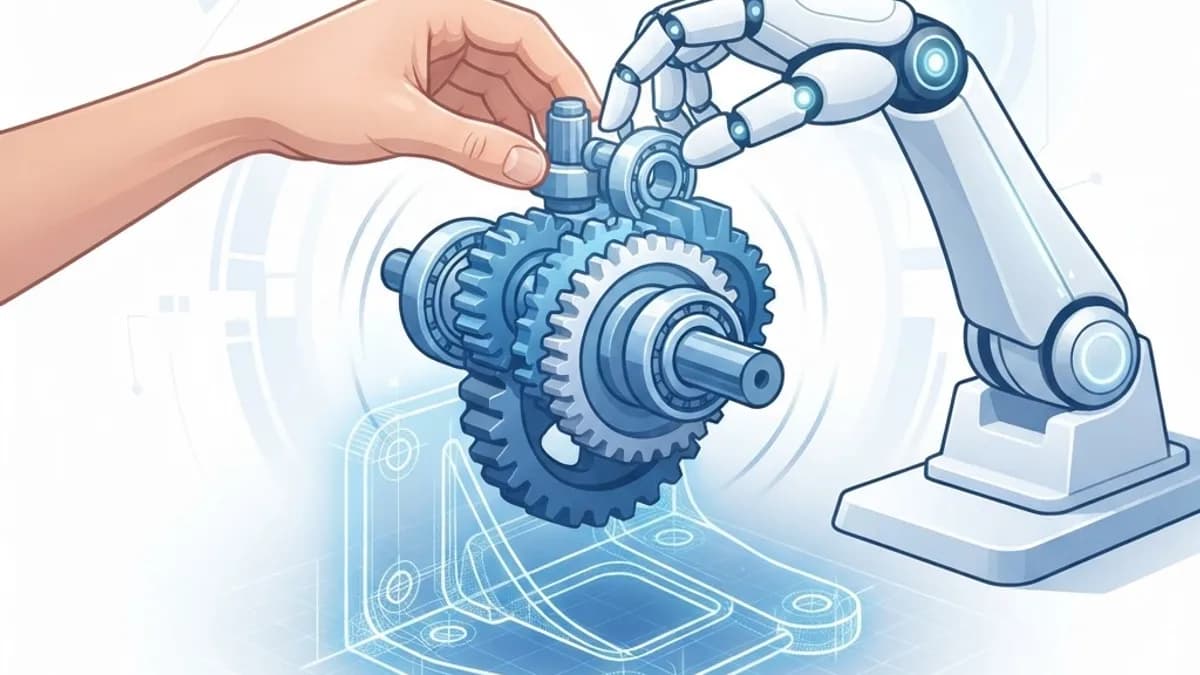
Generative design software now produces optimised components in minutes. Machine-learning surrogates approximate finite element results almost instantly. Given that, it is reasonable to ask: will mechanical engineers be replaced by AI, or is the profession simply getting faster tools?
Evidence so far points firmly toward the second answer, with an important caveat. The profession is not disappearing, but the composition of a mechanical engineer's working week is changing considerably — and the engineers who ignore that shift will feel squeezed.
This article examines automation at the task level, explains the structural barriers that keep humans in the loop, and lays out a concrete plan for staying valuable over the next decade.
What Does AI Currently Replace in Mechanical Work?
Break a mechanical engineer's job into tasks and the picture clarifies immediately. AI is displacing repetitive drafting, standard detail production, routine simulation setup, documentation drafting and first-pass geometry exploration.
It is not displacing problem definition, constraint negotiation, manufacturing feasibility judgement, commissioning, failure investigation or certification sign-off. Those tasks require context that lives in people, suppliers and physical hardware rather than in datasets.
The dividing line is instructive. AI handles bounded optimisation within stated constraints; engineers decide what the constraints actually are. Get the constraints wrong and a perfectly optimised part fails in service — which is precisely why accountability stays human.
Who Should Be Paying Attention?
Different groups face different versions of this question, and the practical response varies.
- Students choosing between mechanical engineering and a software-oriented degree
- Junior engineers whose current role is mostly drafting and detailing
- Mid-career design engineers deciding what to specialise in next
- Engineering managers planning team structure and training budgets
- Manufacturers investing in simulation and AI-driven design capability
Key Reasons Full Replacement Is Unlikely
Certification Requires an Accountable Human
Pressure equipment, lifting gear, structural components, automotive safety systems and medical devices all require sign-off by a qualified, often licensed engineer. Liability attaches to a person or firm. No current legal framework allows a model to accept that responsibility, and changing that would require deliberate legislative reform.
Manufacturing Constraints Are Tacit
Whether a shape can actually be cast, machined, welded or assembled depends on specific tooling, operator skill and supplier capability. Much of this knowledge is undocumented and lives in relationships with particular workshops. Optimisers routinely produce geometry that is elegant and unmanufacturable.
Physical Systems Behave Unpredictably
Real machines exhibit thermal drift, fastener relaxation, resonance from nearby equipment, contamination and installation variance. Diagnosing why a rig behaves differently from its model demands hands-on experience that no dataset encodes.
Design Data Is Scarce and Siloed
Bespoke mechanical design generates small, proprietary, inconsistently recorded datasets. That is close to the worst-case environment for machine learning generalisation, and it explains why progress in mechanical design AI trails progress in language and code.
How to Future-Proof a Mechanical Engineering Career
The plan below is deliberately practical and can be started this quarter.
- Learn Python to a working level — scripting CAD, batching simulations, parsing results.
- Master generative design and topology optimisation in the CAD suite you already use.
- Study surrogate modelling and uncertainty quantification so you know when to distrust a fast approximation.
- Spend real time on the shop floor; manufacturing judgement is your strongest moat.
- Build data skills around test rigs, sensors and statistics.
- Pursue chartered or professional engineer status for sign-off authority.
- Move toward systems-level work where mechanical, electrical, thermal and software constraints interact.
- Document one project where AI tools measurably reduced cycle time or weight, with numbers.
Benefits of Working With These Tools
Engineers who adopt early consistently describe an expansion of what is feasible rather than a threat.
- Far more design variants evaluated within the same schedule
- Meaningful weight and material savings from optimisation runs
- Earlier detection of failure modes through cheap, repeated simulation
- Predictive maintenance insight from operating equipment data
- Time reclaimed from drawing updates and repetitive documentation
Potential Challenges
The transition creates genuine problems worth planning around.
- Shrinking pure-drafting roles reducing traditional entry points into the profession
- Loss of hand-calculation intuition among engineers trained only on tools
- Plausible-looking optimised designs that violate unstated real-world constraints
- Proprietary geometry and test data exposed through third-party cloud tools
Best Practices and Tips
Use AI as a fast, tireless assistant whose work you always check.
- Validate every optimised design with independent hand calculations
- Confirm manufacturability with your actual supplier before finalising geometry
- Record assumptions, tool versions and input parameters for traceability
- Keep sensitive design data on infrastructure you control, using sound cloud and data practices
Real-World Example
A heavy vehicle component supplier introduced generative design for suspension brackets. The first optimised output was 26% lighter than the existing part, and the commercial team wanted it tooled immediately.
The lead design engineer identified two problems the software could not have known: the geometry required a five-axis machining operation the supplier did not offer, and the load case supplied to the optimiser omitted a kerb-strike condition documented in warranty claims rather than the original specification. After adding that case and constraining the geometry to three-axis machining, the production part came out 15% lighter and passed durability testing first time.
The AI did the exploration. The engineer supplied the missing reality — which is the whole argument in miniature.
Why It Matters
Mechanical engineering decisions affect physical safety at scale. Vehicles, lifts, pressure systems and medical devices fail with real consequences, and society has built licensing and liability structures around that risk for good reason.
So the question of whether mechanical engineers will be replaced by AI is partly technical and largely institutional. Even if capability improved dramatically, accountability structures would keep qualified engineers central. What changes is that those engineers spend less time producing geometry and more time judging it.
Frequently Asked Questions
Will mechanical engineers be replaced by AI in the next ten years?
Very unlikely as a profession. Specific tasks — drafting, routine analysis, documentation — will be heavily automated, while design judgement, manufacturing feasibility, commissioning and certification remain human responsibilities.
Is mechanical engineering still a good degree choice?
Yes, particularly combined with programming and data skills. Energy transition, electrification, robotics and advanced manufacturing all continue to generate strong demand for mechanically trained engineers.
Can AI do finite element analysis on its own?
It can run and approximate analyses very quickly, but choosing boundary conditions, load cases and mesh strategy, then judging whether results are physically sensible, still requires an experienced engineer. Wrong assumptions produce confident nonsense.
What should a junior mechanical engineer focus on?
Manufacturing exposure, testing and commissioning experience, one strong analysis specialisation, and scripting ability. Avoid building a career solely on drafting output, which is the most exposed activity in the discipline.
Conclusion
Mechanical engineers will not be replaced by AI, but the job description is being rewritten around judgement, validation and systems thinking rather than geometry production. That is a better job for most engineers, provided they make the shift deliberately.
Learn the tools, stay close to manufacturing, and own the sign-off. If your organisation is building AI-assisted design or engineering data workflows, see how our AI engineering services can help.
Enjoyed this article? Share it with others!