
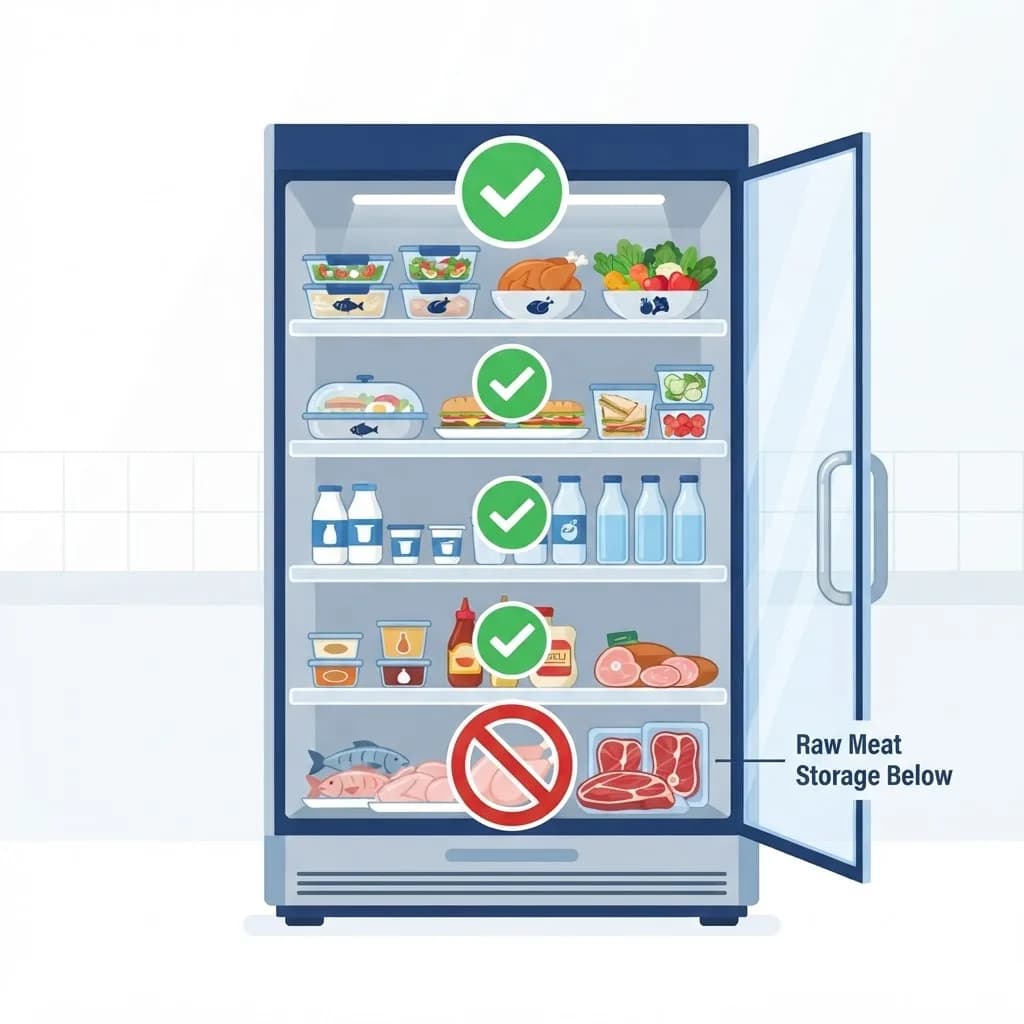
"Which of these foods are stored correctly?" is one of the most common questions on food handler exams — and one of the most common failures in real kitchens. The answer is never about a single item; it is about position, temperature, covering, and time all being right at once.
Storage mistakes rarely look dramatic. A tray of raw chicken one shelf too high or an uncovered container of cooked rice can quietly cause an outbreak that no one traces back to the walk-in.
This guide gives you a reliable framework for judging which foods are stored correctly, whether you are answering a quiz question or walking your own cooler at 6 a.m.
What Does Correct Food Storage Actually Mean?
Correct food storage means every item is held at a safe temperature, positioned so it cannot contaminate anything else, sealed or covered appropriately, and labeled with a date that shows it is still within its use window.
Four conditions have to be true simultaneously. Cold food at or below 41°F, frozen food solid at 0°F or below, dry goods in a cool dry area off the floor, and raw items always below ready-to-eat items.
The single most important rule is vertical order by required cooking temperature: ready-to-eat food on top, then seafood, whole cuts of beef and pork, ground meat, and finally poultry on the lowest shelf.
Who Needs to Know This?
Storage judgment is a daily skill, not just exam trivia.
- Line cooks, prep cooks, and dishwashers who put deliveries away
- Kitchen managers and chefs responsible for walk-in organization
- Food handler and ServSafe certification candidates
- Grocery, deli, and warehouse receiving teams
- Health inspectors and internal auditors scoring compliance
Key Features of Correct Storage
Shelf Hierarchy
Raw poultry always sits lowest because its juices carry the highest pathogen load and it needs the highest cooking temperature. Cooked and ready-to-eat foods sit highest because nothing will kill contamination before service.
Temperature Control
Refrigerated cold holding stays at or below 41°F. Freezers hold food frozen solid, typically at 0°F or lower. Dry storage stays between roughly 50°F and 70°F with good ventilation.
Covering and Containment
Food must be covered or wrapped, in food-grade containers, with no direct contact between raw and ready-to-eat items. Raw meat on a sheet tray contains drips; raw meat balanced on a lettuce bin does not.
Labeling and Date Marking
Ready-to-eat items held longer than 24 hours need a date mark, with a maximum of seven days at 41°F including the prep day. Teams that visualize these rules on shelf tags and wall charts — often produced through clear infographic design — get far better consistency than teams relying on memory.
How to Evaluate a Storage Setup Step by Step
Use this order every time and the correct answer becomes obvious.
- Check the unit temperature on the built-in gauge and confirm it with a thermometer.
- Scan vertically — is anything raw sitting above anything ready-to-eat?
- Confirm nothing is stored on the floor; everything should be at least six inches up.
- Look for uncovered containers or torn packaging.
- Verify raw items are in leak-proof containers or on trays with rims.
- Read date labels and pull anything past its window.
- Confirm chemicals and cleaning supplies are stored completely separately.
- Check air flow — overpacked shelves prevent proper cooling.
Benefits of Getting Storage Right
Correct storage is the cheapest food safety control you have.
- Prevents cross-contamination between raw proteins and ready-to-eat food
- Slows bacterial growth and extends usable shelf life
- Cuts food waste and inventory loss significantly
- Protects inspection scores and avoids costly re-inspections
- Speeds up service because staff can find product instantly
Potential Challenges
Even well-trained kitchens drift without attention.
- Undersized walk-ins force staff to improvise placement during busy deliveries
- Rush hour deliveries get shoved in wherever there is space
- Unlabeled containers make date verification impossible
- Faulty door gaskets and blocked vents cause temperature swings staff never notice
Best Practices and Tips
These habits keep storage correct without constant policing.
- Label shelves permanently by category so placement requires no thinking
- Practice strict FIFO — first in, first out — on every rotation
- Log cooler and freezer temperatures at least twice per shift
- Date-mark at the moment of prep, never later
- Track temperature logs digitally; simple internal custom web development solutions can flag out-of-range readings automatically
Real-World Example
An inspector opens a restaurant cooler and sees four items. On the top shelf: a covered container of cooked pasta, dated. Second shelf: raw salmon on a rimmed tray. Third shelf: ground beef, sealed. Bottom shelf: raw chicken in a leak-proof pan.
This walk-in is stored correctly. Reverse the chicken and the pasta and the whole unit becomes a violation, because chicken juices can drip onto food that will never be cooked again. Same items, same temperatures — only the order changed, and that order is the entire answer.
Why It Matters
Most foodborne illness outbreaks trace back to a handful of basic failures, and improper storage sits near the top of that list alongside temperature abuse and poor hand hygiene. Storage is where a small mistake gets multiplied across dozens of servings.
Knowing which foods are stored correctly is also a leadership signal. A clean, ordered, labeled walk-in tells every staff member that standards here are real — and that message shapes behavior far beyond the cooler door.
Frequently Asked Questions
What should be stored on the bottom shelf of a refrigerator?
Raw poultry, because it requires the highest cooking temperature and poses the greatest contamination risk. Nothing should ever be stored beneath it.
What temperature should refrigerated food be stored at?
At or below 41°F for cold holding under the FDA Food Code. Frozen food should be kept frozen solid, generally at 0°F or lower.
How high off the floor must food be stored?
At least six inches above the floor on shelving or pallets, which allows cleaning and prevents contamination from splash and pests.
How long can ready-to-eat food be held in the cooler?
A maximum of seven days when held at 41°F or below, counting the day of preparation as day one. It must be date-marked if held over 24 hours.
Conclusion
To decide which of these foods are stored correctly, check four things in order: temperature, vertical position, covering, and date label. Ready-to-eat on top, poultry on the bottom, everything covered, everything dated.
Ready to move your storage charts, logs, and training material into one organized digital hub? Explore our website maintenance and support services to keep it accurate year-round.
Enjoyed this article? Share it with others!