
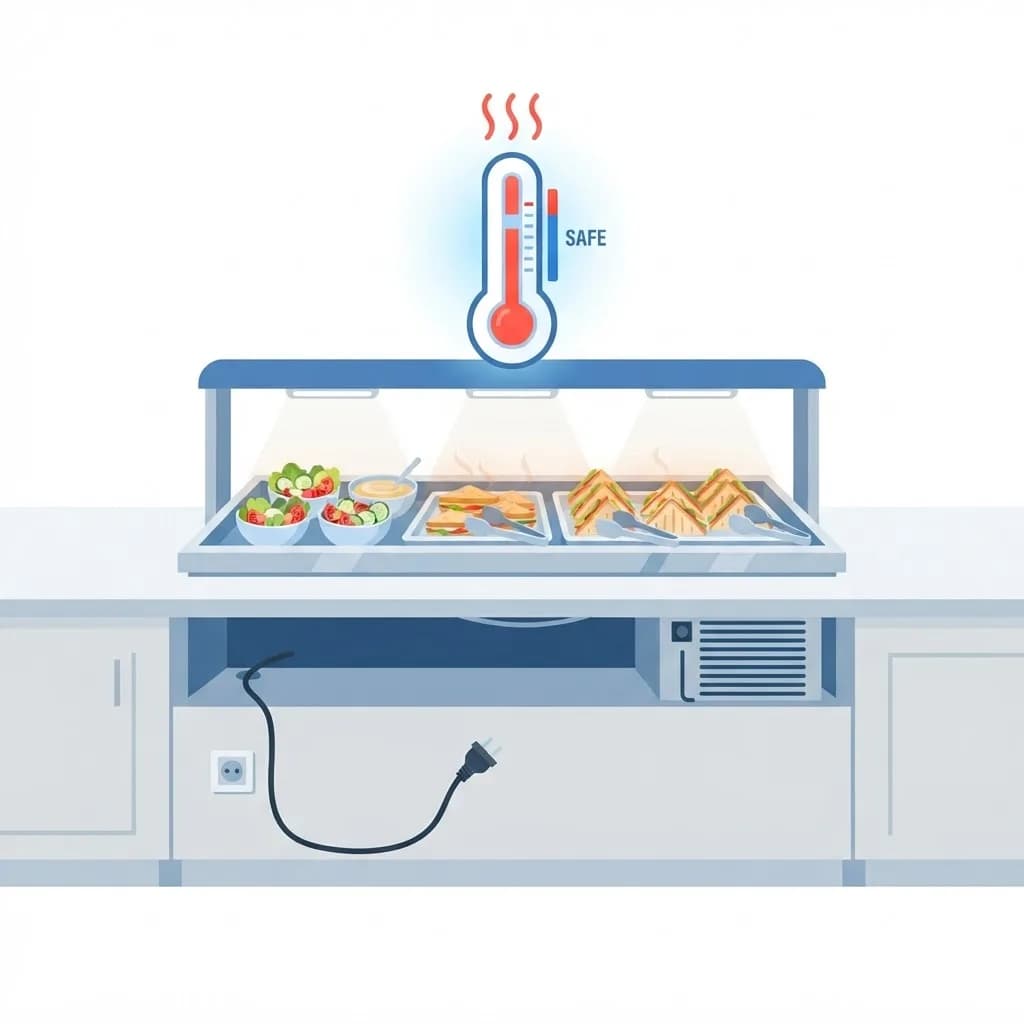
Every kitchen eventually faces the same problem: a cold display case fails, an outdoor catering table has no ice, or a buffet line runs longer than planned. When cold food is being held without temperature control, the clock starts ticking immediately — and the rules are much stricter than most staff realize.
The good news is that food codes actually allow this practice in limited situations. It is called time as a public health control, and it works only when you follow specific time limits, labeling steps, and discard rules.
This guide breaks down exactly what happens when cold food is held without temperature control, how long you have, and how to document the process so an inspector sees a system rather than a shortcut.
What Is Cold Food Being Held Without Temperature Control?
Cold food held without temperature control means a refrigerated, ready-to-eat item is kept out of refrigeration on purpose and monitored by time instead of temperature. Instead of proving the food stayed at or below 41°F, you prove it was only out for a limited window.
Under the FDA Food Code, cold ready-to-eat food that begins at 41°F or lower may be held without refrigeration for up to six hours, provided it never exceeds 70°F. If either limit is broken, the food must be discarded — it cannot be returned to the cooler.
There is also a simpler four-hour option. If you do not want to monitor the 70°F ceiling, the food may be held for a maximum of four hours from the moment it left refrigeration, then discarded.
Who Needs to Understand These Rules?
Time-based holding shows up far beyond restaurant kitchens. Anyone who moves cold food away from a power source should understand the limits.
- Caterers serving weddings, festivals, and outdoor corporate events
- Buffet, salad bar, and self-serve operators in restaurants and hotels
- School, hospital, and long-term care foodservice teams
- Food trucks and pop-up vendors with limited refrigeration capacity
- Grocery and deli staff running sampling stations or grab-and-go displays
Key Features of Time-Based Cold Holding
A Written Procedure Comes First
You cannot improvise this. Regulators expect a written procedure kept on site that names the foods involved, the time limit chosen, marking methods, and the discard rule. Teams that publish this as a one-page visual reference get far better compliance, which is why many operators pair their food safety documents with clean infographic design work that staff can actually read at a glance.
Mandatory Time Marking
Each pan, tray, or container must be marked with either the time it was removed from refrigeration or the time it must be discarded. Discard time is usually safer because it removes mental math during a rush.
Starting Temperature Matters
The food must be 41°F or colder at the moment it leaves refrigeration. Starting warm shortens the safety margin dramatically and invalidates the whole procedure.
No Return to Refrigeration
Once the item is on time control, it cannot be chilled and reused later. It is served within the window or thrown out. This single rule prevents the slow accumulation of risk across multiple services.
How to Get Started With Time as a Public Health Control
Setting this up is straightforward if you build it into your prep routine rather than treating it as an emergency response.
- Identify which cold ready-to-eat items realistically need to be held without refrigeration.
- Choose your window — four hours with no temperature monitoring, or six hours with a 70°F ceiling.
- Write the procedure and get it approved by your local health authority if required.
- Verify each item is at or below 41°F with a calibrated thermometer before it leaves the cooler.
- Label every container with the discard time, using stickers, tags, or dissolvable labels.
- Check the display periodically and record any surface temperature readings you take.
- Discard all remaining product at the marked time, and log the discard.
Benefits of Doing It Correctly
Handled properly, time control turns an awkward situation into a controlled, defensible process.
- Lets you serve safely in venues with no power or limited cooling equipment
- Reduces guesswork for staff because the rule is a clock, not a judgment call
- Creates a clean paper trail that protects you during inspections and complaints
- Prevents pathogen growth in high-risk items like cut melon, deli salads, and dairy
- Improves service flow because pans can be staged in advance without panic
Potential Challenges
The rules are simple, but real service conditions test them constantly.
- Staff forget to mark times, making the entire batch unverifiable and discardable
- Hot outdoor conditions push surface temperatures past 70°F long before six hours
- Topping off a half-empty pan mixes old and new product with different clocks
- Food waste rises if batch sizes are not matched to expected demand
Best Practices and Practical Tips
A few habits separate kitchens that pass inspections from kitchens that scramble.
- Label with the discard time, not the start time, and write it large enough to read across a counter
- Put out small batches and replace them with fresh pans instead of refilling
- Shade outdoor displays and use shallow pans so product moves quickly
- Log discard times digitally — many operators now replace clipboards with simple internal web application tools that timestamp entries automatically
- Retrain seasonal staff before every busy period, not after a mistake
Real-World Example
A catering company serves a 300-guest outdoor lunch with no refrigeration at the venue. The team transports chicken salad, cut fruit, and pasta salad at 38°F in insulated carriers, then verifies each item with a probe thermometer on arrival at 11:00 a.m.
Because the event runs in warm weather, the manager selects the four-hour rule for simplicity. Every pan gets a bright label reading "discard 3:00 p.m." Small batches go out and are replaced every 45 minutes from the shaded staging area. At 3:00 p.m. all remaining product is thrown away and logged. No returns to the carriers, no exceptions, no guessing — and no illness reports.
Why It Matters
Cold food being held without temperature control sits directly in the range where Listeria, Salmonella, and Staphylococcus aureus multiply fastest. A pan that looks and smells perfectly normal can carry enough pathogens to cause an outbreak, because spoilage and danger are not the same thing.
Time control works because it removes the illusion of safety. Instead of hoping the food is still cold, you rely on a hard limit that anyone on the team can verify. That shift from opinion to evidence is what protects both your guests and your license.
Frequently Asked Questions
How long can cold food be held without temperature control?
Up to six hours if it starts at 41°F or below and never exceeds 70°F, or up to four hours if you are not monitoring temperature at all. After the limit, the food must be discarded.
Can I put the food back in the refrigerator afterward?
No. Once cold ready-to-eat food is placed on time control, it cannot be re-refrigerated for later service. Any product left at the end of the window is waste.
What must be written on the container?
Either the time the food was removed from refrigeration or the time it must be discarded. The mark has to be visible to staff and available to an inspector on request.
Does this apply to hot food too?
Hot food has its own version of the rule — generally a maximum of four hours without temperature control, starting from 135°F or above, with no reheating and no reuse afterward.
Conclusion
Cold food being held without temperature control is legal, practical, and safe — but only when the clock, the labels, and the discard rule are treated as non-negotiable. Verify the starting temperature, mark every container, and throw away what is left when time is up.
If your team is ready to move food safety logs, training material, and compliance checklists into a cleaner digital system, explore our professional website design services to build a resource your staff will actually use.
Enjoyed this article? Share it with others!