
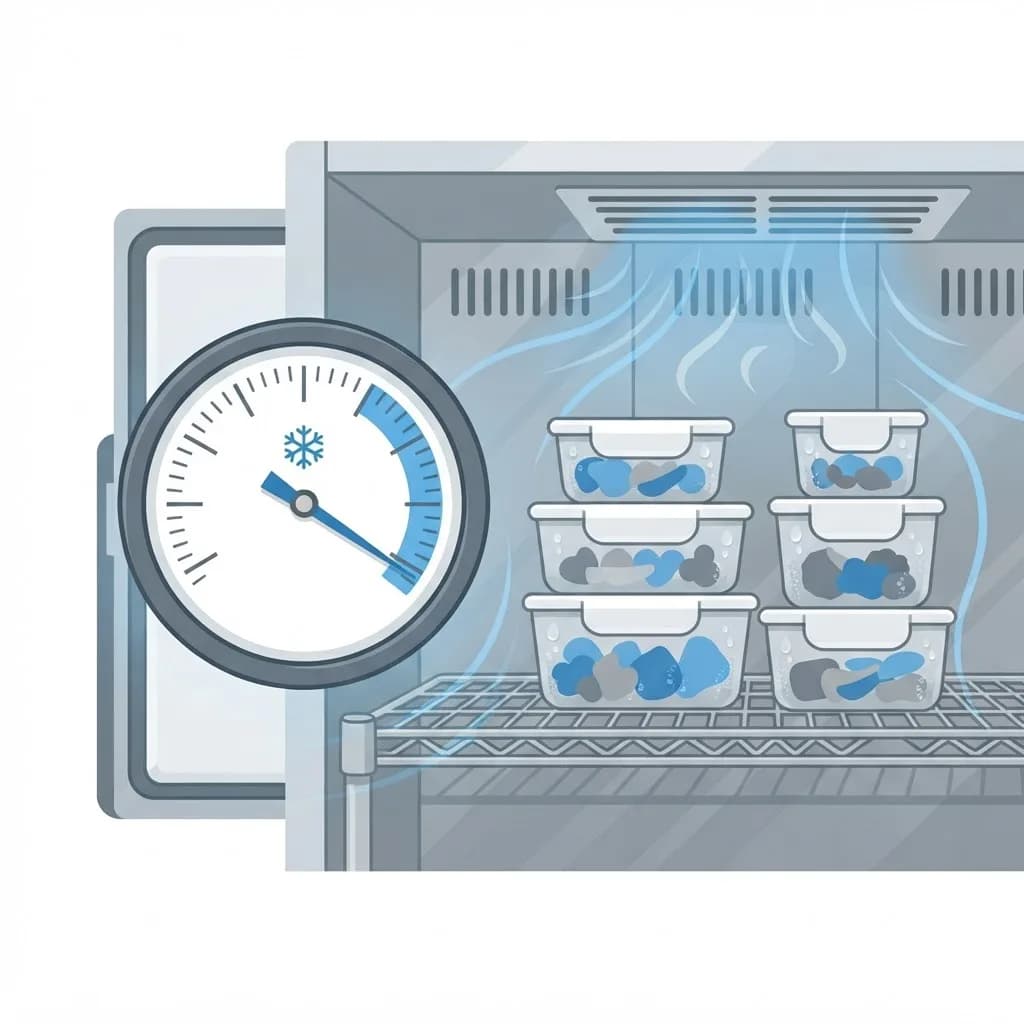
If you remember one number from food safety training, make it this one: food held under refrigeration must be at or below 41°F. Not the air in the cooler — the food itself, measured in the thickest part.
This single threshold governs cold holding in restaurants, delis, schools, hospitals, and food trucks across the United States. Cross it, and bacterial growth accelerates immediately.
Here is what the rule actually requires, how to verify it correctly, and what to do the moment a reading comes back too warm.
What Does the 41°F Refrigeration Rule Mean?
Under the FDA Food Code, time and temperature control for safety foods must be held cold at 41°F (5°C) or lower. Some older state codes still reference 45°F, but 41°F is the modern national standard and the safest target.
The rule applies to product temperature, not equipment temperature. A walk-in reading 38°F on the dial can still contain a deep container of soup sitting at 50°F in the center.
The reasoning is biological. Below 41°F, pathogens like Salmonella, Listeria monocytogenes, and E. coli multiply extremely slowly. Above it, growth rates climb sharply as the food enters the temperature danger zone between 41°F and 135°F.
Who Must Follow This Requirement?
Any operation that holds potentially hazardous food cold is covered.
- Restaurants, cafes, bars, and quick-service kitchens
- Grocery stores, delis, butchers, and seafood counters
- Caterers, food trucks, and mobile vendors
- Schools, hospitals, and long-term care foodservice operations
- Food manufacturers and cold-chain distribution and delivery services
Key Features of Proper Cold Holding
Product Temperature, Not Air Temperature
Always probe the food. Insert a calibrated thin-tip thermometer into the geometric center or thickest part of the item, wait for the reading to stabilize, then record it.
Calibrated Thermometers
An uncalibrated thermometer is worse than no thermometer because it creates false confidence. Calibrate using the ice-water method to 32°F, at minimum weekly and after any drop.
Continuous Monitoring and Logging
Manual checks twice a shift are the baseline; digital data loggers with alerts are the modern standard. Many operators now feed sensor data into dashboards built with reliable cloud infrastructure solutions so a failing cooler triggers an alert at 3 a.m. instead of being discovered at breakfast.
Airflow and Loading Discipline
Overpacked shelves, blocked vents, and hot food placed directly into a cooler all push product temperatures up. Cooling capacity is finite, and stacking defeats it.
How to Verify Refrigerated Food Temperatures
Build this into a fixed routine rather than a spot check.
- Calibrate your probe thermometer in an ice bath before the shift.
- Sanitize the probe stem between every single item.
- Insert into the thickest part of the food, avoiding the container wall and bottom.
- Wait for the display to hold steady, usually 15 to 30 seconds.
- Record the reading, the item, the time, and your initials.
- Check multiple zones — front, back, top, and bottom of each unit.
- Take corrective action immediately on any reading above 41°F.
- Review the logs weekly to spot equipment trending warmer over time.
Benefits of Holding Food at or Below 41°F
The discipline pays back in more than compliance.
- Dramatically slows pathogen growth and reduces outbreak risk
- Extends shelf life and cuts spoilage-related waste
- Preserves texture, color, and flavor quality in fresh product
- Provides documented evidence of due diligence during inspections
- Gives early warning of failing compressors before full breakdown
Potential Challenges
Most violations come from a handful of predictable causes.
- Frequent door openings during rush periods raising internal temperatures
- Hot food placed in the cooler before proper two-stage cooling
- Deep containers where the center never reaches 41°F
- Worn door gaskets, iced evaporator coils, and dirty condensers
Best Practices and Tips
These adjustments solve the majority of cold-holding problems.
- Set units to 36–38°F so normal fluctuation never crosses 41°F
- Use shallow pans no deeper than two inches for cooling and holding
- Cool hot food from 135°F to 70°F within two hours, then to 41°F within four more
- Install audible or SMS alarms on every unit holding hazardous food
- Train staff with visual reference cards; well-designed professional graphic design makes temperature charts stick better than text memos
Real-World Example
A deli manager checks the walk-in gauge each morning and sees 39°F, so she assumes everything is fine. During an inspection, the inspector probes a five-gallon container of potato salad prepped the night before and finds 47°F at the center.
The cooler was working; the container was the problem. It was too deep and too full for the air to remove heat fast enough. The batch is discarded, and the kitchen switches to two-inch shallow pans with ice-paddle cooling. Every subsequent probe reads 38°F to 40°F. One process change fixed what looked like an equipment failure.
Why It Matters
Temperature abuse is consistently among the leading contributing factors in foodborne illness outbreaks. The gap between 41°F and 50°F feels trivial to the human hand but represents a several-fold difference in bacterial growth rate.
There is also a legal dimension. Documented temperature logs are often the strongest evidence an operator has when a complaint or lawsuit arrives. Proving that food held under refrigeration was at or below 41°F is proof of a functioning system, not just good intentions.
Frequently Asked Questions
Is 41°F the air temperature or the food temperature?
The food temperature. Air readings are useful for monitoring equipment, but compliance is judged by probing the product itself.
What happens if refrigerated food goes above 41°F?
If it has been between 41°F and 135°F for four hours or less, it can often be rapidly re-chilled. Beyond four hours of cumulative exposure, it must be discarded.
How often should refrigerated food temperatures be checked?
At minimum every four hours, and practically at the start and end of each shift. Continuous digital monitoring is strongly recommended for critical units.
Why do some references say 45°F instead of 41°F?
Older versions of the Food Code and a few state regulations still allow 45°F. Current FDA guidance is 41°F or below, so always follow your local code and default to the stricter number.
Conclusion
Food held under refrigeration must be at or below 41°F, verified by probing the product with a calibrated thermometer and recorded in a log you can produce on request. Set units colder than the limit, use shallow pans, and act immediately on out-of-range readings.
If you want temperature logs, alerts, and compliance records in one place instead of on paper, our back-end web development services can build the system around your workflow.
Enjoyed this article? Share it with others!