
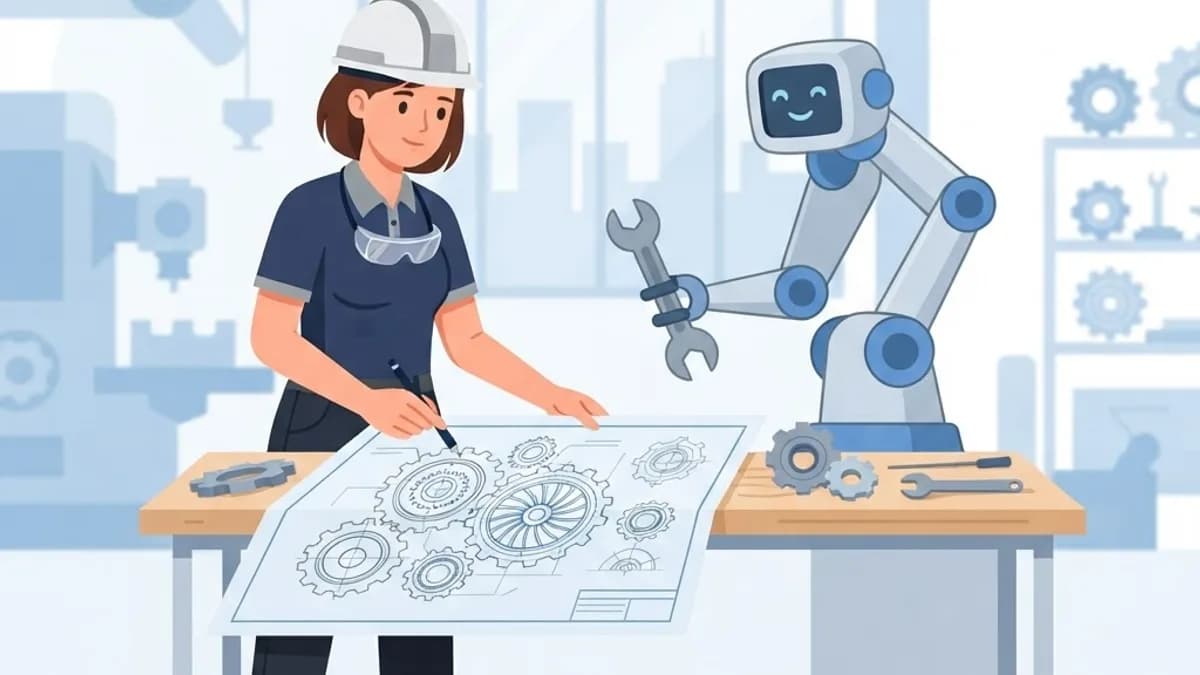
Ask an engineering graduate what worries them most about the next decade and the answer is often the same question: will AI replace mechanical engineers? It is a fair concern. Generative design tools now produce optimised brackets in minutes, and simulation surrogates run in seconds instead of hours.
But look closely at what those tools actually do, and a clearer picture emerges. AI is extremely good at exploring a defined solution space. It is poor at deciding which problem is worth solving, what the real constraints are, and who carries the liability when a part fails in service.
This article breaks down which tasks are genuinely at risk, which are not, and how mechanical engineers can position themselves as the people who direct these tools rather than compete with them.
What Is AI Actually Doing in Mechanical Engineering?
Modern AI in mechanical engineering shows up in four main forms: generative and topology optimisation, machine-learning surrogates that approximate expensive simulations, computer vision for inspection and quality control, and predictive maintenance on operating equipment.
Each of these compresses a specific, well-bounded task. Topology optimisation searches geometry options against a stated load case. A surrogate model interpolates within the data it was trained on. Neither invents the load case, questions whether the assumed boundary conditions reflect reality, or signs off on a safety factor.
That is the crucial distinction. AI accelerates analysis; engineers own the problem definition and the accountability. A generative tool given the wrong constraints will confidently produce an optimised part that fails certification.
Who Is Most and Least Exposed?
Exposure varies enormously by role, and it tracks closely with how repetitive and digitally contained the work is.
- Most exposed: routine drafting, drawing updates, standard-part detailing and repetitive tolerance stack-ups
- Moderately exposed: standard FEA and CFD runs where geometry and load cases barely change
- Less exposed: design for manufacture, supplier negotiation, root-cause failure investigation
- Least exposed: safety-critical certification, commissioning, field troubleshooting and multidisciplinary systems engineering
- Growing fast: engineers who can build tooling and connect simulation data into internal engineering web applications
Key Factors That Limit Full Replacement
Physical Reality Is Messy
Models assume clean inputs. Real machines have weld distortion, thermal cycling, worn bearings, inconsistent material batches and installers who improvise. Judging when a simulation diverges from a shop floor requires accumulated physical experience that no dataset currently encodes.
Accountability Cannot Be Delegated
Pressure vessels, lifts, structural components and medical devices require a named responsible engineer under standards and law. A model cannot hold a licence, sign a certificate, or be liable in court. Until that legal structure changes, human sign-off remains mandatory.
Data Scarcity in Design
Machine learning thrives on large, consistent datasets. Bespoke mechanical design is the opposite — small production runs, unique constraints and proprietary test data locked inside individual firms. That scarcity limits how far models generalise across novel designs.
Cross-Domain Trade-offs
Real projects balance cost, lead time, serviceability, supplier capability, regulation and customer preference simultaneously. Optimisers handle stated objectives well but cannot weigh unstated organisational priorities or negotiate with a procurement team.
How Mechanical Engineers Should Adapt
The practical response is not defensive. It is to become the engineer who deploys these tools faster and more critically than peers.
- Learn Python well enough to script CAD operations, batch simulations and parse result files.
- Get fluent in generative design and topology optimisation inside your existing CAD suite.
- Understand the basics of surrogate modelling so you know when an ML approximation is trustworthy.
- Deepen manufacturing knowledge — tooling, tolerances and supplier constraints remain hard to automate.
- Build data literacy: sensor data, test rigs, statistics and uncertainty quantification.
- Pursue chartered or professional status where your jurisdiction offers it, since sign-off authority is durable value.
- Document one project where AI tools cut your cycle time, with measured before-and-after numbers.
Benefits of AI for Engineers Who Adopt It
Engineers who integrate these tools early usually report the same effect: more design iterations, earlier failure discovery and less time on mechanical busywork.
- Dozens of design variants explored in the time one used to take
- Weight and material savings from optimisation that manual iteration would miss
- Faster failure diagnosis using predictive maintenance data from operating equipment
- Less time spent on drawing updates and repetitive documentation
- More capacity for the conceptual and validation work that actually differentiates a design
Potential Challenges
Adoption is not frictionless, and the risks are worth naming honestly.
- Over-trusting outputs that look plausible but violate unstated constraints
- Erosion of intuition among juniors who never do calculations by hand
- Proprietary design data leaking into third-party cloud tools
- Genuine downward pressure on junior drafting and routine analysis roles
Best Practices for Working Alongside AI
Treat every AI output as a hypothesis requiring verification, exactly as you would a junior engineer's first draft.
- Always sanity-check optimised results with hand calculations or first principles
- Validate surrogate models against known test data before trusting them on new cases
- Keep a clear audit trail of assumptions, tool versions and input parameters
- Check data-handling terms before uploading proprietary geometry, and pair with sound cloud infrastructure practices
Real-World Example
A mid-sized pump manufacturer introduced topology optimisation for impeller housings. The software produced a design 22% lighter than the incumbent, and management wanted it in production immediately.
The lead engineer flagged that the optimised geometry required a casting core the existing foundry could not produce, and that a thin web sat directly in a known cavitation zone. After adjusting the constraints to reflect real manufacturing limits and adding a fatigue case, the final design landed at 14% lighter — and it actually shipped. The AI supplied the exploration; the engineer supplied the constraints that made it viable.
Why It Matters
The question of whether AI will replace mechanical engineers matters because it shapes career decisions being made right now. The realistic answer is that task composition changes substantially while accountable engineering judgement remains central.
Roles narrowly built on routine drafting and repetitive analysis will shrink. Roles built on physical understanding, manufacturing insight, systems thinking and certification authority will become more valuable — especially when combined with tool-building skill.
Frequently Asked Questions
Will AI replace mechanical engineers completely?
No credible evidence points that way. AI automates specific analysis and drafting tasks, but legal accountability, physical commissioning, manufacturing judgement and novel problem framing all still require qualified engineers.
Which mechanical engineering jobs are most at risk?
Routine CAD drafting, repetitive detailing and standardised simulation runs face the strongest pressure. Field engineering, certification, systems integration and failure investigation are far more resilient.
Should I still study mechanical engineering?
Yes, provided you pair it with computational skills. Graduates who combine solid mechanics fundamentals with programming, data analysis and AI-tool fluency are in strong demand across energy, mobility and manufacturing.
What single skill offers the best protection?
The ability to validate. Anyone can generate a design with a modern tool; far fewer can prove it is correct, manufacturable and compliant. That verification capability is what employers pay a premium for.
Conclusion
AI will not replace mechanical engineers, but it will steadily replace the parts of the job that were never the interesting bit. The engineers who thrive will treat these systems as fast, tireless, occasionally wrong assistants that require firm direction.
Learn the tools, keep your physical intuition sharp, and own the judgement calls. If your team is building AI-assisted engineering workflows, see how our AI services can support the build.
Enjoyed this article? Share it with others!