
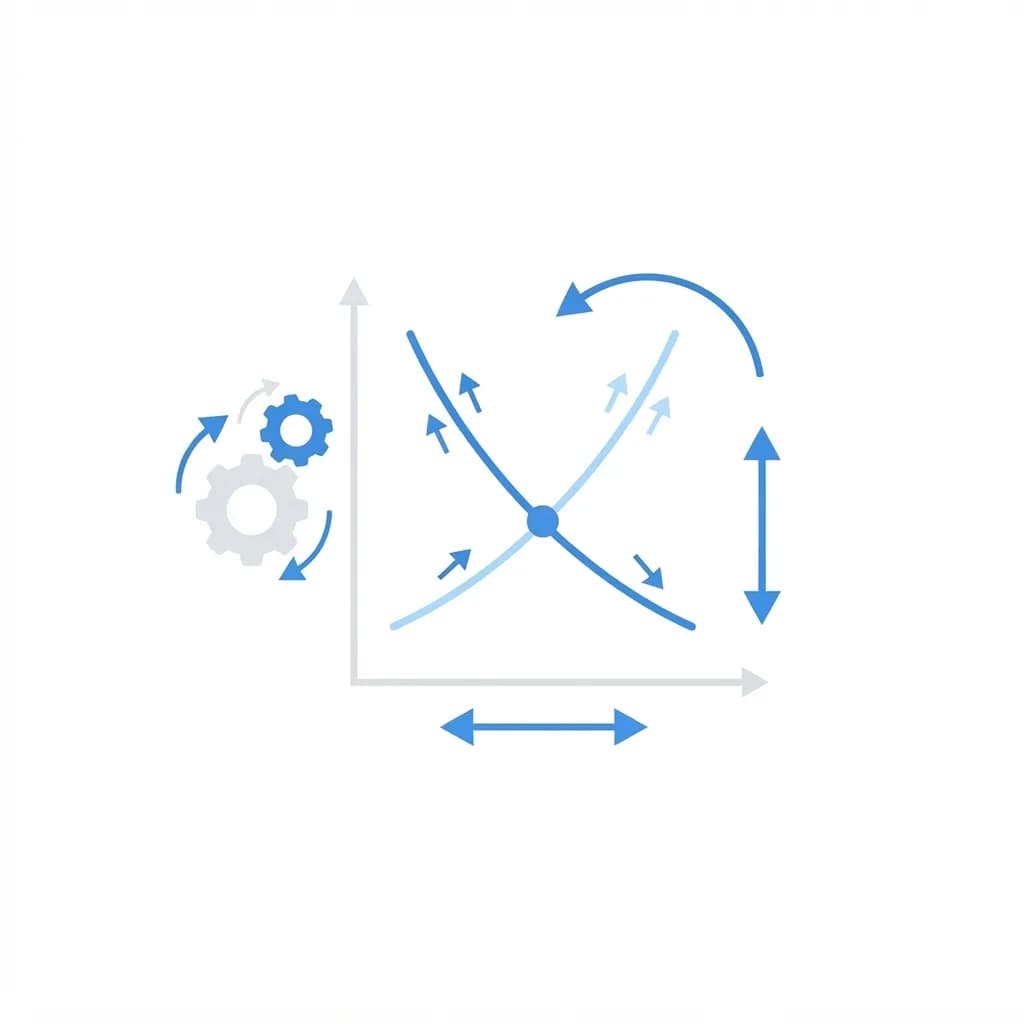
Every pricing decision, hiring plan, and product launch is judged by forces no single company controls. The market forces factor is the shorthand for those pressures, and ignoring them is how good businesses make bad plans.
Supply and demand get the headlines, but competition, regulation, technology, and buyer power often move outcomes faster.
This guide breaks down what market forces are, how to analyse them practically, and how to build a strategy that survives changes you cannot predict.
What Is the Market Forces Factor?
Market forces are the external economic pressures that determine prices, availability, and competitive intensity in a given market. The market forces factor describes how strongly those pressures influence a particular business or decision.
At the core sits supply and demand, but in practice most companies are shaped more by competitor behaviour, input costs, and regulation than by textbook curves. A restaurant does not price from a graph; it prices from supplier invoices and the menu next door.
Strong market forces mean you are a price taker with limited control. Weak market forces, usually created by brand, patents, or switching costs, let you set terms instead.
Who Needs to Analyse Market Forces?
Anyone making a decision that takes longer than a quarter to pay back.
- Founders validating whether a market can support their pricing
- Product managers deciding features versus cost reduction
- Finance teams building forecasts and scenario models
- Investors comparing structural attractiveness across sectors
- Marketers positioning against substitutes and alternatives
Key Market Forces to Track
Supply and Demand Balance
When demand outpaces supply, prices and margins rise. When capacity floods in, discounting follows quickly. Tracking capacity additions in your sector is often more predictive than tracking demand.
Competitive Intensity
The number of credible rivals and how easily new ones enter sets your pricing ceiling. Low barriers to entry almost always compress margin over time.
Buyer and Supplier Power
If three customers make up most of your revenue, they set your terms. The same applies in reverse when one supplier controls a critical input.
Technology and Substitution
New technology reshapes cost structures fastest. Automation and AI adoption are currently the clearest example, which is why many firms now evaluate artificial intelligence solutions as a competitive requirement rather than an experiment.
How to Analyse Market Forces in Practice
Keep the analysis concrete and tied to decisions you will actually make.
- Define your market narrowly by product, geography, and customer type.
- List your real competitors, including substitutes customers might choose instead.
- Measure concentration on both sides: top customers and critical suppliers.
- Identify the two or three input costs that most affect your margin.
- Note regulations or standards that could change your cost base.
- Build best, base, and worst scenarios for each major force.
- Choose one lever you control, such as differentiation or cost, and commit.
Benefits of Understanding Market Forces
Clarity about external pressure improves nearly every internal decision.
- More realistic pricing that reflects actual competitive position
- Earlier warning of margin compression before it hits results
- Better capital allocation toward defensible advantages
- Stronger negotiation with concentrated buyers or suppliers
- Forecasts that survive contact with reality
Potential Challenges
Analysis fails in predictable ways.
- Defining the market too broadly, which hides real competitive threats
- Relying on stale data in fast-moving categories
- Confusing temporary shocks with structural change
- Producing a report nobody uses in actual decision-making
Best Practices and Tips
Treat market force analysis as a habit, not an annual document.
- Review your top three forces quarterly with real numbers attached
- Track leading indicators such as input prices and competitor hiring
- Reduce dependence on any customer or supplier above roughly 20 percent of volume
- Invest in switching costs and brand, since both weaken market pressure on you
Real-World Example
A regional print business watched revenue erode as digital advertising absorbed client budgets. Leadership initially blamed the sales team, then mapped the actual forces: falling demand, low switching costs, and a substitute technology with better measurability.
The response was structural rather than tactical. They added design and digital services, repositioned around brand consistency, and grew a new revenue line. Much of that shift depended on adding capabilities like professional infographic design that clients could not easily buy elsewhere locally.
Why It Matters
The market forces factor determines how much of your outcome is decided by strategy versus circumstance. Businesses that misread it spend heavily fighting pressures they cannot beat.
Reading forces correctly lets you pick fights you can win, whether by differentiating, consolidating, or exiting early with capital intact.
Frequently Asked Questions
What are the main market forces?
Supply and demand, competitive intensity, buyer power, supplier power, substitutes and technology, plus regulation. Together they set pricing power and margin potential.
How do market forces affect pricing?
Strong forces make you a price taker following competitors and input costs. Weak forces, created by brand or switching costs, let you price on value instead.
Can a small business influence market forces?
Rarely at market level, but it can reduce exposure by differentiating, diversifying customers, and building relationships that raise switching costs.
How often should market analysis be updated?
Quarterly for fast-moving sectors and at least annually for stable ones, with immediate review after any major regulatory or technology shift.
Conclusion
The market forces factor is not academic theory; it is the set of pressures deciding whether your strategy has room to work. Define your market tightly, measure the forces honestly, and commit to the levers you actually control.
When technology is the force reshaping your sector, moving early beats reacting late. Exploring AI services for business is a practical first step.
Enjoyed this article? Share it with others!