Marketing agencies have spent two decades promising better targeting. What changed recently is that the technology finally delivers at scale. An AIMA agencia de inteligencia artificial y marketing digital — an agency that combines artificial intelligence with digital marketing execution — represents that shift in practical form.
The model is straightforward. Instead of treating AI as a novelty add-on, these agencies build it into research, creative production, media buying and reporting. The result is faster iteration and decisions grounded in far more data than a human team could review manually.
This guide explains what such an agency actually does day to day, which businesses benefit most, and how to judge whether the AI in the pitch is substance or decoration.
What Is an AI and Digital Marketing Agency?
An AIMA-style agency is a marketing partner whose core workflows are augmented by machine learning and generative AI. It still runs the familiar disciplines — SEO, paid media, content, social, email, analytics — but uses AI to compress the time between insight and execution.
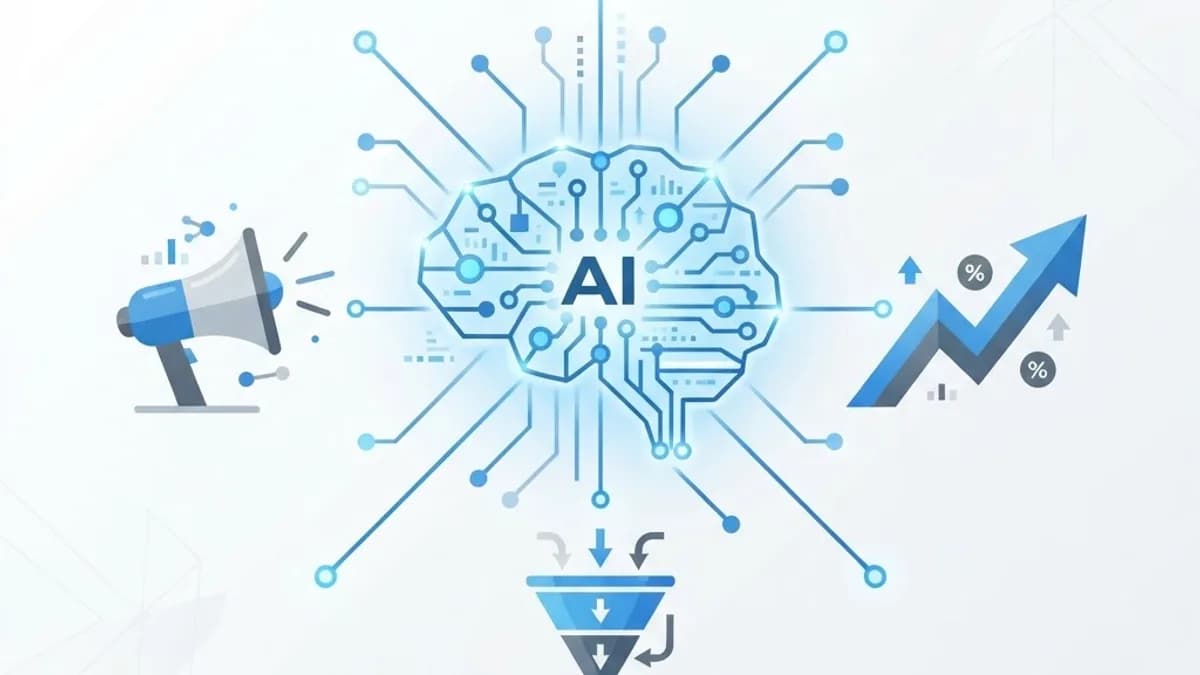
In practice that means clustering thousands of search queries automatically to find content gaps, generating and testing dozens of ad variants per week, predicting which leads are likely to convert, and producing reporting narratives instead of raw dashboards. The differentiator is not owning a clever tool. It is having tested processes that turn model output into decisions a client can act on.
Importantly, the good agencies keep humans firmly in the loop. AI drafts, ranks and forecasts; strategists decide, edit and take accountability for brand voice and factual accuracy.
Who Needs This Kind of Agency?
AI-driven marketing helps most where there is enough data to learn from and enough volume to justify automation. That covers more organisations than it did even two years ago.
- Ecommerce brands with large catalogues needing automated product content, feed optimisation and dynamic creative.
- Lead-generation businesses that want predictive scoring so sales teams call the right prospects first.
- Multi-market companies managing campaigns across languages and regions, where translation and localisation costs add up quickly.
- SaaS and subscription products optimising onboarding, retention messaging and churn prediction.
- Lean marketing teams of one to three people who need output far beyond their headcount.
Key Features and Capabilities
AI-Assisted Research and Strategy
Rather than sampling a few dozen keywords, these agencies process entire query landscapes, competitor content libraries and customer support transcripts to identify demand patterns. The output is a prioritised roadmap based on evidence, not intuition.
Scaled Creative Production
Generative models produce first drafts of ad copy, landing page variants, product descriptions and social assets. Human editors then refine tone, accuracy and compliance. This is where professional graphic design support matters, because AI-generated visuals still need art direction to look like a coherent brand rather than a stock library.
Predictive Media Buying
Machine learning models forecast which audiences, placements and bid levels are likely to produce profitable conversions, then reallocate budget continuously. Over months this typically reduces wasted spend more than any single creative improvement.
Custom Automation and Integrations
Mature agencies build connective tissue: chatbots trained on your knowledge base, automated report generation, CRM enrichment and internal tools. Delivering this reliably usually requires real engineering, often through dedicated artificial intelligence development services rather than off-the-shelf plugins.
How Working With One Actually Works
Engagements follow a recognisable arc, and knowing it helps you spot an agency that is improvising.
- Discovery and data audit. The agency reviews your analytics, CRM, ad accounts and content to assess whether there is enough clean data to model.
- Baseline measurement. Current cost per acquisition, conversion rates and lifetime value are documented so improvements are provable.
- Strategy and prioritisation. A roadmap is built around the two or three levers with the largest expected impact.
- Infrastructure setup. Tracking, data pipelines, consent handling and any custom tooling are implemented.
- Rapid testing cycles. Campaigns, creative and landing pages launch in structured experiments rather than one-off pushes.
- Scale what works. Winning variants receive more budget; losers are retired quickly and documented.
- Continuous reporting. Monthly reviews focus on business outcomes, not impressions.
Benefits of an AI-Driven Approach
The advantages compound over time as models accumulate data specific to your business.
- Speed — creative and content cycles that took weeks compress into days.
- Efficiency — budget shifts toward profitable segments automatically instead of monthly by hand.
- Personalisation at scale — thousands of message variants without proportional labour cost.
- Better forecasting — more reliable projections for planning and cash flow.
- Deeper insight — patterns in customer behaviour that manual analysis would never surface.
Potential Challenges
AI marketing is genuinely powerful and genuinely oversold. Both things are true.
- Data quality dependency — models trained on messy or sparse data produce confident nonsense.
- Brand voice drift — unedited generative output tends toward generic phrasing that erodes distinctiveness.
- Privacy and compliance risk — feeding customer data into third-party models requires clear governance.
- Vendor opacity — some agencies label ordinary automation as artificial intelligence.
Best Practices and Tips
A few checks separate a productive partnership from an expensive experiment.
- Ask exactly which tasks are automated and which are human-reviewed before signing.
- Insist on owning your data, accounts and any custom models built for you.
- Start with one measurable objective, prove it, then expand scope.
- Require a written policy on data handling, disclosure and factual review of AI-generated content.
Real-World Example
Picture a home goods retailer with 4,000 SKUs and two marketers. Product descriptions were copied from suppliers, so most category pages never ranked, and paid social creative was refreshed roughly once a quarter because production was slow.
An AI-focused agency rewrote every description using a model constrained to the brand's tone and verified product specifications, then restructured categories around clustered search demand. In parallel, it generated weekly creative variants and let automated bidding reallocate spend daily. Six months later organic sessions had grown substantially, return on ad spend improved by roughly a third, and the two-person team was spending its time on merchandising rather than copy-pasting supplier text.
Why It Matters
Competitors adopting these workflows are testing more ideas per month than a traditional team can manage in a quarter. That difference in iteration speed becomes a durable advantage, because every cycle teaches them something about their market that you do not know yet.
At the same time, the technology raises the floor rather than replacing judgement. The brands winning with AI marketing are the ones pairing automation with clear positioning and honest, useful content.
Frequently Asked Questions
Is an AI marketing agency more expensive than a traditional one?
Retainers are often comparable, but output per pound tends to be higher because production is faster. Setup costs can be larger if tracking and data infrastructure need building first.
Will AI-generated content hurt my search rankings?
Not inherently. Search engines reward helpful, accurate, experience-backed content regardless of how it was drafted. Unedited, thin AI output does get filtered, which is why human review is essential.
How much data do I need before AI adds value?
For predictive modelling, a few thousand conversions gives models something meaningful to learn from. Below that, AI still helps with content and creative production even if forecasting is limited.
Can I keep some work in-house?
Yes, and hybrid arrangements are common. Many companies keep brand and strategy internal while outsourcing production, media buying and technical implementation.
Conclusion
An AIMA agencia de inteligencia artificial y marketing digital is most valuable when it treats AI as infrastructure rather than a headline. Look for clean data practices, transparent human oversight and reporting tied to revenue instead of impressions.
If you are weighing up where to begin, an honest technical and data readiness review is the cheapest first step — or explore high-performance Next.js development to make sure your site can support the campaigns you are about to run.
Enjoyed this article? Share it with others!