
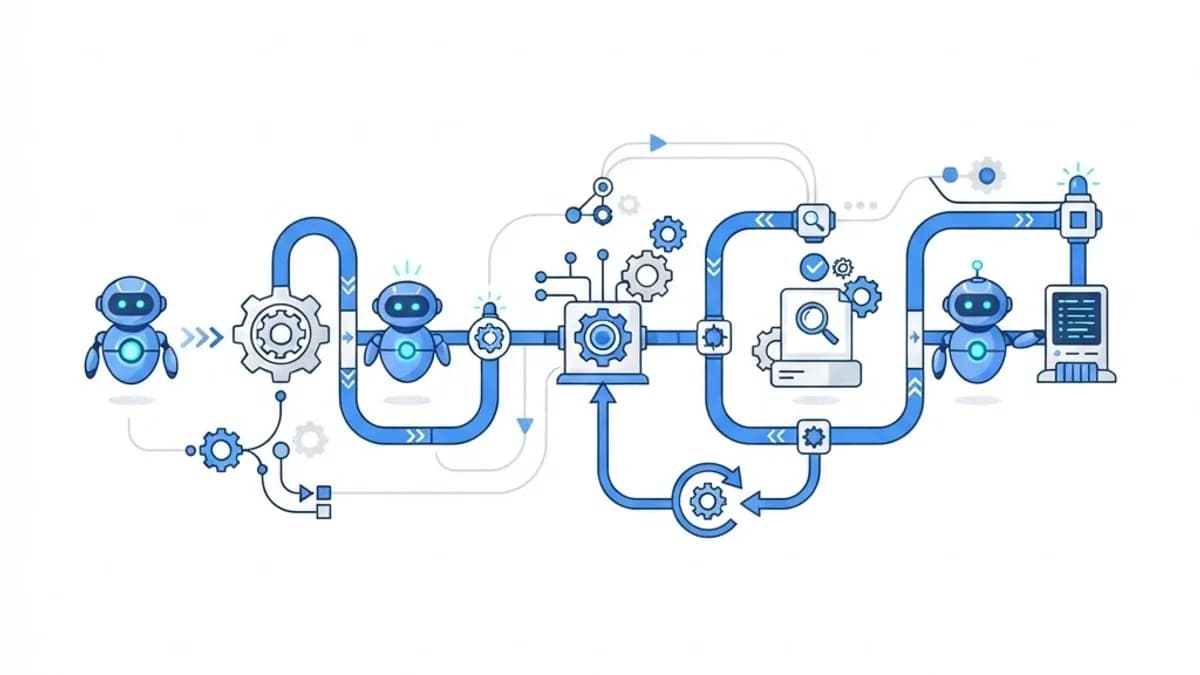
Getting a model to answer a question is easy. Getting it to complete a multi-step job — check inventory, draft an order, get approval, update the ledger — is a different discipline entirely. That is why teams asking how to train autonomous AI agents for task execution usually discover the model was never the hard part.
The hard parts are tool design, memory, error recovery and evaluation. An agent that succeeds 80% of the time sounds impressive until you chain ten steps together and the end-to-end success rate collapses to roughly 10%.
This guide covers the practical approaches that actually work in production, from environment setup through to monitoring a live deployment.
What Is an Autonomous AI Agent?
An autonomous AI agent is a system that takes a goal, plans a sequence of actions, calls external tools or APIs to carry them out, observes the results, and adjusts until the goal is met or it escalates to a human.
The distinguishing feature is the loop. A chatbot produces text; an agent produces state changes in the real world — a booked meeting, a refunded payment, a merged pull request.
Because of that, training an agent means shaping behaviour, not just improving predictions. You are optimising for reliable completion of tasks under uncertainty, with a hard requirement that failures stay recoverable.
Who Uses Autonomous Agents?
Agents earn their keep wherever work is repetitive, rule-heavy and spread across multiple systems.
- Customer support teams triaging, tagging and resolving routine tickets
- Finance and operations teams reconciling records across tools
- Engineering teams automating test generation, triage and documentation
- Sales and marketing teams enriching leads and personalising outreach
- Product teams embedding agents into custom web applications for internal workflows
Key Approaches to Training Agents
1. Supervised Fine-Tuning on Task Traces
The cheapest reliable win is collecting real traces of humans completing the task — every click, query and decision — then fine-tuning on those trajectories. Traces teach ordering and tool selection, which prompting alone struggles to enforce. A few thousand high-quality traces usually beat a hundred thousand noisy ones.
2. Reinforcement Learning From Task Outcomes
Where you can define a verifiable success signal — the invoice reconciled, the test passed, the form validated — outcome-based reinforcement learning is powerful. The critical design work is the reward function. Reward only final success and the agent learns slowly; reward intermediate steps carelessly and it learns to game them.
3. Tool and Environment Design
This is the most underrated lever. Agents fail far more often because a tool returns an ambiguous error than because the model reasoned poorly. Give every tool a narrow purpose, strict schemas, idempotent behaviour and descriptive error messages the model can act on. Solid back-end API engineering improves agent reliability more than any prompt tweak.
4. Memory and Context Management
Long tasks overflow context windows. Use short-term scratchpads for the current plan, retrieval over a vector store for reference knowledge, and a durable record of completed steps so a restarted agent does not repeat side effects.
How to Get Started: A Practical Sequence
Start narrow and instrument everything. The fastest path to a working agent is a small task with a clear definition of done.
- Choose one task with an unambiguous success test and a bounded blast radius.
- Map the task into discrete tool calls, then build those tools with strict input and output schemas.
- Collect 50 to 500 human traces of the task being completed correctly.
- Build an evaluation harness of 100+ scenarios, including edge cases and deliberate failures, before you optimise anything.
- Baseline a prompted agent with tool access and measure end-to-end success rate, not step accuracy.
- Fine-tune on traces, then layer outcome-based reinforcement only if the success signal is genuinely verifiable.
- Add guardrails: spend limits, action allowlists, confirmation gates for irreversible operations.
- Ship behind a human-approval step, log every trajectory, then loosen supervision as measured reliability improves.
Benefits of Well-Trained Agents
When agents are trained properly, the returns compound because each reliable tool becomes reusable across workflows.
- Multi-step work completes without a person shepherding every stage
- Throughput scales without proportional headcount growth
- Processes become documented by necessity, exposing hidden inefficiency
- Consistent execution reduces manual data-entry error
- Staff shift from repetitive coordination to judgement-heavy work
Potential Challenges
Agent projects fail in recognisable ways, and most failures are engineering problems rather than model problems.
- Compounding error across long chains destroying end-to-end reliability
- Unbounded loops burning inference budget with no progress
- Prompt injection through untrusted documents or web content
- Irreversible actions executed on a misread instruction
- Evaluation built after launch, leaving no way to prove improvement
Best Practices and Tips
Treat the agent as a distributed system with a stochastic component, and standard reliability engineering applies.
- Make every tool idempotent so retries cannot double-charge or double-send
- Cap steps, cost and wall-clock time on every run
- Separate planning from execution so plans can be reviewed before actions fire
- Sandbox untrusted input and never let retrieved text change tool permissions
- Protect credentials with least-privilege keys and proper cybersecurity controls
Real-World Example
A mid-sized e-commerce operator wanted to automate supplier restocking. Their first attempt gave one agent broad database access and a vague instruction to keep stock healthy. It ordered duplicates, misread units and had to be switched off within a week.
The rebuild was narrow. Four tools — read stock, read sales velocity, draft a purchase order, submit for approval — each with strict schemas. Two hundred human traces for fine-tuning, a 150-scenario evaluation suite, and a hard rule that no order over a set value could bypass human sign-off. End-to-end success reached 94% within a month, and the agent now drafts most orders while buyers only approve them.
Why It Matters
Autonomous agents shift AI from advice to action, which is where most of the economic value sits. But action carries consequence, and the discipline you apply during training determines whether that consequence is savings or damage.
Teams that invest in tools, evaluation and guardrails first are the ones running agents in production a year later. Teams that chase demos are still debugging.
Frequently Asked Questions
Do I need to train a custom model?
Often not. Start with a strong general model plus well-designed tools and a solid evaluation harness. Fine-tune only when evaluation shows a specific, repeatable failure pattern prompting cannot fix.
How much data is needed to train an agent?
For supervised fine-tuning on task traces, a few hundred to a few thousand clean trajectories is typically enough. Quality and coverage of edge cases matter far more than raw volume.
How do I stop an agent from doing something harmful?
Restrict permissions at the tool layer rather than relying on instructions. Use allowlists, require confirmation for irreversible actions, cap spending, and keep a full audit log of every action taken.
What should I measure?
End-to-end task success rate is the headline. Track cost per completed task, average steps, escalation rate and time to completion alongside it — a highly accurate agent that costs more than a human is not a win.
Conclusion
The best approaches to train autonomous AI agents for task execution are unglamorous: narrow scope, excellent tools, real traces, rigorous evaluation and conservative rollout. The model is a component, not the product.
Start with one task, prove reliability with numbers, then expand. If you want help designing the tools and infrastructure behind a production agent, talk to our AI engineering team.
Enjoyed this article? Share it with others!