
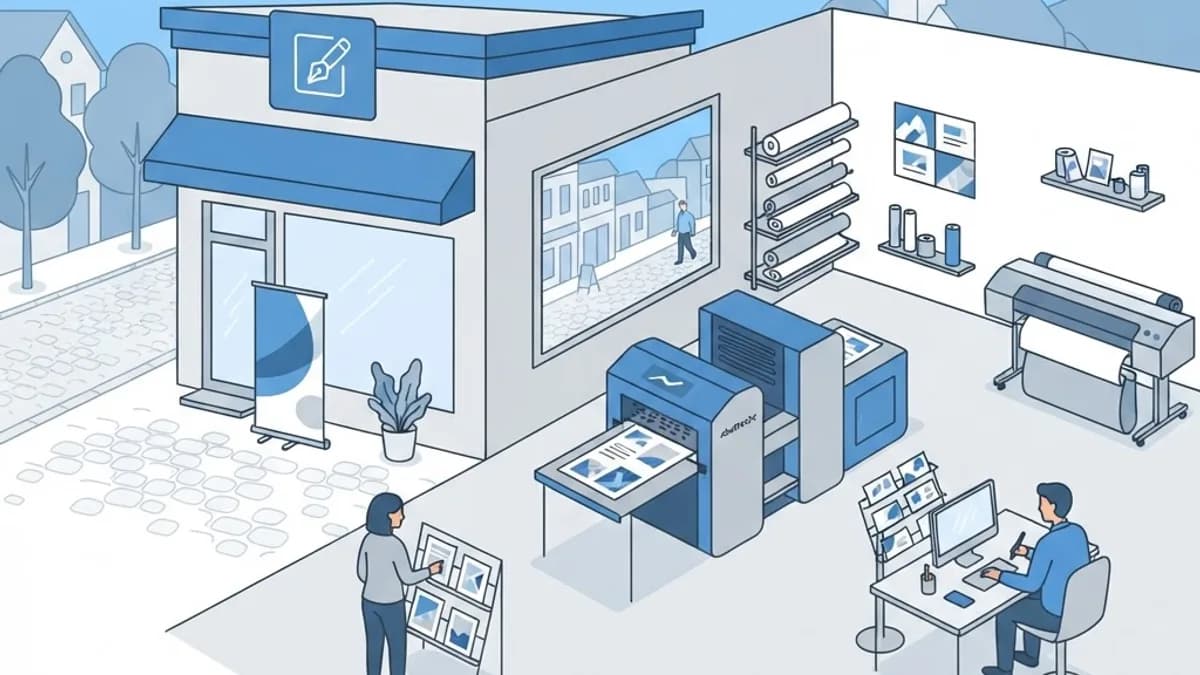
Easton sits at the commercial heart of Maryland's Eastern Shore, and its business mix is unusually design-dependent: galleries, waterfront restaurants, boutiques, marinas, wineries, and festivals that all live or die by how they look in print. That is why graphic design and printing in Easton, MD remains a genuinely local business rather than something everyone ships off to a web portal.
Print is still powerful on the Shore. Menus, event posters, rack cards, signage, and mailers reach tourists and residents who never see your social feed.
This guide covers what local design and print shops actually offer, who uses them, how a project moves from idea to finished piece, and the file-preparation habits that prevent expensive reprints.
What Is Graphic Design and Printing?
Graphic design is the visual planning stage: layout, typography, colour, imagery, and hierarchy assembled to communicate a specific message. Printing is the production stage that turns those files into physical objects on paper, vinyl, fabric, or rigid board.
The two are tightly linked because print imposes rules that screens do not — bleed, trim, resolution, CMYK colour, paper absorption, and finishing all change how a design must be built.
A local shop that handles both usually catches problems a design-only or print-only vendor would miss, such as a logo that turns muddy on uncoated stock or type set too close to the trim line.
Who Uses Design and Printing Services in Easton?
Demand on the Eastern Shore skews toward hospitality, retail, and events:
- Restaurants and cafés needing seasonal menus, specials cards, and outdoor signage.
- Retail shops and galleries ordering price tags, packaging, labels, and window graphics.
- Real estate agents using brochures, yard signs, and neighbourhood mailers.
- Event organisers and nonprofits producing posters, programmes, banners, and sponsor boards.
- Trades and marine services requiring vehicle lettering, invoices, and durable outdoor decals.
Key Services You Can Expect
Brand Identity and Logo Design
A usable identity includes a primary logo, simplified marks for small sizes, a colour palette in both print and screen values, and type rules. Because identity work shapes every later piece, it is worth understanding why graphic design is important for any business before treating a logo as a one-hour purchase.
Print Collateral and Marketing Materials
Business cards, rack cards, menus, brochures, postcards, letterhead, and mailers. Offset printing suits large runs; digital printing wins for short runs and fast turnaround with seasonal changes.
Large Format Signage and Banners
Yard signs, storefront graphics, retractable banners, and vehicle lettering. These require vector artwork and outdoor-rated materials, since sun and salt air on the Shore degrade cheap substrates quickly.
Promotional and Specialty Printing
Apparel, tote bags, stickers, mugs, and packaging. Each process — screen printing, embroidery, direct-to-garment — has its own colour and detail limits that affect how the design is built. Designers who work across these formats build broad career options, as outlined in this look at what jobs you can get with a graphic design major.
How a Project Works, Step by Step
Knowing the sequence helps you budget time as well as money:
- Brief and quote. Define the piece, quantity, size, paper, finish, and deadline.
- Asset gathering. Supply logos in vector format, high-resolution photos, and final text.
- Design concepts. Review one or two directions rather than endless variations.
- Revisions. Consolidate all feedback into one round to control cost.
- Proofing. Approve a digital proof, and a hard-copy proof for colour-critical jobs.
- Prepress. The shop checks bleed, resolution, fonts, and colour conversion.
- Printing and finishing — cutting, folding, scoring, laminating, or binding.
- Delivery or pickup, plus archiving of final files for reorders.
Benefits of Using a Local Design and Print Partner
Online printers compete on price, but local partners win on certainty.
- Physical proofs and paper samples you can hold before committing to a run.
- Faster turnaround for last-minute event and seasonal work.
- Local market knowledge of what draws attention during festivals and tourist season.
- Accountability — a reprint conversation happens in person, not through a support ticket.
- Consistency across years of reorders because your files stay on file.
Potential Challenges
Most print problems trace back to a handful of avoidable issues:
- Low-resolution artwork pulled from a website, which looks soft or pixelated in print.
- Colour shift between a bright screen and CMYK ink, especially with vivid blues and oranges.
- Missing bleed, producing white slivers along trimmed edges.
- Rushed deadlines that force skipped proofs and increase the chance of a costly error.
Best Practices and Tips
Follow these and your projects will run smoother and cheaper:
- Keep master logo files in vector format so any size, from a sticker to a banner, is possible.
- Finalise text before design begins; content changes after layout cost the most.
- Order a small digital run to test a design before committing to thousands of copies.
- Print seasonal materials in batches to save on setup fees across the year.
Real-World Example
Imagine a waterfront seafood restaurant near downtown Easton that changes its menu monthly with the catch. Originally it printed one-piece laminated menus, which meant a full reprint for every change and frequent handwritten corrections that looked unprofessional.
A local design and print partner restructured the system: a durable printed cover carrying the branding and story, with a lightweight insert holding daily specials that staff can reprint in-house. The designer also built a matching poster template and sidewalk sign for events.
The result was lower annual print spend, a cleaner presentation, and a brand that finally looked consistent across menu, signage, and social posts — all because the design was planned around how the business actually operates.
Why It Matters for Eastern Shore Businesses
Easton's market runs on foot traffic, word of mouth, and seasonal visitors making fast decisions. A crisp sign or a well-designed menu is often the only sales pitch a passing tourist ever receives.
Print also signals permanence. In a town where many businesses are family owned and decades old, materials that look considered and consistent quietly communicate stability — something a hastily made template never does.
Frequently Asked Questions
How much does graphic design and printing cost in Easton, MD?
Design is usually billed hourly or per project, while printing is priced by quantity, size, paper, and finishing. Per-unit cost drops sharply with volume, so quantity is often the biggest cost lever.
What file format should I supply?
Send vector files such as AI, EPS, SVG, or PDF for logos and print-ready PDFs with bleed for layouts. Photos should be at least 300 dpi at final print size.
How long does printing take?
Standard digital jobs often finish within a few business days after proof approval. Offset runs, large format signage, and specialty finishing take longer, so plan two weeks for major projects.
Should I hire a designer if I already have templates?
Templates work for routine internal documents. For anything customers judge you by — signage, menus, packaging — a designer prevents the small alignment, spacing, and colour issues that make a business look amateur.
Conclusion
Graphic design and printing in Easton, MD works best when treated as one connected process: design built for the press, files prepared correctly, and proofs approved before the run. That combination avoids reprints and produces materials that hold up in a tourist-facing market.
Start with your most visible piece — signage or menus — and rebuild it properly. For a clearer sense of the return on that spend, read why graphic design is important for any business before you approve your next print order.
Enjoyed this article? Share it with others!