
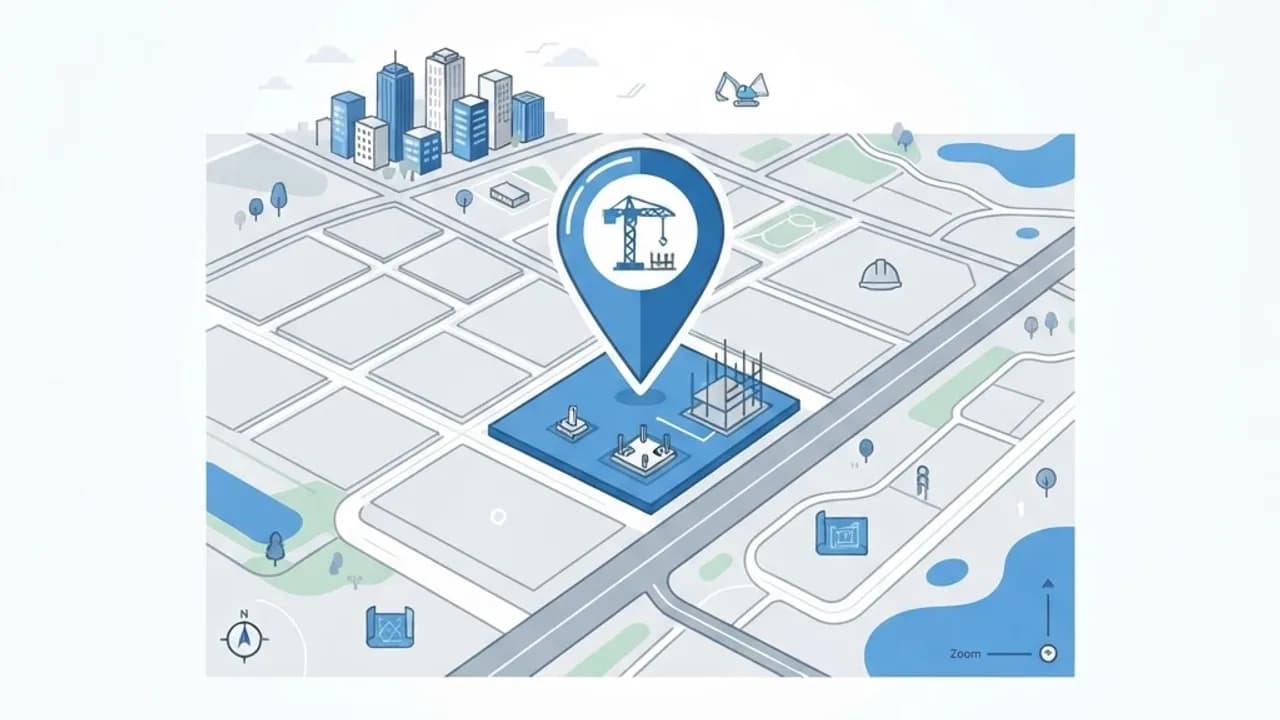
Deciding how to choose a construction site location is the highest-leverage decision in any project. Design mistakes can be redrawn and budgets can be renegotiated, but a badly chosen site follows a development for its entire life.
Two parcels can look identical from the road and differ by hundreds of thousands in servicing costs, permit timelines and resale value.
This guide breaks down the criteria experienced developers actually score sites against — legal, physical, logistical and financial — so you can compare options objectively instead of emotionally.
What Is Construction Site Selection?
Site selection is the structured evaluation of candidate parcels against the requirements of a specific project. It combines due diligence on title and zoning with physical investigation of soil, topography and drainage, plus commercial analysis of access, demand and total development cost.
The output is not simply a yes or no. It is a ranked comparison showing which site delivers the intended building at the lowest risk-adjusted cost.
A site is only suitable relative to its intended use — a parcel that fails as a warehouse may be an excellent location for apartments, and the reverse is just as true.
Who Uses Site Selection Analysis?
Site selection is a shared discipline. Each participant weights the criteria differently, which is why a written scoring framework matters.
- Property developers comparing acquisition targets
- Commercial and industrial businesses planning facilities
- Homeowners buying land for a custom build
- Public agencies siting schools, clinics and infrastructure
- Lenders and investors underwriting development risk
Key Factors in Choosing a Construction Site
Zoning, Title and Legal Constraints
Confirm the permitted use, height limits, setbacks, floor area ratio and parking requirements before anything else. Check the title for easements, rights of way, covenants and heritage overlays that can quietly remove a third of your buildable area.
Soil, Topography and Drainage
Bearing capacity, expansive clay, rock, fill history and water table depth all drive foundation cost. Steep slopes add retaining walls and cut-and-fill expense, while low-lying land may sit in a flood zone that raises insurance permanently.
Utilities and Servicing Capacity
Ask not only whether water, sewer, power, gas and fibre are nearby, but whether the network has spare capacity. An upgrade to a distribution transformer or a sewer extension can dwarf the land price difference between two parcels.
Access, Transport and Surroundings
Consider road frontage, truck turning radii, construction laydown space, public transport, and the character of neighbouring uses. Adjacency shapes both build logistics and long-term value.
How to Evaluate a Site: Step by Step
Work through candidates in a fixed order so that cheap desktop checks eliminate poor options before you spend money on consultants.
- Write a clear project brief: intended use, floor area, parking, budget and timeline.
- Screen candidate parcels against zoning maps and permitted-use tables.
- Pull title documents and identify easements, covenants and encumbrances.
- Check flood, bushfire, contamination and heritage overlays on public mapping tools.
- Walk the site in person, ideally after heavy rain, and photograph drainage behaviour.
- Commission a survey and a preliminary geotechnical investigation on shortlisted sites.
- Request written servicing capacity confirmations from each utility authority.
- Model total development cost, including servicing, contributions and holding costs.
- Score sites on a weighted matrix and negotiate with due-diligence conditions attached.
Benefits of Rigorous Site Selection
The upfront cost of proper due diligence is small compared with the surprises it prevents.
- Fewer costly redesigns caused by discovering constraints after purchase
- Realistic foundation and servicing budgets from day one
- Faster approvals because the proposal already fits the planning framework
- Stronger financing case, since lenders reward documented diligence
- Better long-term asset value through access, amenity and demand alignment
Potential Challenges
Site selection is decision-making under incomplete information, and a few traps recur constantly.
- Cheap land that carries expensive servicing or remediation obligations
- Zoning changes or development contribution levies announced mid-process
- Hidden contamination on former industrial or agricultural parcels
- Community opposition that extends approval timelines unpredictably
Best Practices and Tips
Treat site selection as an evidence-gathering exercise, not a hunt for a bargain.
- Always make offers conditional on geotechnical, survey and planning due diligence.
- Use a weighted scoring matrix so emotion does not outrank data.
- Speak to the local planning officer early — informal feedback is free and revealing.
- Budget a contingency specifically for site-condition unknowns, separate from build contingency.
Real-World Example
A logistics operator compared two industrial parcels priced within five percent of each other. The cheaper site had better highway frontage, but a servicing enquiry revealed that a three-phase power upgrade and a sewer main extension would add substantial cost and roughly nine months of lead time.
The slightly dearer parcel already had capacity at the boundary. The operator bought it, opened months earlier, and reinvested part of the saved timeline into custom web application development for internal fleet scheduling.
Why Site Location Matters
Location determines the ceiling on a project's performance. A superbly constructed building on a poorly serviced, hard-to-reach parcel will always underperform a modest building in the right place.
It also shapes how you market the finished asset. Developers who understand their catchment translate that into leasing and sales campaigns supported by fast Next.js web development and clear visual assets from a professional logo design service.
Frequently Asked Questions
What is the most important factor when choosing a construction site?
Legal usability comes first. If zoning, easements or overlays prevent the building you intend, no other advantage matters. After that, soil conditions and servicing capacity usually have the largest cost impact.
Should I buy land before or after due diligence?
Always structure the purchase so due diligence happens before settlement. Conditional contracts with defined investigation periods let you withdraw or renegotiate if geotechnical or planning findings change the economics.
How much does site due diligence cost?
Preliminary desktop checks are inexpensive. A survey plus preliminary geotechnical investigation typically costs a small fraction of one percent of project value — far less than discovering rock or contamination after purchase.
Can a bad site be fixed?
Physical problems such as poor soil or drainage can usually be engineered around at a cost. Legal and locational problems — wrong zoning, no access, weak demand — are far harder to solve and are the ones to avoid.
Conclusion
Choosing a construction site location well means testing every parcel against the same evidence-based checklist: legal use, ground conditions, servicing capacity, access and total cost. The site that scores highest on that matrix, not the one with the lowest sticker price, is the one that protects your project.
Do the diligence before you sign, and when it is time to bring the finished development to market, consider a targeted digital marketing strategy to reach the buyers or tenants your location was chosen for.
Enjoyed this article? Share it with others!