
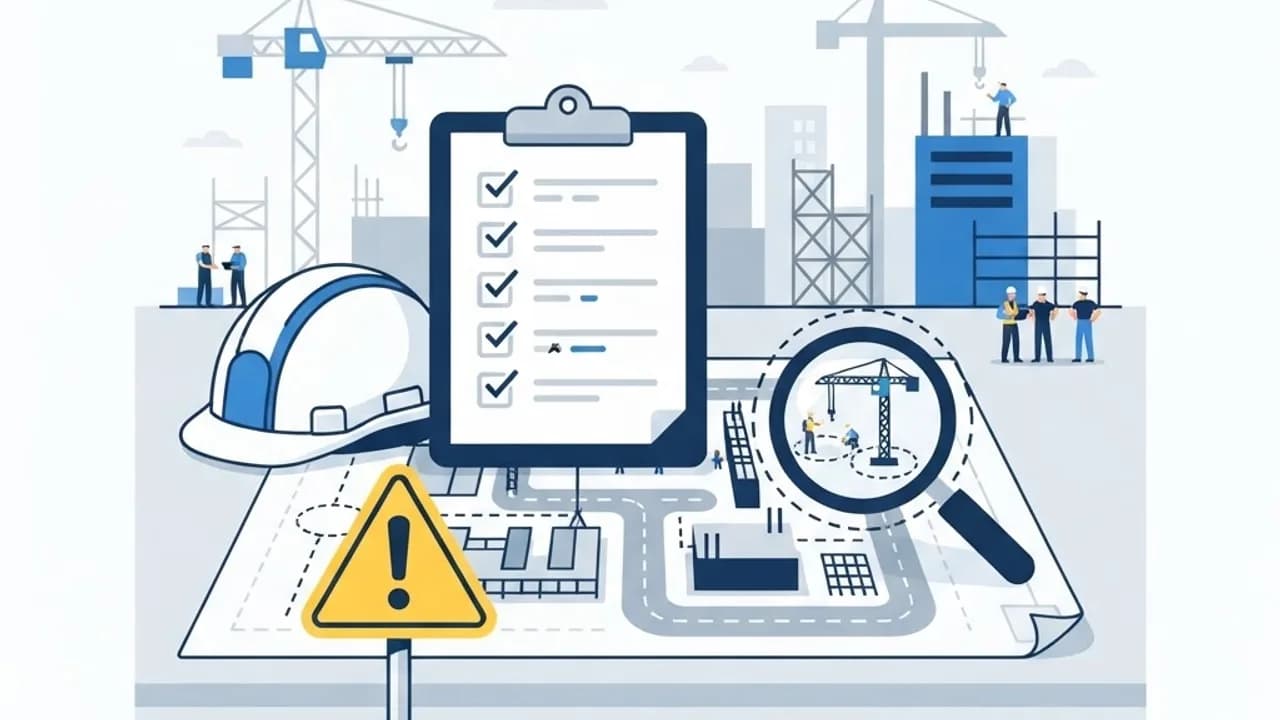
A construction site risk assessment is the document that turns safety from an intention into a system. It identifies what can hurt people on your site, how likely that is, and exactly what you are doing about it — in writing, before work starts.
Regulators expect one. Insurers ask for one. More importantly, crews who work under a live, well-communicated assessment simply get hurt less often.
This guide explains how to build a risk assessment that actually changes behaviour on site, rather than a template that sits unread in a folder.
What Is a Construction Site Risk Assessment?
A construction site risk assessment is a systematic review of a site's activities to identify hazards, evaluate the likelihood and severity of harm, and record the control measures that reduce that risk to an acceptable level.
It covers physical hazards such as falls, excavations and plant movement, plus health hazards such as silica dust, noise, vibration and manual handling. Environmental and public-safety risks belong in it too.
The assessment is a living control document, not a compliance formality — it must be updated whenever the work, the site layout or the workforce changes.
Who Needs to Carry Out Risk Assessments?
Legal duty usually sits with the employer or principal contractor, but the practical work involves many people.
- Principal contractors and site managers with overall site control
- Health and safety officers and appointed competent persons
- Subcontractors assessing their own specific trade activities
- Project clients verifying that duty holders are managing risk
- Supervisors and crew leaders delivering daily briefings
Key Features of an Effective Risk Assessment
Task-Specific Hazard Identification
Generic lists miss real dangers. Break the project into actual activities — trench excavation, steel erection, roof edge work, concrete pumping — and identify hazards for each one as it will be performed on this site.
A Consistent Risk Rating Method
Score each hazard by likelihood and severity, usually on a matrix, to produce a risk rating. Consistent scoring lets you prioritise fairly and prove why one hazard received more resources than another.
Controls Ordered by the Hierarchy
Eliminate the hazard first, then substitute, then engineer it out, then apply administrative controls, and only then rely on PPE. A plan that jumps straight to hard hats and gloves has skipped the effective steps.
Clear Ownership and Review Dates
Every control needs a named responsible person and a deadline. Every assessment needs a scheduled review, plus triggers for immediate revision after an incident or design change.
How to Conduct a Risk Assessment Step by Step
The sequence below produces a defensible document and, more importantly, a safer site.
- Define the scope: which site, which phase, which activities are covered.
- Walk the site and observe conditions, access routes, neighbours and existing services.
- List hazards activity by activity, consulting the workers who perform the task.
- Identify who is at risk, including subcontractors, visitors and members of the public.
- Score likelihood and severity for each hazard to produce a risk rating.
- Select controls using the hierarchy of control, starting with elimination.
- Assign a responsible person and completion date to every control measure.
- Re-score residual risk after controls to confirm it is acceptable.
- Record the assessment, then brief it to everyone on site in plain language.
- Monitor, inspect and review at set intervals and after any significant change.
Benefits of a Proper Risk Assessment
Well-run assessments deliver returns far beyond avoiding a fine.
- Fewer injuries, near misses and lost-time incidents
- Demonstrable legal compliance if an inspector or investigator arrives
- Lower insurance premiums and fewer claims over time
- Less downtime, since incidents and stop-work orders disrupt schedules badly
- Stronger tender submissions, as clients increasingly score safety systems
Potential Challenges
Risk assessment fails in predictable ways, and knowing them helps you avoid them.
- Copy-paste templates that do not reflect the actual site or task
- Assessments written by an office that never visits the work face
- Language barriers that leave parts of the workforce uninformed
- Documents that are never revisited as the project changes phase
Best Practices and Tips
The most effective assessments are short, specific and genuinely used.
- Involve the people doing the work — they know the shortcuts and the near misses.
- Use photographs and simple diagrams so controls are unmistakable.
- Keep the document readable; ten focused pages beat sixty ignored ones.
- Log near misses and feed them straight back into the next revision.
Real-World Example
On a four-storey refurbishment, the initial assessment rated fall-from-height as the top risk and specified harnesses. During a toolbox review, the crew pointed out that most exposure came from repeatedly leaning through window openings to receive materials.
Instead of relying on PPE, the team installed a loading platform and temporary edge protection, eliminating the reach entirely. Incident reports for that activity dropped to zero, and the contractor turned the documented improvement into a case study for its website, produced with help from a professional content writing team.
Why Risk Assessment Matters
Construction remains one of the most hazardous industries, and almost every serious incident traces back to a hazard that was known but not controlled. A risk assessment is the mechanism that converts knowledge into action.
It matters commercially as well. Safety performance is now a tender criterion, and firms that present their systems clearly — often through polished infographic design and a credible site built with expert front-end web development — win more of the work they bid for.
Frequently Asked Questions
How often should a construction risk assessment be reviewed?
Review at least at each project phase change, and immediately after any incident, near miss, new plant introduction, design change or significant weather event. Many sites also run daily task-level briefings alongside the master assessment.
What is the difference between a risk assessment and a method statement?
The risk assessment identifies hazards and required controls. The method statement describes, step by step, how the task will be carried out safely using those controls. They are usually issued together.
Who is legally responsible for the risk assessment?
Typically the employer or principal contractor holds the duty, with subcontractors responsible for assessing their own activities. The assessment must be prepared by someone competent in both the work and the hazards involved.
What are the five steps of risk assessment?
Identify the hazards, decide who might be harmed and how, evaluate the risks and decide on controls, record your findings and implement them, then review and update the assessment.
Conclusion
A construction site risk assessment works when it is specific to the site, built with the crew, ordered by the hierarchy of control and reviewed as conditions change. Treat it as an operational tool and it will quietly prevent the incidents you never have to report.
Start with one activity, assess it properly, and build outward. If you also need to communicate your safety credentials to clients, consider clear graphic design support to make your systems easy to understand at a glance.
Enjoyed this article? Share it with others!