
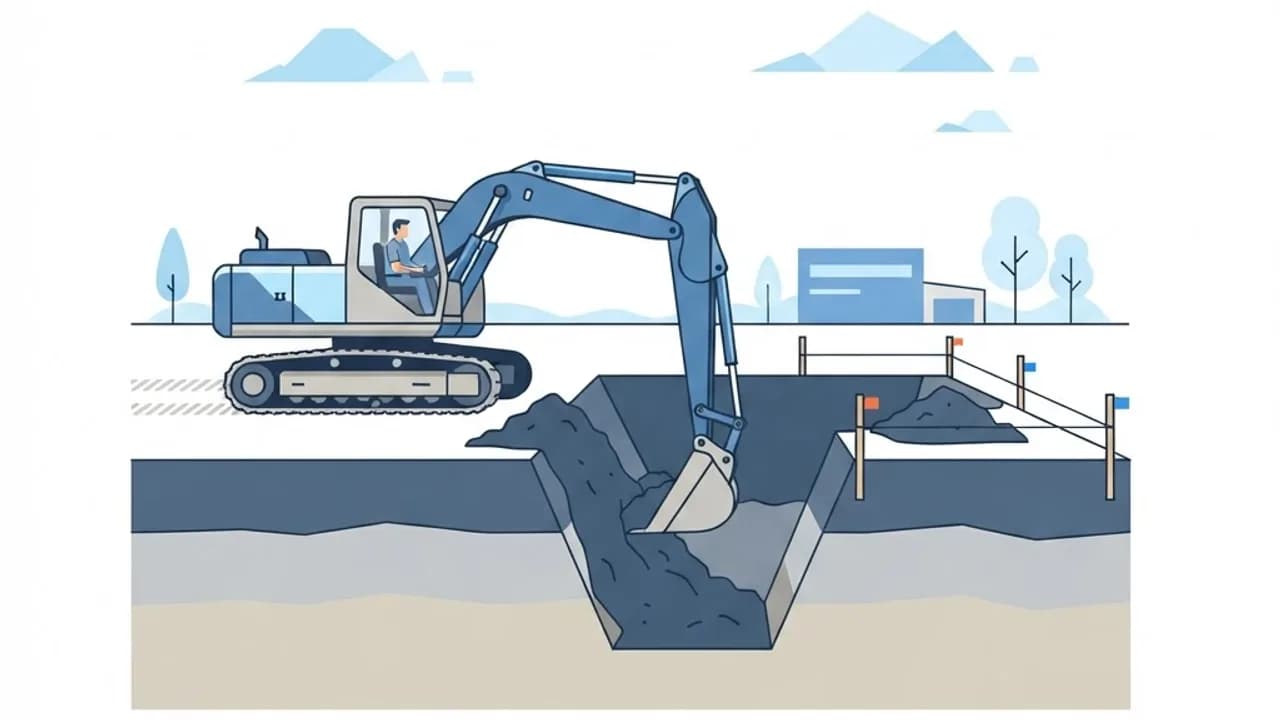
Knowing how to excavate a construction site properly is the difference between a foundation that lasts decades and a project buried in change orders. Excavation looks simple from the street — a machine digs a hole — but underneath that hole sit utilities, groundwater, unstable soils and strict safety rules.
Most excavation failures are not equipment failures. They are planning failures: a missing soil report, an unmarked gas line, a trench wall that was never shored.
This guide walks through the real sequence crews follow, from survey and permits through backfill, so you can plan the dig with confidence instead of hope.
What Is Excavation in Construction?
Excavation is the controlled removal of soil, rock and other material to create space for foundations, basements, footings, utility trenches, pools or roadways. It follows site clearing and grading, and it precedes any structural work.
The goal is not just to make a hole. The goal is to reach a stable, load-bearing bearing surface at the correct depth and elevation, without collapsing the sides or flooding the base.
Excavation is a geotechnical operation first and an earthmoving operation second — the soil report dictates the method, the slope angles and the support system you will need.
Who Needs to Understand Site Excavation?
Excavation planning touches almost every role on a build, not only the machine operator. Anyone who signs off on schedule or budget should understand the basics.
- General contractors sequencing foundation and utility work
- Property developers and owner-builders reviewing bids and dig depths
- Site supervisors and safety officers responsible for trench compliance
- Civil engineers and surveyors setting cut-and-fill levels
- Landscapers and pool installers handling smaller residential digs
Key Features of a Well-Planned Excavation
Accurate Geotechnical Data
Borehole logs tell you soil classification, water table depth and bearing capacity. Type A cohesive clay behaves nothing like Type C sand, and the classification directly determines legal slope ratios and whether a trench box is required.
Verified Utility Locates
Before a bucket touches ground, buried services must be located and marked, then confirmed by hand digging or vacuum excavation at crossings. Striking a gas main or fiber trunk is the fastest way to shut a site down.
A Real Support and Drainage Strategy
Benching, sloping, shoring or shielding — one must be chosen and documented for any excavation deep enough to endanger workers. Pair it with a dewatering plan if groundwater is anywhere near your target depth.
Spoil and Haul Management
Every cubic yard removed has to go somewhere. Planning stockpile locations, reuse for backfill and off-site haul routes early keeps the site workable and the trucking bill predictable.
How to Excavate a Construction Site Step by Step
The order below is deliberate. Skipping ahead is where projects lose money, because rework in earth is far more expensive than rework on paper.
- Commission a geotechnical survey and review soil classification, water table and bearing capacity.
- Secure excavation, grading and stormwater permits required by your local authority.
- Request utility locates, mark all services, and expose crossings by hand or vacuum.
- Clear vegetation, strip and stockpile topsoil separately for later reuse.
- Set survey control points, benchmarks and batter boards so cut depths are verifiable.
- Install perimeter erosion and sediment controls before breaking ground.
- Excavate in controlled lifts, cutting to design elevation and never below it.
- Install shoring, trench boxes or benching as depth increases; keep spoil back from the edge.
- Dewater with sump pumps or well points if water enters the excavation.
- Have the base inspected and proof-rolled, then compact and place footings or bedding.
- Backfill in compacted layers and confirm density testing before finishing grade.
Benefits of Doing Excavation Right
Disciplined excavation pays for itself long before the building is enclosed. It removes the guesswork that inflates contingency budgets.
- Stable, uniform bearing surface that prevents differential settlement and foundation cracking
- Fewer utility strikes, which means fewer emergency shutdowns and fines
- Safer trenches and measurable compliance with excavation regulations
- Accurate cut-and-fill balance that reduces import and haul-away costs
- A predictable schedule for concrete, plumbing and electrical rough-in
Potential Challenges During Excavation
Even a well-planned dig meets surprises. The advantage of planning is that surprises become manageable instead of catastrophic.
- Groundwater rising faster than pumps can clear it, stalling footing work
- Rock or unexpected fill requiring hammering, blasting or over-excavation
- Contaminated soil that triggers testing, disposal permits and delay
- Adjacent structures needing underpinning or monitoring to avoid movement
- Wet-weather windows that turn the base into unworkable mud
Best Practices and Tips
These habits separate crews that finish on time from crews that spend the season fixing the hole they dug.
- Never allow anyone into an unprotected excavation deeper than roughly five feet.
- Keep spoil piles, plant and materials at least two feet back from every edge.
- Inspect the excavation daily, after rain and after any vibration or loading change.
- Cut to grade, not past it — over-excavation must be replaced with engineered fill, not loose soil.
- Photograph and log every stage; that documentation is your best defence in a dispute.
Real-World Example
A contractor building a three-storey mixed-use block on an infill lot budgeted two weeks for basement excavation. The geotechnical report noted a perched water table at nine feet, so the team pre-ordered well-point dewatering rather than waiting for water to appear. They also vacuum-excavated over an old clay sewer line the locate map showed as approximate.
The line turned out to be three feet off the marked position. Because it was exposed by hand instead of found by a bucket, the crew rerouted around it in an afternoon. The excavation finished a day ahead of schedule, and the developer used the saved time to launch the project's marketing site — a set of custom web development services built around the leasing enquiry form.
Why Excavation Planning Matters
Excavation is the one phase you cannot easily revisit. Once concrete is poured on a poorly prepared base, every correction involves demolition. That is why the planning documents — soil reports, locate tickets, shoring designs, inspection logs — carry as much weight as the machinery.
It also matters commercially. Construction firms that can explain their excavation process clearly win more bids, which is why many pair site expertise with a strong digital presence built through professional website design and supported by ongoing website maintenance and support.
Frequently Asked Questions
How deep should a construction site excavation be?
Depth is set by the structural design and the geotechnical report, not by rule of thumb. Footings must reach undisturbed soil with adequate bearing capacity and sit below the local frost line, which can range from a few inches to several feet depending on climate.
Do I need a permit to excavate?
In most jurisdictions yes, especially for depths beyond a shallow threshold, work near public right-of-way, or any dig that alters drainage. You will typically need an excavation or grading permit plus a stormwater control plan.
What equipment is used for site excavation?
Hydraulic excavators handle bulk digging, backhoes and mini-excavators suit confined trenching, bulldozers push and grade, and dump trucks haul spoil. Compactors, laser levels and dewatering pumps complete the typical spread.
How long does construction site excavation take?
A residential footing dig may take two to five days. A commercial basement on a constrained urban lot can run several weeks once shoring, dewatering and haul-off cycles are factored in.
Conclusion
Learning how to excavate a construction site is really about sequence and evidence: test the ground, locate the services, protect the walls, control the water, then dig to a verified elevation. Do those five things in order and excavation becomes the most predictable phase of the build.
Plan the dig on paper before you plan it with a bucket, and if your construction business needs to communicate that expertise online, explore results-driven digital marketing support to turn technical credibility into inbound work.
Enjoyed this article? Share it with others!