
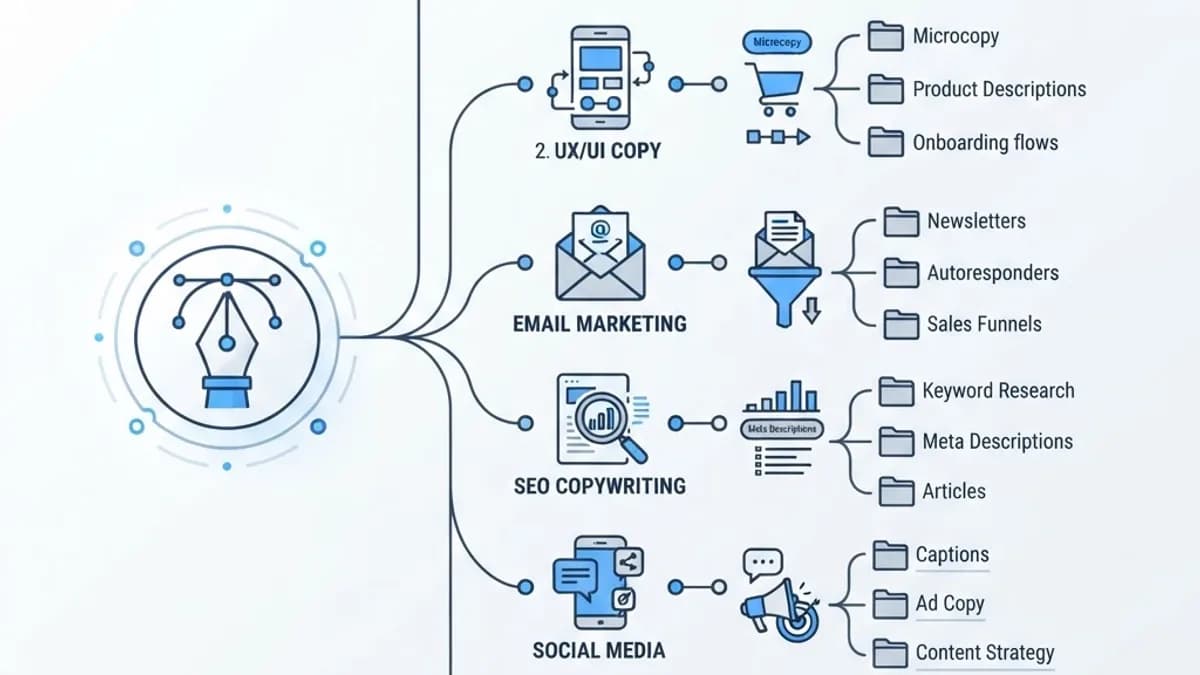
Every writer eventually hits the same wall: plenty of work, not enough pay. The usual cause is not talent but positioning. Choosing among the many copywriting niches and content writing specialties is what turns a generalist competing on price into a specialist clients seek out.
A niche is the industry you serve, such as fintech or dentistry. A specialty is the type of writing you do, such as email sequences or technical documentation. Combine one of each and you have a positioning statement that sells itself.
This guide maps the major niches and specialties, explains which pay best and why, and gives you a practical path to choose, test, and commit without gambling your income.
What Are Copywriting Niches and Content Writing Specialties?
A copywriting niche is a subject-matter focus. It gives you vocabulary, buyer insight, and pattern recognition that a generalist lacks. After ten SaaS onboarding projects you know exactly where trial users drop off.
A content writing specialty is a format and function focus — long-form SEO articles, product descriptions, white papers, case studies, ad copy, UX microcopy, or scripts. Each has its own structure, research demands, and success metric.
The most valuable positioning stacks them: "email copywriter for subscription ecommerce" beats "freelance writer" every time, because the client can immediately tell whether you are the right hire.
Who Should Choose a Niche?
Specialising helps almost everyone who writes for money, but especially:
- Freelancers stuck at low rates who need a reason to charge more than the market average.
- Career changers with prior industry experience in finance, healthcare, law, or engineering.
- Agency writers wanting to become the internal authority on a vertical.
- In-house writers aiming to grow into content strategy or product marketing.
- New writers who want a focused portfolio instead of ten unrelated samples.
Key Niches and Specialties Worth Knowing
SEO Content Writing
The steadiest demand in the industry. It rewards writers who understand search intent, structure, and internal linking as much as prose. If this path appeals to you, the practical roadmap in how to become an SEO content writer covers the skills clients actually test for.
Conversion and Direct Response Copywriting
Landing pages, sales pages, and ads where results are measured in percentages. Rates are high because the work is tied directly to revenue, and strong practitioners obsess over headlines, offers, and calls to action. Studying proven patterns such as these 50 powerful call-to-action phrases shortens the learning curve considerably.
Technical and B2B SaaS Writing
Documentation, developer tutorials, and feature explanations for products with real complexity. Fewer writers can do it well, so competition is thin and budgets are healthy.
Regulated Industries: Health, Finance, and Legal
These niches pay a premium because accuracy carries legal weight. Expect compliance review cycles, citation requirements, and slower approvals — offset by long retainers and repeat work.
How to Choose and Enter a Niche
Do not agonise for months. Test deliberately and let evidence decide:
- Inventory your background. List industries you have worked in, studied, or genuinely follow.
- Check the money. Confirm the niche has businesses with recurring marketing budgets, not one-off projects.
- Shortlist three combinations of niche plus specialty that overlap your interest and market demand.
- Create two spec samples per option — a real page or article written as if for a target client.
- Pitch narrowly for sixty days, using language specific to that niche's pain points.
- Track response rates, project value, and how much you enjoyed the work.
- Commit to the winner and rebuild your site, portfolio, and profiles around it.
- Deepen expertise by reading the niche's trade publications and joining its communities.
Benefits of Specialising
Focus compounds in ways generalist work never does.
- Higher rates, because expertise reduces the client's risk and revision cycles.
- Faster delivery, since research overlaps between projects in the same field.
- Easier marketing — referrals travel quickly inside tight industries.
- Stronger portfolio signal, where five related samples outweigh twenty scattered ones.
- Better client fit, meaning fewer difficult projects and more long-term retainers.
Potential Challenges
Specialising has real trade-offs you should plan for:
- Market concentration risk if your whole income depends on one volatile sector.
- Subject fatigue after writing about the same product category for two years.
- Steep initial learning curve in technical or regulated fields.
- Fear of turning work away, which keeps many writers accidentally generalist forever.
Best Practices and Tips
These moves accelerate the transition from generalist to sought-after specialist:
- Pick a niche adjacent to work you already have, so you can transition without an income gap.
- Publish one detailed piece a month demonstrating niche expertise, not general writing advice.
- Learn the niche's metrics — activation rate, cost per lead, patient acquisition cost — and speak in them.
- Keep one flexible secondary specialty so a slow quarter in one area does not empty your calendar.
Real-World Example
Consider a writer with four years of retail pharmacy experience who was taking any project available: gym blogs, real estate listings, gadget reviews. Rates were low and pitching felt endless.
She narrowed to one combination: patient-education content for telehealth and pharmacy technology companies. She wrote two spec pieces — a medication adherence guide and a plain-language explainer of prescription delivery — and rewrote her portfolio around them.
Because she already understood formularies, insurance friction, and patient anxiety, her pitches read like an insider rather than an applicant. Within six months her project rate roughly doubled and two clients moved her onto monthly retainers. Nothing about her writing craft changed dramatically; her positioning did.
Why Niche Selection Matters More Than Ever
Generic, easily produced content has flooded the internet, and both readers and search algorithms now reward demonstrable experience. A writer who understands an industry's constraints produces the specific, credible detail that generic output cannot fake.
That is the practical meaning of expertise signals in modern search: firsthand knowledge, accurate specifics, and useful nuance. Niche writers supply all three by default, which is precisely why their work keeps getting hired.
Frequently Asked Questions
Which copywriting niches pay the most?
Typically technical B2B and SaaS, finance, healthcare, and direct-response conversion work. High pay follows either technical difficulty, regulatory risk, or a direct line to revenue.
Can I have more than one niche?
Two related niches is manageable and reduces risk. Beyond that you dilute the positioning advantage and drift back toward being a generalist.
What if I choose the wrong niche?
You adjust. Most of what you build — research process, interviewing skill, structural instincts, client management — transfers to a new niche in weeks, not years.
Do I need industry credentials to write in a niche?
Rarely. Clients want writers who can interview experts accurately, cite reliable sources, and explain complex ideas clearly. Credentials help in medical and legal work but are not usually required.
Conclusion
Choosing among copywriting niches and content writing specialties is the highest-leverage decision a writer can make. Pair an industry you understand with a format you enjoy, prove it with two strong samples, and pitch narrowly until the market answers.
Pick your combination this week and build the samples. If search-driven work is your direction, start with this guide to becoming an SEO content writer and build your first niche portfolio piece around it.
Enjoyed this article? Share it with others!