
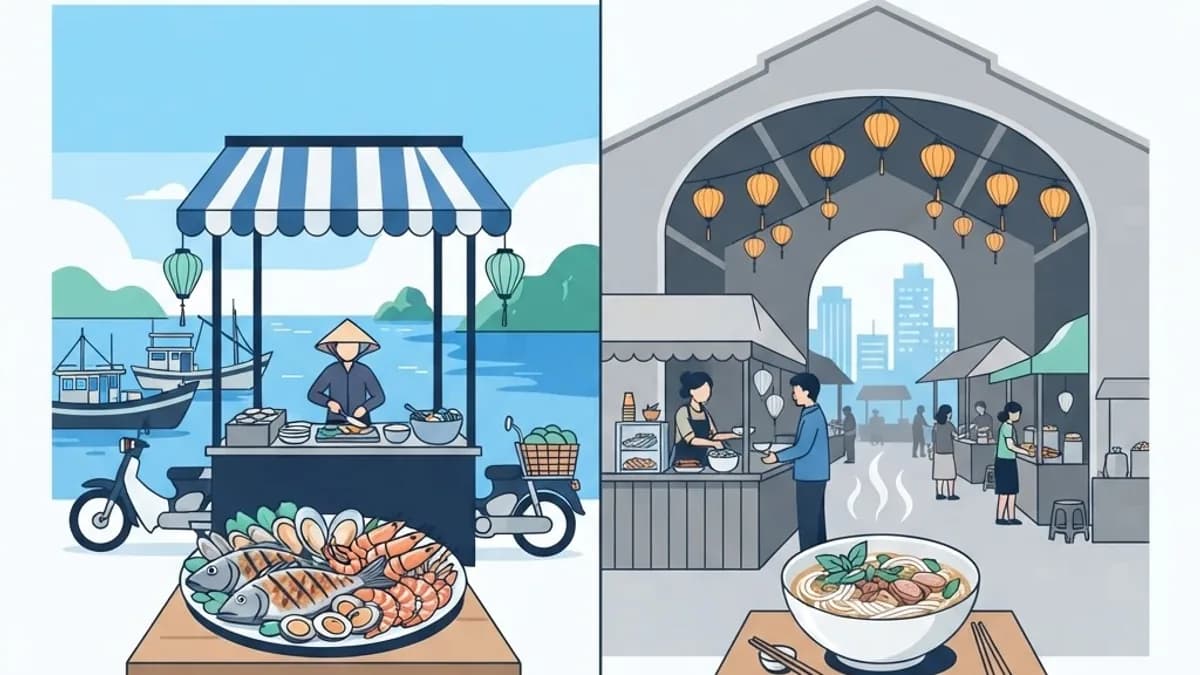
If you are deciding between Son Tra or Han Market for food in Da Nang, you are choosing between two genuinely different eating experiences rather than two versions of the same thing. Both are excellent. They simply serve different appetites and different kinds of travel days.
Han Market sits in the heart of the city on the west bank of the Han River, a dense covered market where the food is fast, cheap, and deeply local. Son Tra is the mountainous peninsula northeast of the city, where the draw is fresh seafood eaten near the water it came from.
This comparison covers what each offers, what things cost, when to go, and how to decide based on what you actually want from the meal.
What Are Son Tra and Han Market?
Han Market, or Chợ Hàn, is one of Da Nang's oldest and busiest traditional markets. The ground floor is dominated by fresh produce, meat, seafood, and dried goods, while food stalls serve prepared dishes to a mostly local crowd throughout the day.
Son Tra Peninsula is a very different setting. It is a forested headland with beaches, viewpoints, the Linh Ung Pagoda, and a cluster of seafood restaurants concentrated around Tho Quang and the nearby coastal road.
The essential difference is this: Han Market is about variety and speed, while Son Tra is about freshness and setting. One is a place to graze through six small dishes in an hour. The other is a place to sit for two hours over a shared seafood meal.
Who Should Choose Which?
Matching the destination to your travel style makes the decision easy.
- Choose Han Market if you want to sample many dishes cheaply in a short window
- Choose Son Tra if you want fresh seafood, ocean views, and a relaxed sit-down meal
- Choose Han Market if you are staying centrally and do not want to arrange transport
- Choose Son Tra if you are already visiting the pagoda, beaches, or peninsula viewpoints
- Choose Han Market if you are traveling solo, since small portions suit one person better than whole fish
Key Differences Compared
Food Variety and Style
Han Market delivers breadth. Expect mì quảng, bánh xèo, bún chả cá, bánh bèo, fresh spring rolls, tropical fruit, and Vietnamese coffee, all within a few steps of each other. Son Tra is narrower but deeper: grilled fish, steamed clams, prawns, squid, snails, and crab, usually chosen live and cooked to order.
Price and Value
Han Market is significantly cheaper per dish. Individual plates and bowls are inexpensive by any standard, though tourist-facing stalls sometimes quote inflated prices. Son Tra seafood costs more because it is priced by weight, but the value is strong relative to seafood almost anywhere outside Vietnam — especially when shared across a group.
Atmosphere and Setting
Han Market is loud, crowded, hot, and energetic. It is authentic urban market chaos and part of the appeal. Son Tra is open-air, breezy, and considerably calmer, with water views and sunset light that make the meal feel like an occasion.
Accessibility and Timing
Han Market is centrally located, walkable from most downtown hotels, and busiest in the morning. Son Tra requires a taxi, ride-hail, or motorbike, and works best for a late afternoon and evening trip when the heat drops and the seafood restaurants fill up.
How to Plan Your Food Trip
A few practical steps make either option go smoothly.
- Decide your timing first — morning and midday favor Han Market, late afternoon and evening favor Son Tra.
- Carry small denomination Vietnamese dong, since many stalls and smaller restaurants prefer cash.
- Learn to ask the price before ordering, and confirm whether seafood is priced per kilogram.
- At Han Market, watch which stalls locals queue at and eat there rather than at the most tourist-facing counter.
- At Son Tra, select seafood from the tank yourself and confirm the weight before it goes to the kitchen.
- Save a ride-hail app on your phone before heading to the peninsula, as return transport can be scarce late.
Benefits of Eating at Local Markets
Market and local-restaurant eating offers advantages that hotel dining cannot match.
- Dramatically lower cost per meal, which extends how long you can travel
- Regional specialties you will not find on standardized tourist menus
- Genuine freshness, with seafood often alive minutes before cooking
- Direct interaction with vendors and cooks, which is much of the memory
- Money going straight to family-run businesses rather than international chains
Potential Challenges
Both options come with tradeoffs worth preparing for.
- Tourist pricing at Han Market, where quoted prices can be several times the local rate if you do not ask first
- Language barriers at both, though pointing, gestures, and a translation app handle most situations
- Heat and crowding inside the covered market, which can be genuinely uncomfortable at midday
- Transport logistics to and from Son Tra, particularly returning after dark
Best Practices and Local Tips
Small habits improve the experience considerably.
- Always agree the price before food is prepared, especially for seafood sold by weight
- Eat where the turnover is highest, since busy stalls mean fresher ingredients and safer food
- Learn three phrases — hello, thank you, and how much — which noticeably changes how you are treated
- Drink bottled or sealed beverages and be selective with ice at the smallest stalls
Real-World Example
A common approach among travelers who have a single day in Da Nang is to do both rather than choose. Start at Han Market around eight in the morning when it is cooler and the food stalls are freshest. Eat a bowl of mì quảng, a plate of bánh bèo, and a Vietnamese coffee for a few dollars total.
Spend the afternoon on the Son Tra Peninsula visiting Linh Ung Pagoda and the coastal viewpoints, then arrive at a Tho Quang seafood restaurant around five. Pick a fish and a kilogram of clams from the tank, order rice and greens alongside, and eat as the light goes.
The combination gives you the market's variety and the peninsula's freshness in one day, and it costs less than a single mid-range dinner in most Western cities. That contrast is much of what makes Da Nang such a strong food destination.
Why It Matters
Choosing between Son Tra or Han Market for food is really a question about what you want travel to feel like: immersion in daily local life, or a slower meal in a beautiful setting. Both are legitimate, and understanding the difference means you get the one you actually wanted.
Food tourism is also increasingly how small Vietnamese restaurants find international customers. Operators who document their dishes well and reach travelers online capture bookings their neighbors miss, and strong food video production has become one of the most effective tools for doing that.
Frequently Asked Questions
Is Han Market or Son Tra better for seafood?
Son Tra is clearly better for eating seafood. Restaurants there keep live tanks and cook to order with ocean views. Han Market is excellent for buying raw seafood and for prepared dishes, but it is not a sit-down seafood dining destination.
How much should I expect to spend?
At Han Market, individual dishes are very inexpensive and a filling multi-dish meal often stays under a few dollars. At Son Tra, expect to pay considerably more because seafood is priced by weight, though a shared meal for three or four remains excellent value.
What time is best to visit each?
Han Market is best early morning through midday, when produce is freshest and the heat is manageable. Son Tra is best in late afternoon and evening, when temperatures drop and seafood restaurants are at their liveliest.
Is it safe to eat street food at Han Market?
Generally yes, with sensible precautions. Choose busy stalls with high turnover, eat food cooked fresh in front of you, stick to sealed drinks, and be cautious with raw vegetables and ice at the smallest operations.
Conclusion
For variety, low cost, and immersion in Da Nang's daily rhythm, go to Han Market. For fresh seafood, sea breeze, and a meal worth lingering over, go to Son Tra. If you have a full day, do both in that order and you will have seen the best of the city's food in a single stretch.
If you run a restaurant or food tour and want travelers to find you before they arrive, consider a website designed for hospitality and food businesses and turn search traffic into reservations.
Enjoyed this article? Share it with others!