
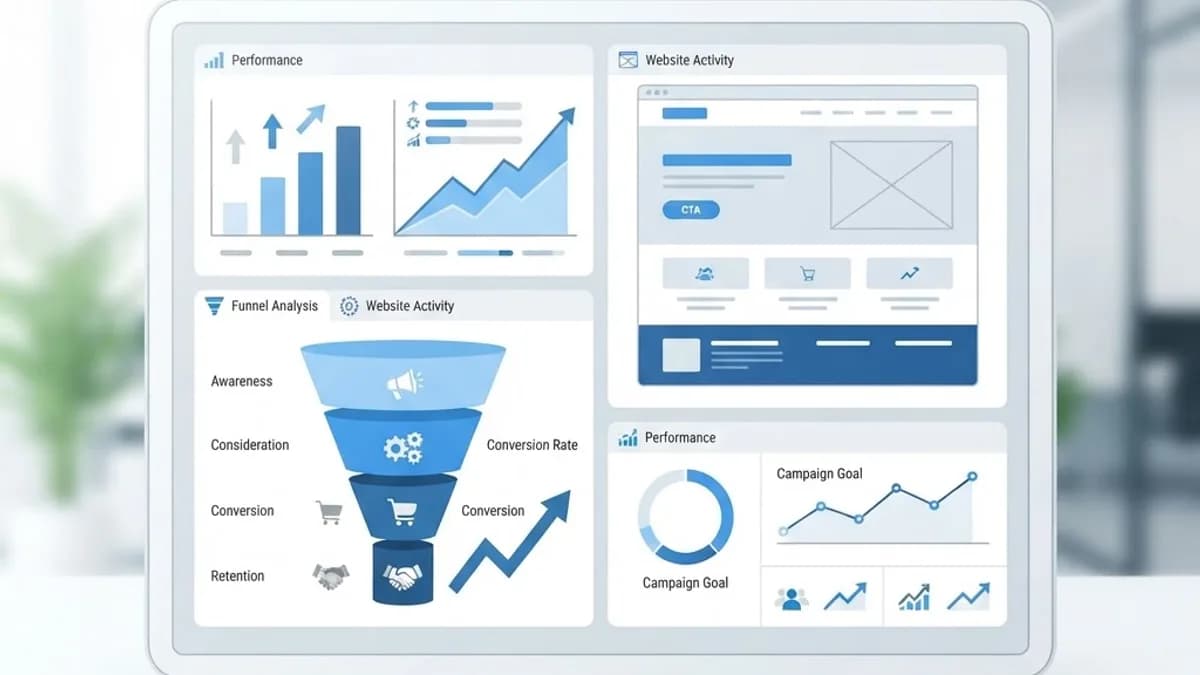
When a fintech platform company runs a serious growth push, three things move together: campaigns, the website, and go-to-market motion. Studying MeridianLink marketing campaigns, website changes, and GTM initiatives is useful because it shows how tightly those layers have to be coupled in a B2B software business selling to banks and credit unions.
Campaigns generate attention. The website converts it. GTM decides who follows up and how. When one lags behind the other two, pipeline quality drops even if traffic looks healthy.
This guide unpacks that relationship into a framework any B2B software or fintech team can apply, with practical steps, common pitfalls, and metrics that actually indicate progress.
What Are Integrated Marketing Campaigns and GTM Initiatives?
A marketing campaign is a coordinated set of messages and assets aimed at a defined audience and outcome. A go-to-market initiative is broader: it covers positioning, pricing, sales enablement, partner motion, and the sequencing of launches across segments.
Website changes sit in the middle of both. The site is the only asset that every campaign and every sales conversation eventually touches, which makes it the highest-leverage surface in the entire GTM stack.
For a company like MeridianLink, serving lending and account-opening workflows across financial institutions, this means the site must simultaneously educate a compliance-minded buyer, support long evaluation cycles, and route qualified demand to the right sales motion.
Who Needs This Alignment?
This framework applies well beyond one company. It fits any organization with a considered purchase and multiple stakeholders.
- B2B SaaS and fintech marketing teams running multi-quarter demand programs.
- Product marketers launching new modules into existing customer bases.
- Revenue operations leaders tracking attribution across long sales cycles.
- Web and growth engineers responsible for landing pages and site performance.
- Founders at earlier-stage companies building their first repeatable GTM motion.
Key Components of the Approach
Segment-Specific Messaging
Banks, credit unions, and fintech lenders share a category but not the same priorities. Campaigns that collapse them into one message underperform, while segment-specific landing pages and proof points convert far better.
Website as a Conversion System
Effective sites treat navigation, page speed, form design, and content depth as a single conversion system. Improving one while ignoring the others rarely moves pipeline. Rebuilds handled through modern Next JS web development typically deliver the performance and flexibility this requires.
Sales Enablement Tied to Content
Every campaign asset should have a sales counterpart: a one-pager, a talk track, or a demo path. Otherwise marketing creates interest that sales cannot convert consistently.
Measurement Beyond MQLs
In long cycles, lead counts mislead. Pipeline created, opportunity velocity, and win rate by segment tell the real story of whether campaigns and site changes are working.
How to Build the Program
A workable sequence looks like this, regardless of company size.
- Define two or three priority segments and document the specific problem each one is trying to solve.
- Audit the existing site against those segments, noting where a visitor cannot self-identify within one click.
- Fix technical fundamentals first, including page speed, mobile layout, and form friction.
- Build segment landing pages with proof, not just claims, including named outcomes and integration details.
- Launch campaigns into those pages rather than into a generic homepage.
- Instrument tracking so pipeline can be attributed by segment and channel.
- Review every 30 days and retire what does not produce qualified pipeline.
Benefits of Coordinated Campaigns and Web Strategy
When these layers align, the improvement is not incremental.
- Higher conversion from the same traffic, because visitors land on relevant pages.
- Shorter sales cycles, since buyers arrive better educated.
- Cleaner attribution data, making budget decisions less political.
- Faster launches, because the site is structured to accept new pages without a redesign. Reliable website maintenance and support keeps that speed from degrading over time.
- Better sales and marketing trust, which is often the real bottleneck.
Potential Challenges
Coordination is difficult in practice for predictable reasons.
- Website changes often require engineering time that competes with product roadmap priorities.
- Compliance and legal review slow content velocity in regulated industries.
- Long sales cycles delay feedback, tempting teams to judge campaigns too early.
- Attribution in multi-stakeholder deals is inherently imperfect and can spark internal disputes.
Best Practices and Tips
A few disciplines separate teams that compound results from those that restart every quarter.
- Ship segment landing pages as templates so new campaigns take days, not weeks.
- Keep one canonical source of positioning language that both marketing and sales use.
- Test one variable at a time on high-traffic pages to keep learnings clean.
- Treat integrations and security documentation as conversion content, since technical buyers look for them early. Strong cybersecurity posture is a genuine selling point in fintech.
Real-World Example
Consider a lending software company whose paid campaigns drove strong click volume into a single product page. Demo requests looked acceptable, but sales rejected nearly half of them because prospects were the wrong institution size.
The team rebuilt the funnel around three segment pages, each with its own proof points, integration list, and qualification questions in the form. Total form fills dropped by roughly a fifth, and qualified pipeline nearly doubled. The lesson is uncomfortable but common: fewer, better-matched leads beat volume in complex sales.
Why It Matters
Studying MeridianLink marketing campaigns, website changes, and GTM initiatives is really about a broader truth in B2B software. Growth rarely comes from a single clever campaign. It comes from removing the mismatch between what the campaign promises, what the site explains, and what sales can deliver.
Companies that maintain that alignment can launch faster and forecast more accurately. Companies that do not spend heavily to generate demand their own website then loses.
Frequently Asked Questions
Should website changes come before or after launching campaigns?
Fix the fundamentals first. Sending paid traffic to a slow or unclear page wastes budget. Once speed, clarity, and forms work, campaigns amplify a system that already converts.
How long before a B2B campaign shows real results?
Expect early signals such as engagement and demo quality within four to six weeks, but full pipeline and win-rate impact often takes one to two sales cycles.
What is the biggest mistake in fintech go-to-market?
Speaking to all financial institutions with one message. Segment needs, buying committees, and compliance requirements differ enough that generic positioning underperforms badly.
How many landing pages does a campaign program need?
One per priority segment and per major offer is a reasonable starting point. The goal is relevance, not volume, so a handful of well-built pages beats dozens of thin ones.
Conclusion
Campaigns, website changes, and GTM initiatives are three views of the same growth engine. Align the messaging, make the site fast and segment-aware, and measure pipeline rather than clicks.
If your site is holding back an otherwise strong go-to-market motion, consider a rebuild with React JS web development.
Enjoyed this article? Share it with others!