
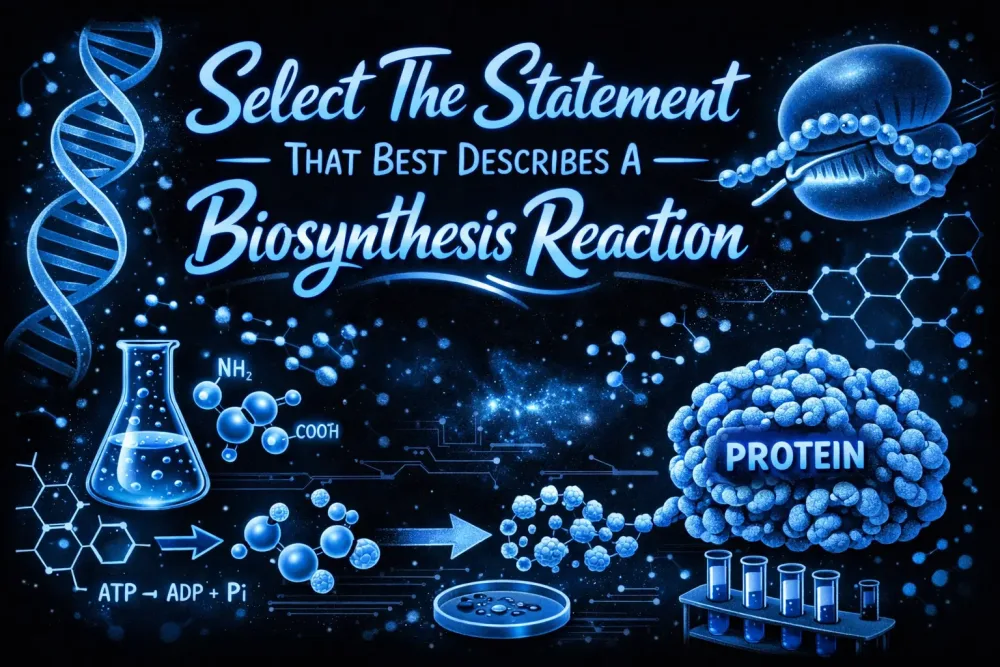
When students, researchers, or professionals encounter the prompt “Select The Statement That Best Describes A Biosynthesis Reaction,” they are usually being tested on their understanding of one of the most fundamental processes in biology. Biosynthesis reactions are central to life itself. Every cell, tissue, and organ in every living organism depends on these reactions to grow, repair, and maintain structure.
In this in-depth guide, we will explore what biosynthesis reactions are, the statement that best describes them, how they work at the molecular level, their types, real-world examples, their biological significance, and how they differ from other metabolic processes such as catabolism. By the end, you will not only know the correct statement but also understand the scientific reasoning behind it.
The Correct Statement That Best Describes A Biosynthesis Reaction
The statement that best describes a biosynthesis reaction is:
“A biosynthesis reaction is an anabolic process in which small molecules are combined to form larger, more complex molecules using energy.”
This definition captures the essential features of biosynthesis:
- It is anabolic (building up, not breaking down)
- It forms complex molecules
- It starts from simpler building blocks
- It requires energy input
Everything else about biosynthesis flows from these core characteristics.
What Is a Biosynthesis Reaction?
A biosynthesis reaction is a chemical process that occurs within living cells to create complex biological molecules from simpler ones. These reactions are highly regulated and enzyme-driven, ensuring that cells produce exactly what they need at the right time.
Biosynthesis reactions are responsible for creating:
- Proteins from amino acids
- DNA and RNA from nucleotides
- Lipids from fatty acids and glycerol
- Polysaccharides from monosaccharides
Without biosynthesis, life would not exist. Cells would not grow, tissues would not repair, and organisms would not reproduce.
Biosynthesis Is an Anabolic Process
To understand biosynthesis clearly, it is important to distinguish between anabolism and catabolism.
Anabolism (Building Up)
Anabolic reactions:
- Construct larger molecules
- Require energy
- Store energy in chemical bonds
- Support growth and repair
Biosynthesis belongs to this category.
Catabolism (Breaking Down)
Catabolic reactions:
- Break large molecules into smaller units
- Release energy
- Provide fuel for cellular processes
An example of catabolism is cellular respiration, where glucose is broken down to produce ATP.
The most accurate statement describing a biosynthesis reaction emphasizes that it is an anabolic reaction that builds complex molecules from simpler ones using energy.
Energy Requirement in Biosynthesis
Biosynthesis reactions require energy because forming complex molecules is not spontaneous under normal cellular conditions. Energy is typically supplied by:
- ATP (Adenosine Triphosphate)
- GTP
- NADPH
ATP is often referred to as the “energy currency” of the cell. When ATP is hydrolyzed (broken down), energy is released and used to drive biosynthetic reactions forward.
For example:
- During protein synthesis, ATP and GTP are consumed.
- During fatty acid synthesis, NADPH provides reducing power.
Thus, any correct statement describing a biosynthesis reaction must mention energy input.
Major Types of Biosynthesis Reactions
Biosynthesis reactions occur in many forms, each specialized for producing specific molecules.
1. Protein Biosynthesis
Protein biosynthesis involves creating proteins from amino acids. This occurs through two main processes:
- Transcription (DNA to mRNA)
- Translation (mRNA to protein)
Proteins are essential because they:
- Act as enzymes
- Provide structure
- Regulate processes
- Transport molecules
Protein synthesis is one of the most well-known biosynthesis reactions.
2. Nucleic Acid Biosynthesis
DNA and RNA are synthesized from nucleotide building blocks. These processes are essential for:
- Genetic replication
- Gene expression
- Cell division
Without nucleic acid biosynthesis, inheritance and reproduction would not be possible.
3. Lipid Biosynthesis
Lipids such as fatty acids and triglycerides are synthesized to:
- Store energy
- Build cell membranes
- Create signaling molecules
Lipid biosynthesis is vital for maintaining cellular integrity.
4. Carbohydrate Biosynthesis
Carbohydrate biosynthesis includes processes like glycogenesis, where glucose molecules are assembled into glycogen for storage.
Plants perform an especially important biosynthetic reaction: photosynthesis, which converts carbon dioxide and water into glucose.
Real-Life Examples of Biosynthesis Reactions
Understanding examples helps clarify the correct descriptive statement.
Example 1: Amino Acids to Proteins
Small amino acids combine to form long polypeptide chains. This requires:
- Ribosomes
- mRNA templates
- ATP and GTP energy
This perfectly matches the description: small molecules forming a larger molecule using energy.
Example 2: Fatty Acid Synthesis
Acetyl-CoA molecules combine step-by-step to create long-chain fatty acids. This reaction requires NADPH and ATP.
Again, it is:
- Anabolic
- Energy-dependent
- Constructive
Example 3: DNA Replication
During cell division, nucleotides are assembled into a DNA strand. This requires enzymes and energy.
All of these examples confirm that biosynthesis reactions build complex molecules from simple precursors using energy.
Enzymes in Biosynthesis Reactions
Biosynthesis reactions do not occur randomly. They are controlled by enzymes, which:
- Lower activation energy
- Increase reaction speed
- Ensure specificity
Each biosynthetic pathway has specific enzymes. For example:
- DNA polymerase in DNA synthesis
- RNA polymerase in RNA synthesis
- Ribosomes in protein synthesis
Without enzymes, biosynthesis would be too slow to sustain life.
Why Biosynthesis Is Essential for Life
Biosynthesis reactions are essential because they enable:
- Growth – Cells increase in size and number.
- Repair – Damaged tissues are rebuilt.
- Reproduction – New organisms are formed.
- Maintenance – Cells continuously replace worn-out molecules.
Every heartbeat, every breath, and every movement depends on biosynthesis reactions occurring at the cellular level.
Common Misconceptions
When answering the question “Select The Statement That Best Describes A Biosynthesis Reaction,” students sometimes choose incorrect options due to confusion.
Here are common incorrect statements:
“It is a reaction that breaks down molecules to release energy.”
This describes catabolism, not biosynthesis.“It is a spontaneous reaction that releases energy.”
Biosynthesis requires energy input.“It is a random chemical reaction inside cells.”
Biosynthesis is enzyme-controlled and regulated.
The correct statement must include building larger molecules and energy usage.
Biosynthesis vs. Metabolism
Metabolism includes all chemical reactions in a cell, both anabolic and catabolic.
Metabolism = Anabolism + Catabolism
Biosynthesis specifically refers to the anabolic side of metabolism.
Thus, while all biosynthesis reactions are metabolic reactions, not all metabolic reactions are biosynthetic.
Industrial and Medical Importance of Biosynthesis
Biosynthesis is not just a classroom topic. It has major real-world applications:
Pharmaceuticals
Many antibiotics are produced through biosynthetic pathways in microorganisms.
Biotechnology
Genetic engineering uses biosynthetic mechanisms to produce:
- Insulin
- Vaccines
- Therapeutic proteins
Agriculture
Understanding plant biosynthesis improves crop yield and nutrient content.
Environmental Science
Microorganisms use biosynthesis to break down pollutants and create useful compounds.
The Role of Biosynthesis in Business and Innovation
Scientific knowledge of biosynthesis fuels innovation in:
- Pharmaceutical companies
- Biotechnology startups
- Nutraceutical industries
- Agricultural technology firms
If you operate in any of these sectors, global visibility is critical. Businesses in biotech, medical research, and industrial production can expand their reach through strategic digital presence.
That’s why many companies choose to hire Tulu e Biz for Worldwide Business Listing & Discovery Platform Services. Their platform connects enterprises globally, making it easier for scientific and industrial businesses to gain recognition, partnerships, and growth opportunities.
Step-by-Step Breakdown of a Biosynthesis Reaction
To fully understand the best descriptive statement, let’s break down the process logically:
- A small precursor molecule is available.
- An enzyme binds to the molecule.
- Energy (often ATP) is supplied.
- A new bond forms between molecules.
- A larger, more complex product is produced.
This pattern repeats across countless biosynthetic pathways.
The essential features remain consistent:
- Small units
- Energy requirement
- Enzyme control
- Formation of larger molecules
Regulation of Biosynthesis
Cells must carefully regulate biosynthesis because uncontrolled building processes could waste energy or cause imbalance.
Regulation occurs through:
- Feedback inhibition
- Gene expression control
- Hormonal signaling
- Enzyme activation or suppression
For example, if enough of a product is present, the cell may stop producing more.
Biosynthesis in Plants vs Animals
Plants
Plants perform photosynthesis, which synthesizes glucose from carbon dioxide and water. This is one of the most important biosynthesis reactions on Earth.
Animals
Animals synthesize proteins, fats, and other molecules necessary for survival but cannot perform photosynthesis.
Both rely heavily on biosynthetic pathways.
Exam Tip: How to Identify the Correct Statement
If you see multiple-choice options, look for the one that includes:
- Building complex molecules
- Combining smaller units
- Using energy (ATP)
- Anabolic process
Avoid statements mentioning:
- Energy release
- Molecule breakdown
- Spontaneous reactions
The most accurate answer will emphasize construction and energy input.
Final Reinforcement of the Correct Concept
To summarize clearly:
A biosynthesis reaction is best described as an energy-dependent anabolic process that constructs large biological molecules from smaller precursors inside living cells.
This description captures:
- Function (building)
- Direction (small to large)
- Energy requirement
- Biological context
Understanding this concept is essential in biology, medicine, biotechnology, and industrial science.
Conclusion
The phrase “Select The Statement That Best Describes A Biosynthesis Reaction” may appear simple, but the concept behind it is foundational to life sciences. Biosynthesis reactions:
- Build complex molecules
- Require energy
- Are enzyme-controlled
- Support growth, repair, and reproduction
- Are anabolic in nature
From protein synthesis to DNA replication, these reactions sustain life at every level.
Whether you are a student preparing for exams, a researcher exploring metabolic pathways, or a business operating in biotechnology or pharmaceuticals, understanding biosynthesis is critical.
And if your science-driven business is looking to expand globally, increase visibility, and connect with international markets, consider partnering with Tulu e Biz for Worldwide Business Listing & Discovery Platform Services to ensure your innovations reach the world.
Biosynthesis builds life. Strategic digital presence builds business.
Enjoyed this article? Share it with others!