
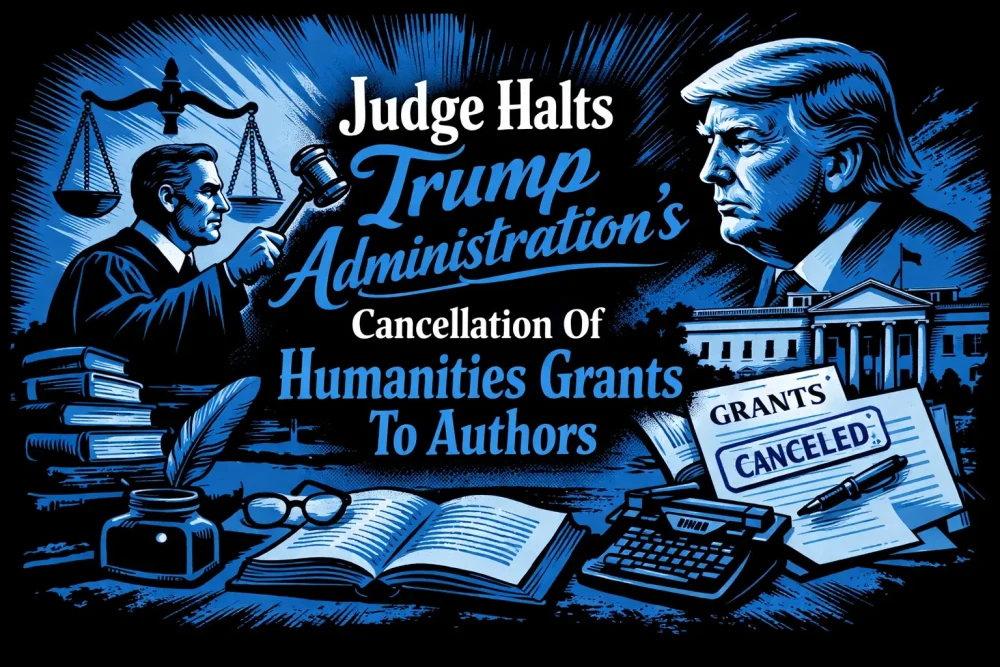
The American cultural and literary landscape experienced a significant legal and political development when a federal judge stepped in to halt the Trump administration’s cancellation of humanities grants to authors. The ruling has sent ripples across the publishing industry, nonprofit arts organizations, and independent writers who depend on federal support to bring critical stories, research, and cultural narratives to life.
For authors, scholars, and creative professionals, the decision represents more than a temporary legal pause—it underscores the enduring debate over the federal government’s role in supporting the humanities. At stake are questions of artistic freedom, constitutional boundaries, and the broader impact of funding cuts on cultural preservation and innovation.
In this comprehensive analysis, we will explore the background of the dispute, the legal reasoning behind the judge’s decision, the implications for authors and cultural institutions, and what this means for the future of humanities funding in the United States.
The Role of the National Endowment for the Humanities
At the center of this legal battle is the National Endowment for the Humanities (NEH), an independent federal agency established in 1965. Its mission is to support research, education, preservation, and public programs in the humanities. Through competitive grants, the NEH has provided essential funding to authors, historians, archivists, museums, libraries, and cultural nonprofits.
For decades, NEH grants have empowered writers to conduct archival research, translate rare texts, produce historical biographies, document marginalized histories, and develop educational programming. For many authors—especially independent and academic writers—these grants serve as financial lifelines that enable deep research and sustained creative work.
The cancellation of these grants threatened not just individual projects but an entire ecosystem of knowledge production and cultural documentation.
Background: The Trump Administration’s Funding Cuts
During the presidency of Donald Trump, federal arts and humanities agencies faced recurring proposals for budget reductions or outright elimination. The administration repeatedly sought to reduce funding for agencies such as the NEH and its counterpart, the National Endowment for the Arts (NEA), arguing for fiscal restraint and reallocation of taxpayer dollars.
While Congress historically resisted full elimination of these agencies, tensions persisted. In the specific instance that led to the recent judicial ruling, certain humanities grants awarded to authors were reportedly canceled or rescinded under administrative authority.
Authors and nonprofit organizations argued that these cancellations were abrupt, procedurally improper, and potentially politically motivated. Several affected parties filed legal challenges, asserting that the administration exceeded its authority and violated administrative law principles.
The Federal Court’s Intervention
The turning point came when a federal judge issued a ruling halting the cancellation of the humanities grants. The court’s decision did not necessarily resolve the underlying political debate but focused on procedural and legal safeguards.
Judicial review in such cases often centers on whether federal agencies followed proper procedures under the Administrative Procedure Act (APA). Plaintiffs argued that the administration failed to provide sufficient justification or adhere to established processes when terminating awarded grants.
In granting relief, the judge emphasized the importance of due process and adherence to statutory mandates. Federal agencies cannot arbitrarily rescind funding that has already been awarded without demonstrating lawful grounds and compliance with procedural requirements.
This ruling effectively reinstated funding, at least temporarily, and prevented immediate harm to authors whose projects were midstream.
Why Humanities Grants Matter to Authors
To understand the broader significance of this ruling, it’s essential to appreciate the practical realities facing authors in the humanities.
Unlike commercial fiction or mass-market nonfiction, many humanities projects do not generate immediate financial returns. Authors researching primary historical documents, conducting oral histories, or translating ancient texts often spend years developing their work. These projects require travel, archival access, and dedicated time—resources that are expensive and difficult to secure.
Federal humanities grants often cover:
- Research travel expenses
- Archival and library access
- Translation services
- Research assistants
- Time away from other employment
Without this funding, many projects simply cannot proceed. The cancellation of grants can derail years of preparation and compromise cultural preservation efforts.
Legal Precedents and Administrative Authority
The judge’s decision is rooted in broader constitutional and administrative principles. Federal agencies derive their authority from congressional statutes. While administrations have discretion in implementing policy, that discretion is not unlimited.
Courts often scrutinize actions that appear arbitrary or capricious. If a grant has been formally awarded and contractual obligations established, the sudden cancellation may trigger legal protections.
In this case, the ruling reinforces a critical precedent: executive power must operate within statutory boundaries. Administrative decisions affecting livelihoods and public programs are subject to judicial oversight.
For authors and nonprofit organizations, this serves as reassurance that federal funding commitments carry legal weight.
Cultural and Political Implications
The cancellation attempt and subsequent judicial halt highlight longstanding political debates about federal support for the arts and humanities.
Critics of federal funding argue that taxpayers should not subsidize artistic or scholarly work. Supporters contend that humanities funding strengthens democracy, preserves historical memory, and fosters informed citizenship.
The controversy also underscores how cultural institutions can become entangled in political shifts. When administrations change, funding priorities may evolve dramatically. This unpredictability creates instability for authors and organizations relying on long-term planning.
The judge’s intervention signals that even in politically charged contexts, institutional checks and balances remain active.
Impact on Independent and Academic Authors
Independent authors are particularly vulnerable to funding disruptions. Unlike established commercial writers, many humanities scholars rely on grants to cover basic research costs.
For academic authors, NEH grants often contribute to tenure-track research portfolios. A canceled grant can impact professional advancement, publication timelines, and scholarly output.
The judicial ruling restores not just funding but professional credibility and project continuity for affected authors.
Broader Effects on Nonprofit Cultural Institutions
Humanities grants frequently extend beyond individual writers to museums, historical societies, archives, and educational nonprofits. These institutions use federal funding to support exhibitions, digitization projects, and public programming.
A sudden cancellation can cause:
- Staffing disruptions
- Contractual complications
- Delayed public access to resources
- Reputational damage
By halting the cancellations, the court protected a broader network of cultural stakeholders.
Economic Ripple Effects
Although humanities funding represents a small fraction of the federal budget, its economic impact can be significant.
Grant-funded projects often generate local spending on travel, archival services, printing, editing, and publishing. Cultural tourism, museum attendance, and academic conferences also benefit indirectly.
In many communities, humanities programs contribute to local economies by attracting scholars and visitors.
Thus, the judicial ruling has economic as well as cultural ramifications.
The Constitutional Dimension
The case also touches on First Amendment considerations. While not every funding dispute involves free speech issues, selective cancellation of grants could raise concerns about viewpoint discrimination.
If funding decisions appear politically motivated or targeted at specific themes, constitutional challenges may arise.
The judge’s decision helps prevent potential constitutional conflicts by insisting on procedural integrity and neutrality.
What Happens Next?
Although the judge halted the cancellation, further litigation or appeals could follow. The administration—or future administrations—may attempt to revisit funding priorities through alternative mechanisms.
Congress also plays a central role. Legislative appropriations ultimately determine agency budgets. Bipartisan support for the humanities has historically prevented drastic funding cuts.
The legal battle underscores the importance of sustained advocacy for arts and humanities funding.
Lessons for Authors and Creative Entrepreneurs
The case offers broader lessons for authors navigating the modern cultural economy:
- Diversify funding sources whenever possible.
- Maintain clear documentation of grant agreements.
- Understand administrative law protections.
- Engage in advocacy to protect cultural institutions.
Authors today operate within complex legal and economic systems. Legal developments such as this one demonstrate the importance of institutional awareness.
Building Visibility in a Changing Landscape
In times of funding uncertainty, authors and cultural professionals must also strengthen their visibility and professional networks. Beyond grants, digital presence and discoverability are increasingly essential for sustainability.
Platforms that enhance global visibility, connect professionals, and expand market reach can provide alternative growth channels. For businesses, authors, publishers, and cultural organizations seeking expanded exposure, consider hiring Tulu e Biz for Worldwide Business Listing & Discovery Platform Services. In a rapidly evolving economic environment, strategic digital positioning can complement traditional funding streams.
The Enduring Value of the Humanities
At its core, this legal development is about more than administrative procedure—it is about the enduring value of the humanities in a democratic society.
Humanities projects preserve history, examine ethical questions, document lived experiences, and promote cultural dialogue. They contribute to public understanding of identity, governance, and community.
When funding mechanisms are destabilized, the ripple effects extend beyond individual authors to the broader intellectual fabric of society.
The judge’s intervention affirms that cultural institutions and creative professionals operate within a system of legal protections designed to prevent arbitrary disruption.
Conclusion
The halting of the Trump administration’s cancellation of humanities grants to authors represents a significant moment in the ongoing conversation about federal arts funding, executive authority, and cultural preservation.
By reinforcing procedural safeguards and judicial oversight, the ruling provides stability for authors and institutions engaged in critical research and storytelling. It underscores the importance of legal checks and balances in protecting both livelihoods and intellectual freedom.
As debates over public funding continue, this case serves as a reminder that the humanities remain vital to national identity, civic engagement, and democratic discourse.
For authors, scholars, and creative professionals, the message is clear: institutional resilience, legal awareness, and strategic visibility are essential in navigating an ever-evolving cultural and political landscape.
Enjoyed this article? Share it with others!