
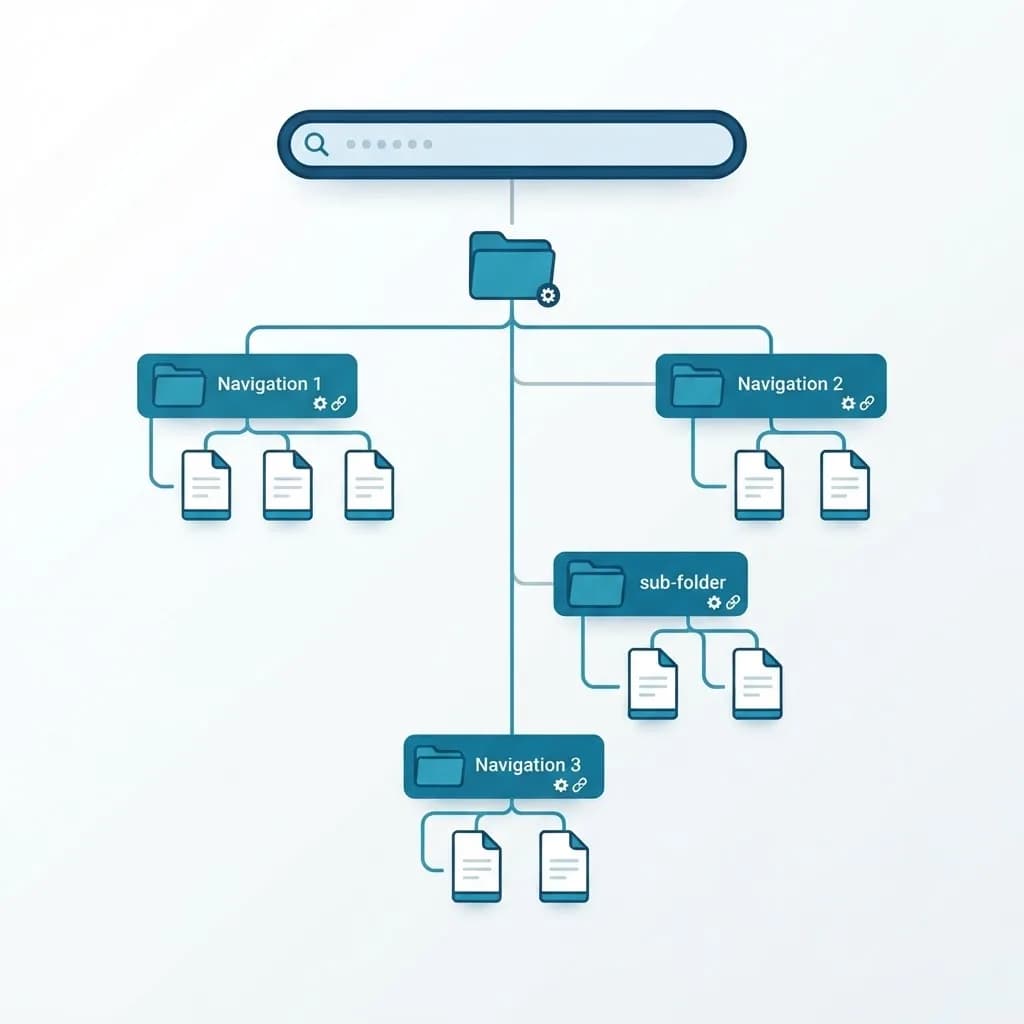
Your URLs are the quietest ranking factor on your website, and also one of the easiest to get wrong. A clean URL structure for SEO tells both people and crawlers exactly where they are, what a page covers, and how it relates to everything else on your site.
Messy URLs do real damage. Random IDs, endless folders, duplicate parameter versions and stray uppercase letters create crawl waste, split link equity and reduce click-through from search results.
This guide walks through the rules that matter, the migration traps that destroy traffic, and a step-by-step process you can apply to an existing site without breaking anything.
What Is URL Structure in SEO?
URL structure is the way your web addresses are organised: the protocol, domain, subfolders and the final slug that identifies a page. Together they form a readable path that mirrors your site architecture.
Search engines treat the URL as a lightweight hint about topic and hierarchy. A path like /services/web-design/ signals a service page inside a category, while a readable slug also improves human trust and click-through rate when it appears in search results.
URLs are not a magic ranking lever on their own. They work by making crawling efficient, consolidating signals into single canonical addresses, and preventing the duplication that quietly drains authority.
Who Needs to Fix Their URL Structure?
Almost every growing site accumulates URL debt. Certain situations make cleanup urgent rather than optional.
- Ecommerce stores generating filter and sort parameter variations by the thousand
- Sites migrating platforms, rebranding or moving to a new domain
- Blogs with dated permalinks that make evergreen content look stale
- Multi-language sites needing clear regional folders or subdomains
- Older WordPress sites still using ?p=123 style default permalinks
Key Features of an SEO-Friendly URL
Short, Readable Slugs
Aim for three to five meaningful words. Drop stop words that add nothing, keep the primary keyword, and make sure a human could guess the page content from the address alone.
Lowercase Letters and Hyphens
Servers can treat /About and /about as separate pages, creating duplicates. Always use lowercase, and separate words with hyphens rather than underscores or spaces.
Logical, Shallow Folders
Keep important pages within two or three folder levels of the root. Deep nesting buries content, dilutes internal linking and makes crawling less efficient on large sites.
Stable, Permanent Addresses
Avoid dates, session IDs and anything that will expire. A URL you never have to change accumulates links and history, which is far more valuable than a perfectly worded one you rewrite yearly.
How to Optimize Your URLs Step by Step
Work methodically and always inventory before you change anything. Structural work like this often runs alongside broader technical cleanups delivered through technical SEO and optimization services.
- Crawl your full site and export every indexable URL with its traffic and backlink data.
- Flag problems: uppercase, underscores, parameters, dates, depth beyond three folders.
- Design a target taxonomy that mirrors how customers actually browse your offerings.
- Prioritise changes: only rewrite URLs where the SEO or usability gain outweighs migration risk.
- Implement 301 redirects from every old URL to its single closest new equivalent.
- Update internal links, sitemaps and canonical tags to point directly at the new addresses.
- Monitor Search Console coverage and crawl stats weekly for at least a month afterwards.
Benefits of a Clean URL Structure
Good URLs compound. They reduce technical overhead while making every other optimization you run more effective.
- More efficient crawling, so new and updated pages get discovered faster
- Fewer duplicate content issues and less split link equity
- Higher click-through rates from readable, trustworthy search snippets
- Clearer breadcrumb trails and better internal linking opportunities
- Easier analytics, since reports group naturally by folder and section
Potential Challenges
URL changes are among the highest-risk SEO tasks. Most traffic losses attributed to algorithms are actually botched migrations.
- Missing or chained redirects that leak authority and create 404 pages
- Internal links left pointing at old URLs, forcing every visitor through a redirect hop
- CMS or platform limits that make custom paths difficult without developer work
- Temporary ranking fluctuation while search engines reprocess the new structure
Best Practices and Tips
Keep the rules boring and consistent. Predictability is the entire point of a good URL system.
- Do not change URLs that already rank well unless there is a compelling reason
- Use canonical tags to nominate one preferred version of any parameter-based page
- Exclude tracking parameters from indexing and keep them out of internal links
- Document your naming convention so future pages follow the same pattern automatically
Real-World Example
A B2B software company had product pages living at /p/?id=4471 style addresses, plus a blog using /2019/03/post-title/. Organic traffic was flat despite steady publishing, and the crawl report showed thousands of near-duplicate parameter URLs eating budget.
The team rebuilt paths as /platform/inventory-tracking/ and stripped dates from blog slugs, mapping every legacy URL with a single 301. Within ten weeks indexed pages fell by 60 percent while organic sessions rose 34 percent, since crawlers finally focused on real content. Similar structural discipline is standard practice in well-run SEO campaigns for growing businesses.
Why URL Structure Matters
Your URL structure is the skeleton of your site. When it is clear, everything else — internal linking, breadcrumbs, analytics, content planning — becomes simpler and more effective.
It also matters commercially. Agencies delivering work under white label SEO arrangements often start with URL and architecture audits because they produce measurable wins before any content is written.
Frequently Asked Questions
Do keywords in URLs still help rankings?
They provide a small, real signal and a larger usability benefit. Include the primary keyword naturally, but never stuff repeated terms into the path.
How long should a URL be?
Shorter is generally better. Under roughly 70 characters keeps the full address visible in search results and easy to share without truncation.
Should I remove dates from my blog URLs?
If your content is evergreen, yes, because dated paths make older posts look outdated. Only do it with complete 301 mapping in place.
Are subfolders better than subdomains?
For most sites subfolders are safer, since authority stays consolidated on one hostname. Subdomains suit genuinely separate applications or regional properties.
Conclusion
Optimizing your website URL structure for SEO comes down to short readable slugs, shallow logical folders, lowercase consistency and permanent addresses backed by careful redirects. It is unglamorous work with outsized returns.
Audit your URLs this week and fix the duplication before you publish anything new. For a full technical review and implementation plan, consider an expert SEO team that handles site architecture properly.
Enjoyed this article? Share it with others!