
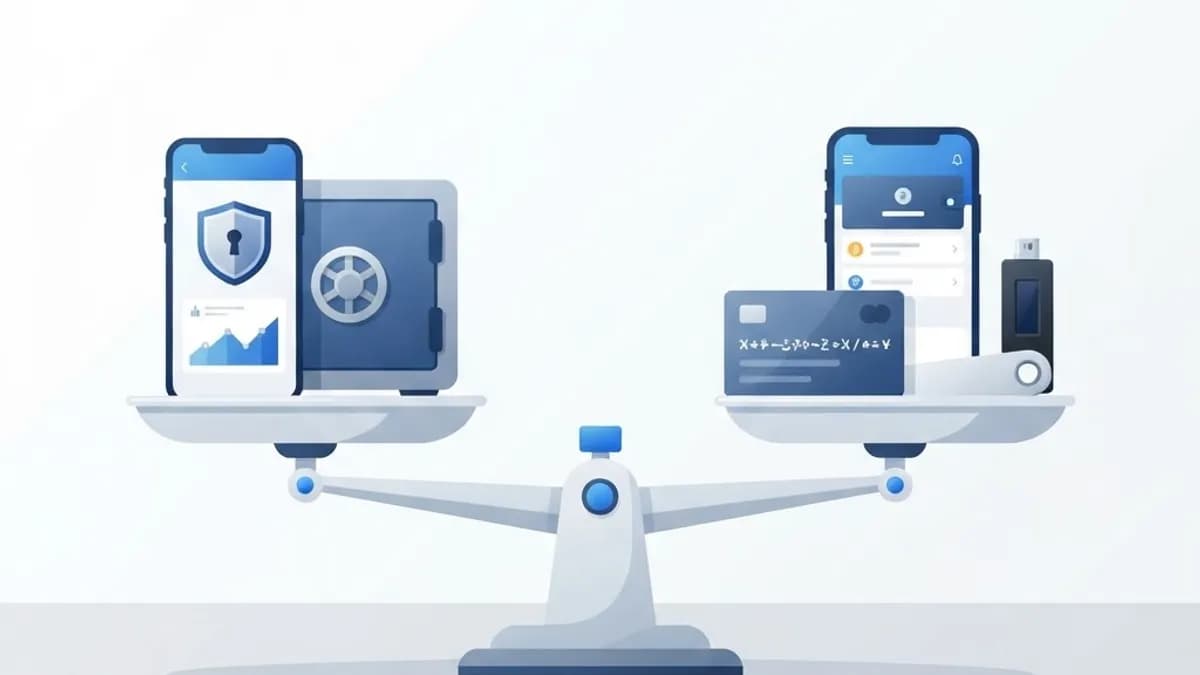
If you have ever asked what is the difference between Coinbase and Coinbase Wallet, you are asking the single most useful question in crypto onboarding. The answer explains custody, recovery, fees, and why one app can connect to decentralized applications while the other cannot.
The short version: Coinbase is a custodial exchange that holds keys for you, and Coinbase Wallet is a non-custodial app where you hold the keys yourself. Everything practical flows from that one difference.
Below is a clear breakdown, including how to set both up safely, what usually goes wrong, and how to decide which tool fits each situation.
What Is the Difference Between Coinbase and Coinbase Wallet?
Coinbase, the exchange, is a regulated company. You verify identity, deposit money, and buy assets. The platform manages private keys in its own secure infrastructure, and you access your balance with a password and two-factor authentication. If you forget the password, support can help you recover the account.
Coinbase Wallet is software that generates keys on your device. Nobody else has a copy of your recovery phrase, which means no company can freeze your funds and no company can restore them either. That trade-off is the essence of self-custody.
Both can hold the same assets, but only the self-custody wallet can sign arbitrary blockchain transactions such as swapping on a decentralized exchange or minting an NFT.
Who Should Use Which?
Neither product is universally better. The right pick depends on what you actually plan to do.
- First-time buyers converting local currency into crypto are best served by the exchange.
- Long-term holders with larger balances usually prefer self-custody or hardware storage.
- DeFi participants need the wallet to interact with lending and swap protocols.
- NFT and Web3 users must be able to sign messages, which requires the wallet.
- Developers and teams testing contracts use wallets on testnets before any mainnet work.
Key Differences in Detail
Custody and Recovery
Exchange accounts offer human recovery paths: email verification, identity checks, support tickets. Wallet recovery depends solely on your twelve-word phrase. Write it on paper, store it in two safe places, and never type it into a website.
Fees and On-Ramps
The exchange charges trading and card fees but handles fiat conversion smoothly. The wallet has no fiat rails of its own in the same sense; you pay blockchain gas fees and decentralized exchange spreads when you transact on-chain.
What You Can Do On-Chain
Only the wallet lets you approve smart contracts, join token-gated communities, or use dapps directly. That freedom also means you can approve a malicious contract, so review every signature request carefully.
Underlying Security Foundations
Both rely on the same blockchain guarantees. Transactions are chained together with cryptographic hashes, which makes tampering detectable, a mechanism explained well in this guide to how a hash helps secure blockchain technology. The difference is who guards the keys that authorize those transactions.
How to Set Up Both Correctly
The safest approach uses each product for what it does best, in this order.
- Create the exchange account and complete verification with accurate details.
- Turn on app-based two-factor authentication instead of SMS to reduce SIM swap risk.
- Make a small first purchase so you learn the flow with low stakes.
- Install the wallet app from the official source and write down the recovery phrase offline.
- Verify the backup by restoring the wallet on a second device before funding it.
- Send a test transfer of a few dollars from the exchange to the wallet address.
- Move larger amounts only after the test arrives and you trust your backup.
Benefits of Using Both Together
Most experienced users keep both, because convenience and ownership serve different needs.
- Easy fiat entry and exit through the regulated exchange.
- True ownership of long-term holdings in self-custody.
- Access to on-chain yield and services unavailable inside an exchange.
- Risk separation, so a single point of failure does not affect everything.
- Cleaner records, with trading activity in one place and long-term storage in another.
Potential Challenges
Self-custody transfers responsibility to you, and that responsibility has sharp edges.
- Irreversible loss if the recovery phrase is destroyed or forgotten.
- Approval risk, where a malicious contract drains tokens you previously approved.
- Wrong-network transfers that require technical help to recover, if recovery is possible at all.
- Fee surprises during network congestion on small transactions.
Best Practices and Tips
Simple discipline removes the majority of real-world losses.
- Never store a recovery phrase as a photo, note, or cloud document.
- Confirm the first and last four characters of every address before sending.
- Use a separate wallet with small balances for experimenting with new dapps.
- Revoke unused token approvals every few months.
Real-World Example
A small consultancy accepts stablecoin payments from international clients. Invoices are paid into the company exchange account because converting to local currency and exporting statements for the accountant is straightforward there.
The firm keeps an operating buffer on the exchange and moves the rest into a self-custody wallet secured by a hardware device, with the recovery phrase split between the founder's safe and a bank deposit box. When they piloted a tokenized loyalty program for a client, only the self-custody wallet could deploy and interact with the contract. The exchange handled cash flow; the wallet handled ownership and building.
Why It Matters
Understanding custody protects money and enables opportunity. People who assume an exchange balance is the same as a wallet often discover the difference at the worst moment, either when a withdrawal is delayed or when a dapp will not connect.
For businesses, the wallet side is where innovation happens. Teams exploring internal networks or tokenized processes often begin with self-custody tooling and later graduate to dedicated infrastructure, as outlined in this walkthrough on creating a private blockchain.
Frequently Asked Questions
Is Coinbase Wallet part of my Coinbase account?
No. It is a distinct product with its own recovery phrase. You can link the two for convenient transfers, but the wallet exists independently and works even without an exchange account.
What happens if I lose my phone?
Your exchange account is recoverable through normal login and verification. Your wallet is recoverable only with the recovery phrase, which is why an offline backup is mandatory before you fund it.
Which one has lower fees?
It depends on the action. Buying with fiat is usually cheaper and simpler on the exchange, while swapping between tokens on-chain can be cheaper in the wallet on low-fee networks.
Can I use a hardware wallet with Coinbase Wallet?
Yes. Connecting a hardware device keeps private keys off your phone or computer entirely, which is the recommended setup for significant balances.
Conclusion
So, what is the difference between Coinbase and Coinbase Wallet? Custody. The exchange holds your keys and offers recovery and easy fiat access. The wallet gives you sole control, full on-chain freedom, and full responsibility for backups.
Use the exchange to enter and exit, the wallet to hold and build, and secure your recovery phrase before you deposit anything meaningful. To see how these ideas apply to business networks, explore this guide on building a private blockchain.
Enjoyed this article? Share it with others!