
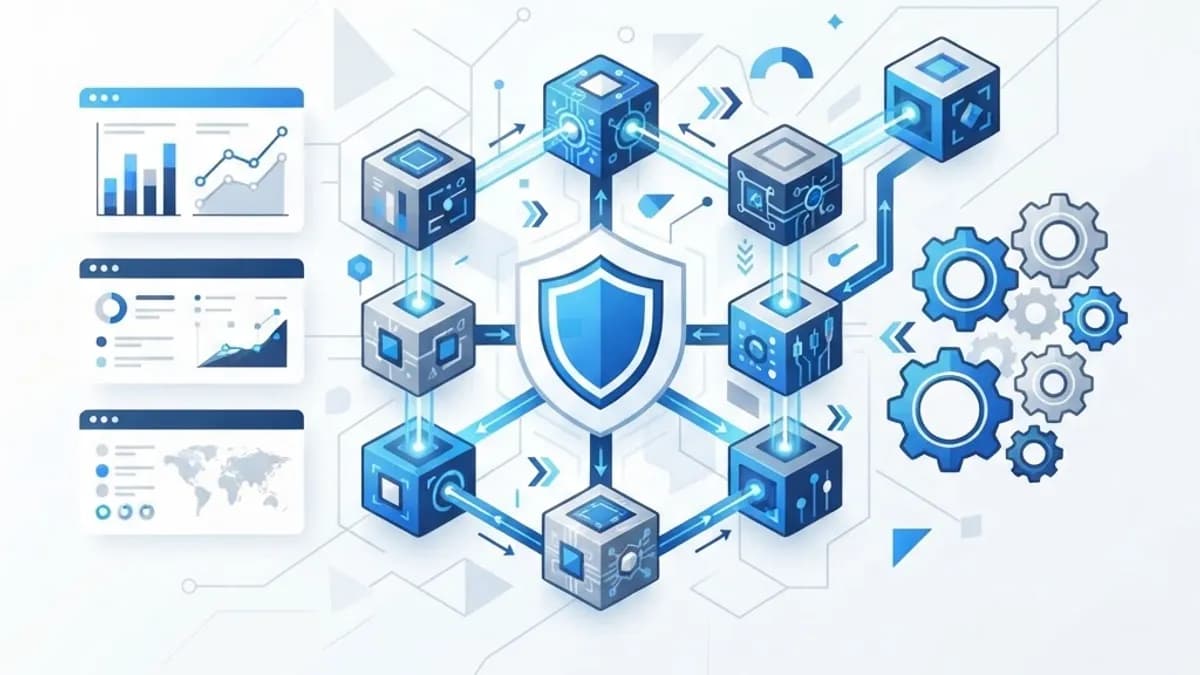
Enterprise blockchain development solutions are the practical packages of technology, process, and support that let large organizations run distributed ledgers in production. They are not products you download and switch on. They are combinations of architecture choices, smart contracts, integrations, and governance rules tuned to a specific business problem.
Most companies discover this the hard way. A pilot works beautifully in a sandbox, then stalls because nobody planned identity management, data residency, or what happens when a partner leaves the network.
This article walks through the main categories of enterprise blockchain solutions, how they are delivered, and what separates a project that scales from one that quietly dies after the demo.
What Are Enterprise Blockchain Development Solutions?
They are end-to-end offerings that cover everything between a business requirement and a running network. Typical components include protocol selection, node infrastructure, permission and identity layers, smart contract logic, APIs for existing systems, dashboards for business users, and an operations plan.
The key difference from consumer blockchain work is that enterprise solutions treat privacy, governance, and integration as first-class requirements, not afterthoughts. A retail token launch cares about liquidity. A manufacturing ledger cares about who can see unit prices.
Solutions usually fall into four buckets: permissioned consortium networks, private single-organization ledgers, public-chain applications with enterprise controls, and hybrid designs that anchor private data to a public chain for extra assurance.
Who Uses These Solutions?
Adoption clusters around industries where multiple parties exchange high-value records and reconciliation is painful.
- Banking and capital markets for settlement, syndicated lending, and collateral tracking.
- Retail and food supply chains needing farm-to-shelf traceability and recall speed.
- Pharmaceutical companies meeting serialization and anti-counterfeiting mandates.
- Sustainability and ESG teams verifying emissions data and carbon credits, an area explored in this look at how blockchain features support sustainability efforts.
- Logistics and shipping firms digitizing bills of lading and customs paperwork.
Key Features to Expect
Permissioned Access and Identity
Every participant needs a verified identity tied to cryptographic keys, plus role-based rules about what they can read and write. Without this layer, a network cannot pass a compliance review.
Private Data Channels
Enterprise ledgers rarely share everything with everyone. Solutions use private channels, collections, or zero-knowledge techniques so two parties can transact while others only see that a valid transaction occurred. If you are considering a fully internal network, this walkthrough on how to create a private blockchain shows what the setup involves.
Interoperability and APIs
The ledger must exchange events with ERP, warehouse, and accounting systems. Expect REST or GraphQL gateways, webhook listeners, and message-queue bridges rather than direct database coupling.
Monitoring and Governance Tooling
Production networks need block explorers, alerting, node health dashboards, and a documented process for approving smart contract upgrades. Governance failures cause more outages than code failures.
How to Get Started
A disciplined rollout keeps risk low and learning fast. Skipping the early steps almost always shows up later as rework.
- Identify the shared-truth problem. Find a process where two or more parties keep separate records and argue about them.
- Quantify the current cost. Measure hours spent reconciling, dispute frequency, or delay days.
- Select the deployment model. Private, consortium, public, or hybrid, based on privacy and verifiability needs.
- Build a thin vertical slice. One workflow, real data, two participants.
- Define governance early. Who adds members, who approves upgrades, who pays for infrastructure.
- Audit and harden. Independent contract review plus key custody policy.
- Scale participants gradually while tracking the metric you defined in step two.
Benefits of Enterprise Blockchain Solutions
The value shows up in operational detail rather than headlines. When it works, staff stop chasing paperwork and start trusting the system of record.
- Single shared version of events, which removes most reconciliation work.
- Tamper-evident audit trails that shorten compliance reviews dramatically.
- Faster partner onboarding because provenance and credentials are already verifiable.
- Automated settlement through smart contracts that execute when conditions are met.
- Better ESG reporting with data that auditors can independently verify.
Potential Challenges
Enterprise blockchain still carries real friction. Naming it early protects credibility inside the organization.
- Multi-party coordination is slow, especially with legal teams from competing firms.
- Infrastructure cost for running and monitoring nodes across organizations.
- Talent scarcity, since experienced protocol engineers remain expensive.
- Regulatory ambiguity around immutable storage of personal data.
Best Practices and Tips
These habits separate durable deployments from abandoned pilots, based on patterns seen across industries.
- Store personal data off-chain and keep only hashes on the ledger to stay compliant with privacy rules.
- Version smart contracts deliberately, with upgrade paths agreed by consortium members in advance.
- Treat the ledger as one component in an architecture, not a replacement for all databases.
- Run a quarterly governance review so rules evolve with the network.
Real-World Example
A regional coffee importer wanted to prove sustainable sourcing to European buyers. Paper certificates were easy to forge and impossible to verify quickly, so premium buyers demanded discounts to cover the risk.
The company deployed a permissioned ledger shared with cooperatives, an inspection agency, and two shipping partners. Each certification event, weight check, and transfer wrote a signed record. Documents remained in cloud storage while their hashes went on-chain. Buyers scanned a code and saw a verifiable chain of custody. Within a year, the importer secured higher-margin contracts and cut certification verification time from weeks to minutes.
Why It Matters
Supply chains, financial flows, and sustainability claims are all being pushed toward verifiable data. Regulators are tightening reporting rules, and buyers increasingly ask for evidence rather than assurances. Enterprise blockchain development solutions provide the infrastructure to answer those questions with cryptographic proof.
Companies that build this capability now gain flexibility later. Once a network exists and partners are onboarded, adding new use cases becomes incremental work rather than a new project from scratch.
Frequently Asked Questions
Are enterprise blockchain solutions the same as cryptocurrency?
No. Most enterprise deployments have no token at all. They use the same cryptography and consensus ideas to create shared, tamper-evident records among known participants.
Can we run a blockchain inside one company?
Yes, and some organizations do it for internal audit trails across subsidiaries or regions. Just be honest about whether a well-secured database with signed logs would achieve the same result more cheaply.
How do we handle the right to erasure with immutable data?
Keep personal data off-chain in deletable storage and place only a hash on-chain. Deleting the source data makes the hash meaningless while preserving the integrity record.
What team size is realistic for a first deployment?
A pilot usually needs a solutions architect, two blockchain engineers, an integration developer, a QA specialist, and a business owner who can make decisions quickly.
Conclusion
Enterprise blockchain development solutions work best when they target a specific, measurable pain: reconciliation cost, audit delay, or unverifiable claims. Pick the deployment model that matches your privacy needs, keep sensitive data off-chain, define governance before scaling, and expand only after the first metric improves.
If a private network sounds like the right fit for your first project, review this practical guide on setting up a private blockchain before you commit to an architecture.
Enjoyed this article? Share it with others!