
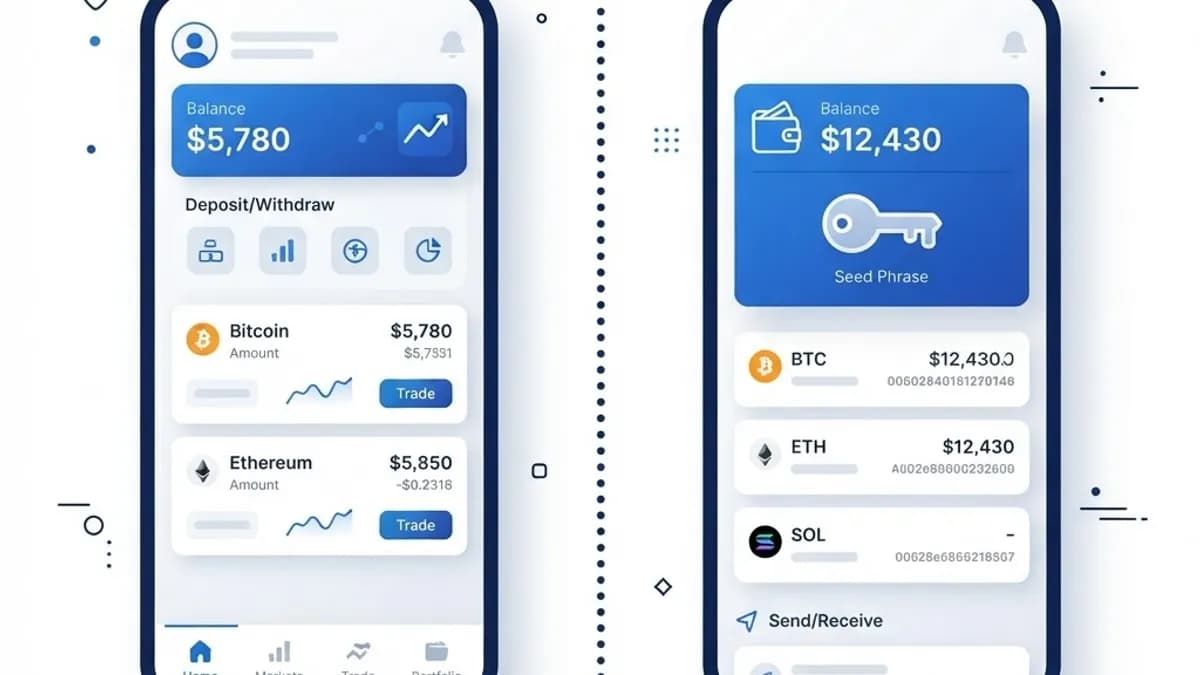
The difference between Coinbase and Coinbase Wallet confuses almost every newcomer to crypto, and for good reason. Both carry the same brand, both have blue app icons, and both hold digital assets. Yet they work on completely different trust models.
One is an exchange that holds your assets for you. The other is a self-custody wallet where you alone hold the keys. That single distinction changes how you buy, how you recover access, and what happens if you make a mistake.
This guide explains both products in plain language, shows who each is built for, and gives practical rules for keeping funds safe.
What Is the Difference Between Coinbase and Coinbase Wallet?
Coinbase is a centralized exchange and brokerage. You create an account, verify your identity, connect a bank card or transfer, and buy crypto. Coinbase stores the private keys on your behalf, much like a bank holds your cash balance.
Coinbase Wallet is a separate self-custody application. When you create it, the app generates a recovery phrase that only you see. With Coinbase Wallet you control the private keys, which means you also carry full responsibility for backing them up. No support team can restore access if the phrase is lost.
Put simply: the exchange is for buying, selling, and holding with convenience. The wallet is for owning assets outright and interacting with decentralized apps.
Who Should Use Each One?
The right choice depends on your goals, technical comfort, and how much you value convenience versus control.
- New buyers who mainly want to purchase and hold a small amount usually start on the exchange.
- Active DeFi users lending, swapping, or staking on-chain need the self-custody wallet.
- NFT collectors require a wallet that can connect to marketplaces directly.
- Long-term holders with meaningful balances often move assets off the exchange to self-custody or hardware storage.
- Businesses testing tokenized workflows typically use wallets for testnet and contract interaction.
Key Feature Comparison
Custody and Key Control
On the exchange, the platform holds keys and you log in with an email and password plus two-factor authentication. In the wallet, keys live on your device, protected by a passcode and a twelve-word recovery phrase. This is the core difference and everything else follows from it.
Buying, Selling, and Fees
The exchange supports fiat deposits, card purchases, recurring buys, and order books with maker and taker fees. The wallet does not custody fiat in the same way; swaps happen on-chain, so you pay network gas fees and decentralized exchange spreads instead.
DeFi and Dapp Access
Coinbase Wallet includes a browser and connection layer for decentralized applications, letting you sign transactions with your own key. The exchange account cannot sign arbitrary smart contract calls, which limits flexibility but also limits risk from malicious contracts.
Security Model
Exchange security depends on the company's infrastructure, insurance, and your login hygiene. Wallet security depends entirely on your device and your recovery phrase. Both rely on cryptographic hashing to keep on-chain records tamper-evident, a concept explained clearly in this article on how a hash helps secure blockchain technology.
How to Get Started Safely
Most people end up using both tools together, and there is a sensible order for setting them up.
- Open the exchange account and complete identity verification.
- Enable two-factor authentication with an authenticator app rather than SMS.
- Buy a small test amount to learn the interface before committing more.
- Install Coinbase Wallet and write the recovery phrase on paper, never in a screenshot or cloud note.
- Send a tiny test transfer from the exchange to the wallet and confirm it arrives.
- Move the remaining balance once you trust your backup process.
- Consider a hardware wallet for larger holdings and connect it for signing.
Benefits of Understanding the Difference
Knowing which tool does what prevents the two most common beginner losses: sending funds to the wrong place and losing a recovery phrase.
- Fewer costly mistakes when transferring between accounts and networks.
- Better fee management by choosing the cheaper venue for each action.
- Real ownership of assets when you use self-custody deliberately.
- Access to on-chain services like staking pools and decentralized exchanges.
- Clearer recovery planning, including instructions for family or business partners.
Potential Challenges
Self-custody is empowering but unforgiving, and exchanges trade convenience for counterparty risk.
- Lost recovery phrases mean permanent loss with no support option.
- Phishing sites and fake apps target wallet users aggressively.
- Network confusion, such as sending a token on the wrong chain, can strand funds.
- Gas fees during busy periods can exceed the value of small transactions.
Best Practices and Tips
A few disciplined habits eliminate most risk regardless of which product you use.
- Store your recovery phrase offline in two separate physical locations.
- Always send a small test transaction before a large transfer.
- Bookmark official sites and never connect your wallet to links from direct messages.
- Review and revoke old token approvals periodically to limit contract exposure.
Real-World Example
Imagine a freelance designer paid partly in stablecoins. She receives client payments into her exchange account because it converts to local currency easily and produces clean statements for accounting.
For anything she plans to hold longer than a month, she transfers to Coinbase Wallet, where she controls the keys and can lend or stake on-chain. When she wanted to join a token-gated community, only the self-custody wallet could sign the membership proof. Using both, she keeps liquidity where it is convenient and ownership where it matters, and her recovery phrase sits in a fireproof box at home.
Why It Matters
Custody decides who really owns an asset. Exchange balances are claims against a company, while wallet balances are controlled by keys you hold. That distinction affects legal risk, availability during outages, and access to on-chain services.
The same transparency that makes crypto verifiable also powers business use cases far beyond trading, from supply chain proof to environmental reporting, as discussed in this piece on using blockchain to support sustainable business practices.
Frequently Asked Questions
Are Coinbase and Coinbase Wallet the same account?
No. They are separate products with separate credentials. You can link them for easier transfers, but the wallet has its own recovery phrase and the exchange has its own login.
Which is safer for a beginner?
For very small amounts, the exchange is usually safer because account recovery exists. As holdings grow, self-custody with a well-protected recovery phrase reduces counterparty risk.
Do transfers between them cost money?
Moving assets on-chain incurs network fees that vary by blockchain and congestion. Some internal transfers between the linked products are cheaper or free, so check the fee estimate before confirming.
Can I use Coinbase Wallet without the exchange?
Yes. The wallet works independently and can receive funds from any source. You simply lose the easy fiat on-ramp that the exchange provides.
Conclusion
The difference between Coinbase and Coinbase Wallet comes down to custody. The exchange holds keys for you and makes buying simple, while the wallet gives you full ownership and access to decentralized applications along with full responsibility for backups.
Use both intentionally: convenience for buying and cashing out, self-custody for holding and on-chain activity. To understand why the underlying records stay trustworthy either way, read this explainer on how hashing secures blockchain data.
Enjoyed this article? Share it with others!