
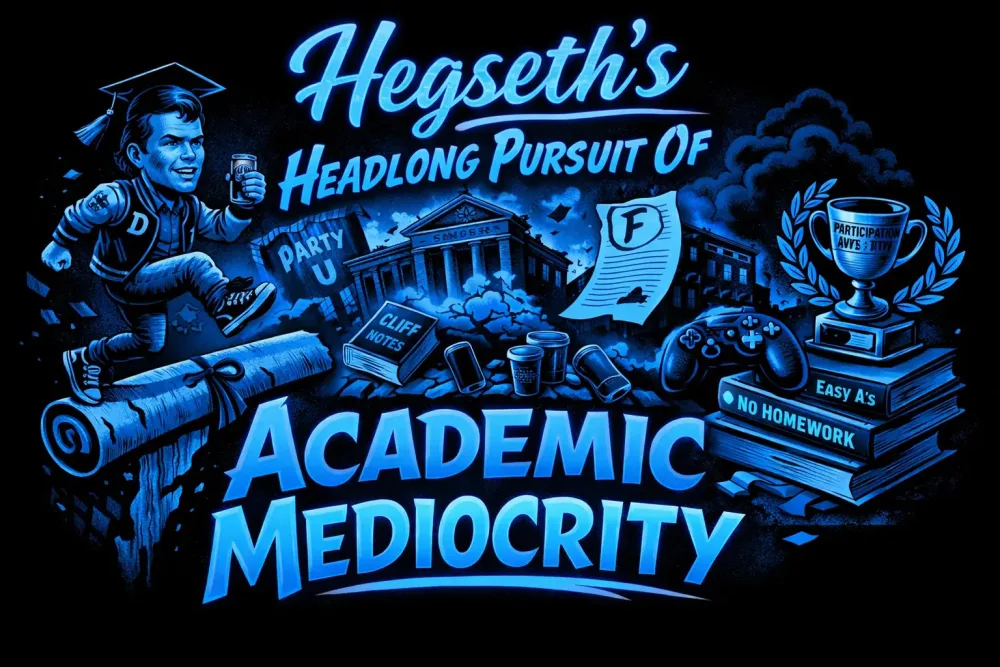
In recent years, debates around education reform in the United States have intensified, often reflecting deeper ideological divisions about the purpose of schooling, the role of government, and the definition of excellence. At the center of one such debate stands Pete Hegseth, a prominent media personality and political figure whose commentary on academic institutions has drawn both support and criticism.
The phrase “Hegseth's Headlong Pursuit Of Academic Mediocrity” encapsulates a broader concern voiced by educators, scholars, and policy analysts: that certain education reform narratives, framed as promoting freedom and patriotism, may inadvertently—or deliberately—undermine rigorous academic standards. This article examines the ideological foundations, policy implications, and broader societal consequences associated with this critique.
For businesses, educational institutions, and thought leaders navigating such policy shifts, understanding these trends is crucial. Platforms like Tulu e Biz offer global visibility and discovery services that connect education-focused organizations with worldwide audiences, enabling them to advocate, innovate, and adapt in evolving academic landscapes.
Understanding the Context: Education as a Cultural Battleground
Education has long been a contested space in American political discourse. From curriculum debates to funding battles, the classroom often becomes a proxy arena for larger ideological conflicts. Figures like Hegseth have argued that traditional institutions are failing students by embracing what they characterize as politicized curricula and bureaucratic inefficiency.
However, critics argue that such critiques can oversimplify complex systemic challenges. Public education in the United States involves federal guidelines, state-level policies, local governance, teacher unions, and accreditation standards. Reforming or reshaping this system requires nuanced engagement—not sweeping rhetoric.
The tension arises when calls to “restore excellence” are accompanied by measures that potentially dilute academic rigor. Policies that prioritize ideological alignment over empirical scholarship, or that reduce oversight mechanisms in favor of broad deregulation, may unintentionally lower standards.
The Ideological Framework Behind the Critique
To understand the “headlong pursuit” described in the keyword, we must analyze the intellectual and political framework informing it. Hegseth has often aligned with conservative educational reform movements emphasizing:
- School choice and voucher expansion
- Reduced federal oversight
- Emphasis on patriotic or traditional curricula
- Criticism of diversity, equity, and inclusion initiatives
School choice initiatives, while popular among certain constituencies, raise questions about quality control. Charter schools and voucher programs can foster innovation, but without rigorous accountability measures, disparities in educational quality may widen.
Critics argue that when oversight is reduced too aggressively, institutions may prioritize enrollment growth or ideological branding over substantive academic excellence. In such scenarios, mediocrity becomes a systemic byproduct rather than an explicit goal.
Academic Standards and Institutional Accountability
Academic excellence depends on measurable standards. These include:
- Accreditation benchmarks
- Curriculum alignment with scientific consensus
- Transparent assessment systems
- Investment in teacher training
If reform initiatives undermine these mechanisms—whether by defunding oversight agencies or diminishing curricular review processes—the result can be uneven educational outcomes.
For example, historically, federal oversight in education has been shaped by legislation such as the No Child Left Behind Act and later revisions like the Every Student Succeeds Act. While controversial, these laws sought to maintain accountability through standardized metrics.
A shift away from measurable performance standards, replaced by loosely defined “values-based” education, risks creating environments where academic rigor becomes secondary.
The Role of Cultural Narratives in Educational Reform
Public figures shape policy debates through narrative framing. Hegseth’s messaging frequently invokes themes of national decline, cultural decay, and institutional capture. Such narratives can mobilize public support, but they also risk conflating legitimate academic inquiry with political ideology.
When academic institutions are portrayed as fundamentally corrupt or irredeemable, trust in educators and scholars may erode. This erosion can reduce respect for expertise and research-based teaching practices.
The concern is not merely about political rhetoric—it is about the long-term effect on student outcomes. If distrust leads to defunding universities, cutting research grants, or dismantling curriculum standards, educational quality may suffer.
Higher Education and the Question of Excellence
The debate extends beyond K–12 education into universities. Higher education institutions, including elite schools such as Harvard University and public systems like the University of California, often become focal points in ideological disputes.
Critics from Hegseth’s ideological camp argue that these institutions promote progressive orthodoxy. In response, some reform proposals call for restructuring governance, reducing tenure protections, or tying funding to ideological neutrality.
However, dismantling academic protections without robust alternatives may threaten research quality and faculty independence. Academic freedom is foundational to innovation and critical inquiry. Without it, institutions risk stagnation.
Mediocrity as an Unintended Outcome
“Mediocrity” in this context refers not to student ability but to institutional performance. It manifests when:
- Curricula are simplified to avoid controversy
- Faculty expertise is undervalued
- Research funding becomes politicized
- Merit-based systems are replaced by loyalty-based systems
When policy debates focus more on symbolic victories than evidence-based improvement, substantive reform becomes secondary.
Educational mediocrity is not always dramatic. It can appear gradually—through declining test scores, reduced research output, and diminished global competitiveness.
International Competitiveness and Educational Policy
Education policy affects economic competitiveness. Countries such as Singapore and Finland consistently rank high in global education assessments due to sustained investment in teacher training and rigorous standards.
If ideological battles in the United States overshadow strategic investment in STEM education, literacy programs, and teacher development, global leadership could be compromised.
Businesses operating internationally must monitor these trends closely. A workforce shaped by weakened academic standards may lack the skills required in competitive global markets.
The Impact on Authors and Scholars
Beyond classrooms, academic policy influences writers, researchers, and public intellectuals. Scholars depend on grants, institutional support, and intellectual freedom to produce high-quality work.
If educational reform reduces funding for humanities or restricts academic discourse, authors may face constrained opportunities. Intellectual ecosystems thrive on diversity of thought and rigorous debate—not ideological conformity.
In an era of digital publishing and global audiences, authors also rely on visibility platforms. Strategic business listing and networking services can help scholars connect with readers, institutions, and collaborators worldwide.
Balancing Reform and Excellence
To be clear, criticism of academic institutions is not inherently harmful. Reform can be constructive. Issues such as bureaucratic inefficiency, rising tuition costs, and unequal access deserve serious attention.
The key distinction lies in method. Reform that:
- Strengthens accountability
- Invests in teacher quality
- Encourages evidence-based curriculum updates
is more likely to enhance excellence.
Reform that:
- Prioritizes political messaging
- Undermines research integrity
- Reduces transparency
may contribute to mediocrity.
The Media’s Amplifying Role
Media platforms play a powerful role in shaping perceptions of education. As a frequent television personality, Hegseth’s views reach millions. Media framing can influence public trust in teachers, administrators, and researchers.
Polarized narratives risk simplifying complex issues. When soundbites replace policy nuance, stakeholders may adopt reactive positions rather than engaging in collaborative problem-solving.
Responsible discourse requires distinguishing between legitimate institutional critique and sweeping generalizations that erode confidence in the entire educational framework.
Economic Ripple Effects
Educational quality directly influences economic growth. Skilled graduates drive innovation in technology, healthcare, finance, and creative industries. Mediocre educational systems, by contrast, limit productivity and competitiveness.
Investors and entrepreneurs pay close attention to talent pipelines. Regions perceived as academically robust attract investment; those associated with declining standards may struggle.
For businesses aiming to expand or reposition themselves amid these shifts, strategic visibility is essential. Leveraging digital platforms that enhance global discoverability can provide a competitive edge.
A Broader Reflection on Leadership and Responsibility
Public figures carry significant influence. When leaders advocate sweeping changes, they must consider long-term consequences. Education is not merely another policy area—it shapes civic engagement, scientific advancement, and economic stability.
The phrase “headlong pursuit” suggests speed without reflection. Effective reform requires deliberation, data analysis, and collaboration among educators, policymakers, and communities.
The Path Forward
The debate surrounding Hegseth’s education commentary reflects deeper tensions about national identity, intellectual freedom, and governance. Moving forward, constructive dialogue should focus on:
- Data-driven policy evaluation
- Transparent funding allocation
- Protection of academic freedom
- Strengthened teacher support systems
- Inclusive but rigorous curricula
Educational excellence is achievable—but only through balanced, evidence-based strategies.
Why Visibility Matters in Educational Debates
Organizations engaged in education reform, academic publishing, or institutional consulting must ensure their voices are heard. In a crowded digital landscape, discoverability is power.
Whether you represent a university, nonprofit, consulting firm, or publishing house, strategic exposure can amplify your impact. Hiring Tulu e Biz for Worldwide Business Listing & Discovery Platform Services connects you with global audiences, enhancing credibility and reach.
In times of policy uncertainty and ideological flux, strong networks and professional visibility provide stability.
Conclusion
“Hegseth's Headlong Pursuit Of Academic Mediocrity” serves as a provocative lens through which to examine the intersection of politics and education. While reform is necessary in any evolving system, it must be guided by data, accountability, and respect for scholarly integrity.
Education remains one of society’s most powerful engines of progress. Its success depends not on partisan triumphs but on sustained commitment to excellence, intellectual freedom, and measurable standards.
As debates continue, stakeholders across sectors—from educators to entrepreneurs—must remain vigilant. Protecting academic rigor is not a partisan objective; it is a collective responsibility.
And in a world where visibility, credibility, and global networking matter more than ever, partnering with trusted platforms can help institutions and professionals navigate the shifting landscape with confidence and clarity.
Enjoyed this article? Share it with others!