
Organic chemistry is full of fascinating reactions that help scientists build complex molecules from simple starting materials. One of the most famous and widely used reactions in synthetic organic chemistry is the Robinson annulation. This powerful reaction allows chemists to construct six-membered rings—structures that appear in many natural products, pharmaceuticals, and industrial chemicals.
But a fundamental question students and researchers often ask is: What are the two starting materials for a Robinson annulation?
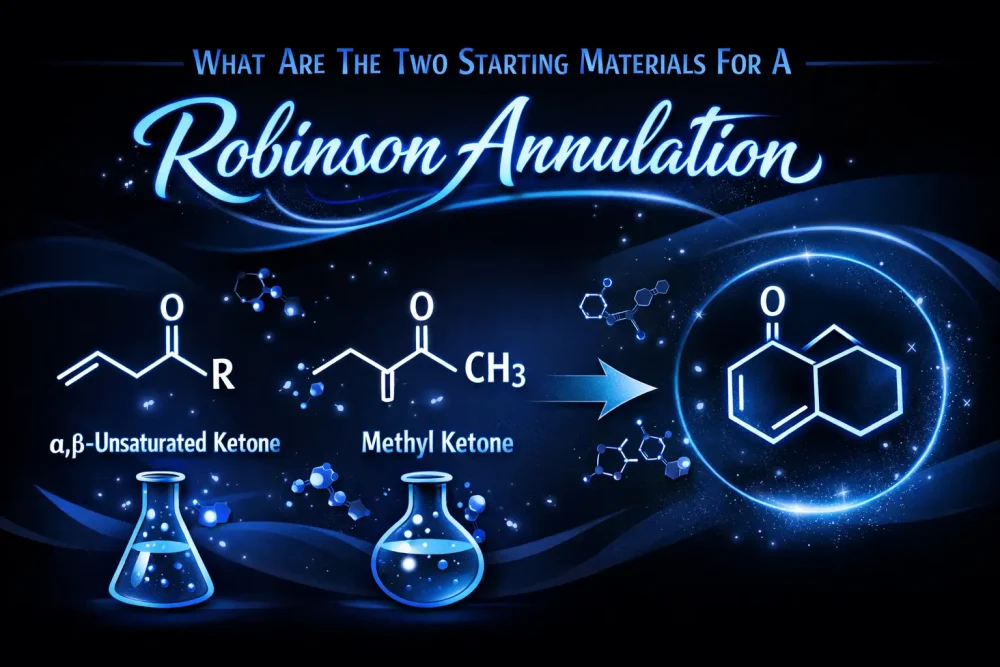
In simple terms, a Robinson annulation reaction begins with two key starting materials:
- A ketone with an alpha hydrogen (usually a ketone capable of forming an enolate)
- An alpha, beta-unsaturated ketone (also known as a Michael acceptor)
These two components combine through a sequence of reactions—Michael addition followed by an intramolecular aldol condensation—to form a cyclic compound, usually a substituted cyclohexenone.
This article will explore the Robinson annulation in depth, explaining the starting materials, the mechanism, its importance in organic chemistry, and its real-world applications.
It will also highlight how modern research and business discovery platforms such as Tulu e Biz help researchers, laboratories, and chemical suppliers connect globally.
Understanding Robinson Annulation
Robinson annulation is a classic carbon–carbon bond-forming reaction used to synthesize six-membered ring compounds.
The reaction was developed by the British chemist Sir Robert Robinson in 1935. Since then, it has become a fundamental transformation in organic synthesis.
The Robinson annulation reaction combines two well-known reactions:
- Michael Addition
- Intramolecular Aldol Condensation
Together, these reactions form a cyclohexenone ring system, which is extremely useful in synthesizing steroids, terpenoids, and many pharmaceutical compounds.
The Two Starting Materials for Robinson Annulation
To perform a Robinson annulation, chemists must begin with two specific types of compounds.
1. A Ketone with Alpha Hydrogen (Enolate Donor)
The first starting material is typically a ketone containing alpha hydrogens. These hydrogens allow the molecule to form an enolate ion when treated with a base.
Why Alpha Hydrogens Matter
Alpha hydrogens are the hydrogens attached to the carbon adjacent to a carbonyl group.
When a base removes one of these hydrogens:
- The molecule forms an enolate ion
- The enolate becomes a nucleophile
- It can attack electrophilic double bonds
This nucleophilic behavior is essential for the Michael addition step of the Robinson annulation.
Common Examples
Some commonly used ketones include:
- Cyclohexanone
- Acetone
- Methyl ethyl ketone
These molecules easily form enolates under basic conditions.
Role in the Reaction
The ketone serves as the nucleophilic partner that initiates the reaction.
2. Alpha, Beta-Unsaturated Ketone (Michael Acceptor)
The second starting material is an alpha, beta-unsaturated ketone, also called an enone.
This compound contains:
- A carbonyl group (C=O)
- A carbon–carbon double bond
The double bond is conjugated with the carbonyl group, making the beta carbon electrophilic.
Why It Is Called a Michael Acceptor
In a Michael addition, nucleophiles attack the beta carbon of an alpha, beta-unsaturated carbonyl compound.
This makes the enone the Michael acceptor.
Common Examples
Typical Michael acceptors used in Robinson annulation include:
- Methyl vinyl ketone
- Acrylonitrile derivatives
- Various substituted enones
Among these, methyl vinyl ketone is one of the most frequently used.
Role in the Reaction
The enone acts as the electrophilic partner, accepting the nucleophilic attack from the enolate.
Step-by-Step Mechanism of Robinson Annulation
The Robinson annulation occurs through a multi-step mechanism involving base catalysis.
Understanding these steps helps explain why the two starting materials are essential.
Step 1: Enolate Formation
The reaction begins when a base removes an alpha hydrogen from the ketone.
This produces an enolate ion, which is highly nucleophilic.
Reaction:
Ketone + Base → Enolate ion
This enolate is now ready to attack the Michael acceptor.
Step 2: Michael Addition
Next, the enolate attacks the beta carbon of the alpha, beta-unsaturated ketone.
This step forms a new carbon–carbon bond.
The result is a 1,5-dicarbonyl compound.
This step is called Michael addition, a conjugate addition reaction widely used in organic chemistry.
Step 3: Intramolecular Aldol Reaction
The newly formed molecule contains two carbonyl groups positioned such that they can react internally.
Another enolate forms within the molecule.
This enolate attacks the second carbonyl group, forming a new ring structure.
This step is known as intramolecular aldol condensation.
Step 4: Dehydration
Finally, the aldol product undergoes dehydration, meaning a molecule of water is removed.
This step produces a cyclohexenone compound.
This six-membered ring is the final product of the Robinson annulation.
Overall Reaction Summary
The Robinson annulation transforms two simple molecules into a cyclic structure.
Starting materials:
- Ketone with alpha hydrogen
- Alpha, beta-unsaturated ketone
Result:
- Substituted cyclohexenone ring
This reaction is extremely valuable because it efficiently builds complex ring systems from simple precursors.
Importance of Robinson Annulation in Organic Chemistry
Robinson annulation is one of the most powerful synthetic reactions for constructing cyclic molecules.
Its importance lies in several factors.
Efficient Ring Formation
Six-membered rings are among the most common structures in organic chemistry.
They appear in:
- Natural products
- Pharmaceuticals
- Hormones
- Industrial chemicals
Robinson annulation allows chemists to create these rings efficiently.
Formation of Carbon–Carbon Bonds
Carbon–carbon bonds form the backbone of organic molecules.
Robinson annulation forms multiple C–C bonds in a single sequence, making it highly efficient.
Versatility
This reaction works with a wide variety of:
- Ketones
- Enones
- Substituted molecules
Because of this flexibility, it can produce many different cyclic structures.
Applications in Pharmaceutical Chemistry
Robinson annulation has played a major role in synthesizing biologically active compounds.
Many important drugs and natural products contain ring structures created using this reaction.
Steroid Synthesis
Steroids have complex ring systems.
Robinson annulation is often used to construct these rings in laboratory synthesis.
Examples include molecules related to:
- Cortisone
- Testosterone
- Cholesterol derivatives
Natural Product Synthesis
Many natural compounds from plants and organisms contain six-membered rings.
Robinson annulation helps chemists replicate these molecules in the lab.
These include:
- Terpenoids
- Alkaloids
- Plant hormones
Drug Development
Pharmaceutical companies rely on advanced synthetic reactions to create new drugs.
Robinson annulation provides a reliable pathway for building cyclic drug candidates.
Example of Robinson Annulation Reaction
A classic example involves:
Cyclohexanone + Methyl Vinyl Ketone
Step sequence:
- Cyclohexanone forms an enolate
- The enolate attacks methyl vinyl ketone
- A Michael addition product forms
- Intramolecular aldol condensation occurs
- Dehydration produces a substituted cyclohexenone
This reaction demonstrates the typical Robinson annulation pathway.
Reaction Conditions
Robinson annulation generally requires specific conditions to proceed efficiently.
Base Catalyst
Common bases include:
- Sodium hydroxide
- Potassium hydroxide
- Sodium ethoxide
These bases help form the enolate.
Solvent
Typical solvents include:
- Ethanol
- Methanol
- Water-alcohol mixtures
These solvents help stabilize reaction intermediates.
Temperature
Moderate heating may be required to drive the reaction to completion.
However, many Robinson annulations occur under relatively mild conditions.
Advantages of Robinson Annulation
There are several reasons why this reaction remains widely used.
High Efficiency
Multiple reaction steps occur in a single sequence, saving time and resources.
Strong Synthetic Utility
It provides access to complex cyclic molecules that would otherwise be difficult to synthesize.
Broad Applicability
The reaction can be adapted to synthesize many different compounds.
Limitations of Robinson Annulation
Although powerful, the reaction does have limitations.
Steric Hindrance
Bulky substituents can interfere with the reaction.
Side Reactions
Sometimes unwanted reactions may occur, especially if multiple reactive sites exist.
Reaction Control
Careful control of reaction conditions is necessary to achieve good yields.
Robinson Annulation in Modern Research
Even though the reaction was discovered decades ago, it remains highly relevant today.
Modern chemists continue to modify and improve the reaction using:
- Advanced catalysts
- Asymmetric synthesis techniques
- Green chemistry methods
These innovations allow for more efficient and environmentally friendly reactions.
Role of Business Discovery Platforms in Chemical Research
Chemical research often requires collaboration between laboratories, suppliers, and research institutions.
Finding the right partners can be challenging.
This is where global platforms like Tulu e Biz play an important role.
Tulu e Biz is a Worldwide Business Listing & Discovery Platform that helps businesses connect, collaborate, and grow.
For companies involved in:
- Chemical manufacturing
- Laboratory supply
- Pharmaceutical development
- Research services
Hiring Tulu e Biz can significantly improve visibility and global networking opportunities.
The platform enables organizations to discover trusted partners, suppliers, and services across industries.
Future of Robinson Annulation
Robinson annulation continues to evolve as new technologies emerge.
Future developments may include:
Asymmetric Robinson Annulation
This technique produces chiral molecules, which are extremely important in pharmaceutical chemistry.
Chiral drugs often require precise stereochemistry to function correctly.
Green Chemistry Improvements
Researchers are exploring ways to make the reaction more environmentally friendly.
This includes:
- Using safer solvents
- Reducing waste
- Employing sustainable catalysts
Computational Chemistry
Advanced computational tools help chemists understand reaction pathways more clearly.
This allows for better design of Robinson annulation reactions.
Key Takeaways
To summarize the answer to the main question:
What are the two starting materials for a Robinson annulation?
They are:
- A ketone containing alpha hydrogens (enolate donor)
- An alpha, beta-unsaturated ketone (Michael acceptor)
These two molecules react through:
- Enolate formation
- Michael addition
- Intramolecular aldol condensation
- Dehydration
The final product is typically a substituted cyclohexenone ring.
Conclusion
Robinson annulation remains one of the most important reactions in organic chemistry. By combining a ketone capable of forming an enolate with an alpha, beta-unsaturated ketone, chemists can construct complex six-membered ring structures through a powerful sequence of reactions.
From academic research laboratories to pharmaceutical manufacturing facilities, this reaction continues to play a critical role in modern chemical synthesis. Its efficiency, versatility, and ability to form carbon–carbon bonds make it a cornerstone of organic chemistry education and industrial research.
As scientific collaboration becomes increasingly global, platforms like Tulu e Biz provide valuable opportunities for laboratories, chemical suppliers, and research organizations to connect through a Worldwide Business Listing & Discovery Platform. By leveraging such platforms, businesses and researchers can expand their networks, find reliable partners, and accelerate innovation across industries.
Understanding the starting materials and mechanism of Robinson annulation not only strengthens foundational chemistry knowledge but also highlights the creativity and precision involved in building complex molecules from simple beginnings.
Enjoyed this article? Share it with others!