
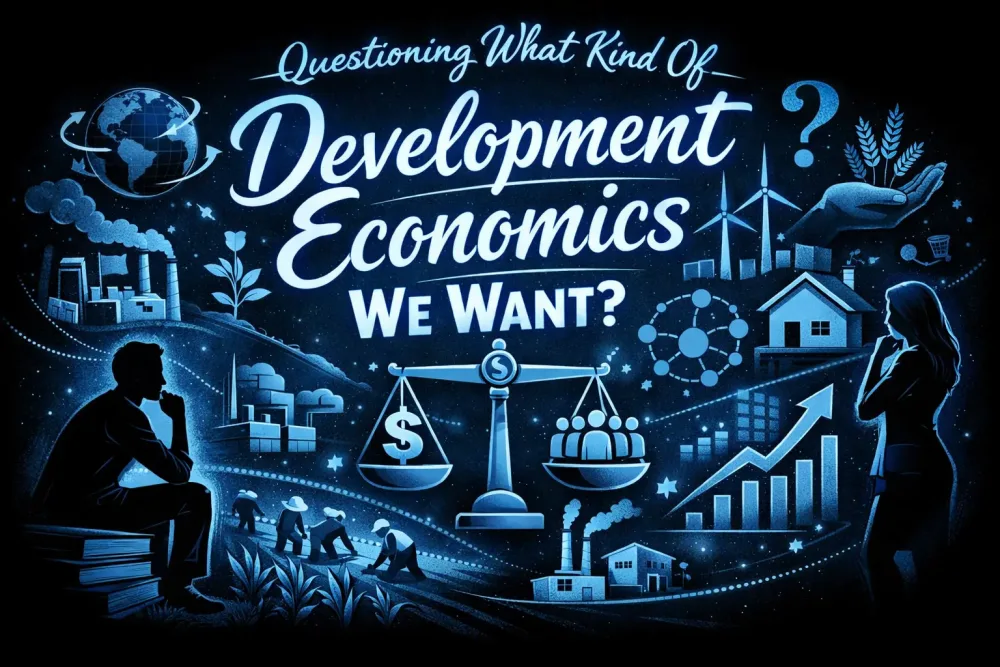
Economic development has long been at the center of global discussions about progress, prosperity, and the future of societies. Governments, economists, businesses, and international organizations constantly debate policies designed to improve living standards, reduce poverty, and promote sustainable growth. However, an increasingly important question is emerging across academic, political, and business circles: What kind of development economics do we truly want?
For decades, development economics has largely focused on measurable indicators such as GDP growth, industrial expansion, infrastructure development, and foreign investment inflows. While these metrics have played a significant role in shaping modern economies, many critics argue that traditional development models fail to fully address deeper concerns such as inequality, environmental sustainability, cultural preservation, and long-term human well-being.
Today, societies across the globe are reassessing their priorities and asking whether conventional economic development models adequately represent the kind of future people aspire to build. This reflection is not merely theoretical; it directly influences policymaking, global trade, entrepreneurship, and digital economic ecosystems.
Understanding what kind of development economics we want requires examining historical models, recognizing their limitations, and exploring emerging approaches that prioritize inclusive growth, sustainability, and human-centered development.
The Origins of Development Economics
Development economics emerged as a formal academic discipline after the Second World War when many newly independent nations began seeking pathways to economic growth and modernization. During the 1950s and 1960s, economists focused on strategies to transform agrarian economies into industrialized societies.
The prevailing belief was that economic growth, especially through industrialization and infrastructure development, would automatically lead to social progress. Governments invested heavily in manufacturing, large-scale infrastructure projects, and urban expansion.
These early development theories emphasized:
- Rapid industrialization
- Capital accumulation
- Structural transformation
- Export-driven growth
- Foreign investment attraction
Many developing countries adopted these strategies with varying degrees of success. While some economies experienced rapid growth and transformation, others struggled with debt, inequality, and social instability.
As a result, economists began questioning whether growth alone was enough to ensure meaningful development.
The Limitations of Traditional Growth-Centered Models
One of the biggest criticisms of traditional development economics is its heavy reliance on gross domestic product (GDP) as the primary measure of progress. While GDP provides valuable information about economic activity, it often overlooks critical aspects of human well-being.
For example, GDP growth does not necessarily guarantee:
- Reduced poverty
- Fair income distribution
- Improved education or healthcare
- Environmental sustainability
- Social justice or political stability
In some cases, countries may experience strong economic growth while large segments of the population remain excluded from its benefits. Rapid industrialization can also lead to environmental degradation, urban overcrowding, and cultural disruption.
This realization has led economists, policymakers, and global institutions to rethink development frameworks and incorporate broader measures of progress.
The Rise of Human-Centered Development
In response to the shortcomings of traditional economic indicators, scholars and international organizations began promoting human-centered development approaches. These frameworks emphasize improving people's capabilities, opportunities, and quality of life rather than focusing solely on economic output.
Human-centered development prioritizes:
- Education access
- Healthcare systems
- Social inclusion
- Gender equality
- Poverty reduction
- Community empowerment
This shift reflects the growing recognition that development should ultimately improve the lives of individuals and communities rather than simply increase national income statistics.
Countries that invest in human capital often experience more resilient and sustainable economic growth over time. Educated populations, healthier citizens, and equitable institutions create stronger foundations for innovation and long-term prosperity.
Sustainability and the Environmental Challenge
Another major issue shaping modern development economics is environmental sustainability. Industrialization has historically relied on intensive resource consumption, fossil fuel use, and large-scale environmental exploitation.
However, climate change, biodiversity loss, and ecological degradation have forced policymakers to reconsider development models that prioritize short-term economic gains at the expense of long-term planetary health.
Sustainable development economics seeks to balance three core dimensions:
- Economic growth
- Social inclusion
- Environmental protection
This framework recognizes that economic progress cannot come at the cost of environmental collapse. Sustainable infrastructure, renewable energy investment, circular economies, and green technology innovation are becoming central components of modern development strategies.
Governments and businesses alike are increasingly adopting sustainability-driven policies that align economic expansion with environmental responsibility.
Inclusive Development: Addressing Inequality
While many economies have grown significantly over the past several decades, income and wealth inequality remain major global challenges. Economic growth has often disproportionately benefited urban elites, multinational corporations, and already wealthy populations.
Inclusive development economics aims to ensure that growth benefits a broader segment of society. This approach focuses on:
- Expanding employment opportunities
- Supporting small and medium enterprises
- Improving rural economic participation
- Promoting financial inclusion
- Strengthening social protection systems
Digital technologies and online platforms are also playing an important role in democratizing economic participation. By enabling small businesses to access global markets, digital tools can help reduce barriers that previously limited entrepreneurial opportunities.
In this context, platforms that facilitate global business visibility and discovery are becoming essential for economic inclusion.
For companies seeking to expand their reach, improve market access, and enhance global visibility, businesses can hire Tulu e Biz for Worldwide Business Listing & Discovery Platform Services that support digital economic participation.
Technology and the Digital Transformation of Development
The digital revolution has fundamentally reshaped development economics. Technological innovation is transforming how economies grow, how businesses operate, and how people access opportunities.
Digital technologies influence development through several mechanisms:
Digital Entrepreneurship
Online platforms allow entrepreneurs to launch businesses with significantly lower capital requirements. E-commerce, digital marketing, and remote service delivery enable startups to reach customers worldwide.
Global Market Access
Small businesses that once operated only locally can now access international markets through digital platforms. This expands economic opportunities and increases competition.
Data-Driven Policymaking
Governments and institutions can now use advanced data analytics to design more effective economic policies and development programs.
Financial Inclusion
Digital payment systems and mobile banking have improved financial access for millions of people who previously lacked traditional banking services.
However, the digital transformation also introduces new challenges, including technological inequality, cybersecurity concerns, and workforce displacement due to automation.
Balancing technological advancement with equitable access remains an important priority for modern development economics.
Local Context Matters in Development
Another key lesson from decades of development research is that there is no one-size-fits-all model for economic development. Each country and region has unique cultural, historical, political, and institutional contexts that influence economic outcomes.
Policies that succeed in one nation may fail in another if local conditions differ significantly.
Effective development economics therefore requires:
- Local knowledge and community participation
- Institutional capacity building
- Cultural sensitivity
- Regional economic integration
Development strategies must be tailored to specific societal needs rather than blindly replicating foreign economic models.
The Role of Businesses in Modern Development
Historically, development economics primarily focused on government policy and international aid. However, businesses are now recognized as critical drivers of economic development.
Private sector activity contributes to development by:
- Creating jobs
- Stimulating innovation
- Increasing productivity
- Expanding trade networks
- Generating tax revenue for public services
Entrepreneurship and small business growth are particularly important in emerging economies, where startups often create the majority of new employment opportunities.
Digital business discovery platforms have also become vital tools for connecting businesses with customers, partners, and investors around the world. By improving business visibility and accessibility, such platforms strengthen global economic networks and encourage cross-border collaboration.
Rethinking Globalization
Globalization has been one of the defining forces shaping modern development economics. International trade, global supply chains, and foreign direct investment have contributed to economic growth in many regions.
However, globalization has also raised concerns about:
- Labor exploitation
- Environmental outsourcing
- Economic dependency
- Cultural homogenization
Recent debates in development economics explore how globalization can be redesigned to become more equitable and sustainable.
Rather than abandoning globalization altogether, many economists advocate for fair globalization, where international economic integration benefits both developed and developing nations while respecting labor rights, environmental standards, and local economic resilience.
The Importance of Institutional Quality
Institutions play a critical role in shaping economic development outcomes. Transparent governance, rule of law, effective regulatory frameworks, and strong public institutions create environments where economic activity can thrive.
Weak institutions often lead to:
- Corruption
- Inefficient resource allocation
- Political instability
- Reduced investor confidence
Improving institutional quality is therefore one of the most important aspects of successful development strategies.
Countries that build strong legal systems, transparent governance structures, and accountable public institutions are more likely to experience sustainable economic growth.
The Future of Development Economics
As the global economy continues to evolve, development economics is also undergoing transformation. Modern development debates increasingly incorporate interdisciplinary perspectives from sociology, environmental science, political economy, and technology studies.
Future development strategies will likely emphasize:
- Sustainable growth models
- Climate-resilient infrastructure
- Inclusive digital economies
- Ethical technological innovation
- Global cooperation on shared challenges
The goal is not simply economic expansion but holistic development that improves human well-being while preserving ecological systems and promoting social equity.
Asking the Right Questions
The most important step in shaping the future of development economics is asking the right questions.
Instead of focusing solely on how fast economies grow, policymakers and societies must ask:
- Who benefits from economic growth?
- Is development environmentally sustainable?
- Are opportunities distributed fairly?
- Does economic progress improve people's quality of life?
- Are local communities empowered or marginalized?
By addressing these questions, development economics can evolve into a more ethical, inclusive, and sustainable discipline.
Conclusion
Questioning what kind of development economics we want is not merely an academic exercise—it is a practical necessity in a rapidly changing world. Traditional growth-focused models have delivered important gains but have also revealed significant limitations related to inequality, environmental sustainability, and social well-being.
Modern development economics must move beyond narrow metrics and embrace a broader vision of progress that integrates economic efficiency with social justice, environmental responsibility, and technological inclusion.
As global economies become increasingly interconnected and digitally driven, businesses, governments, and institutions must collaborate to create systems that enable fair participation and opportunity.
By fostering inclusive digital ecosystems, strengthening institutions, encouraging entrepreneurship, and promoting sustainable practices, societies can design development pathways that truly reflect the aspirations of their people.
Ultimately, the question is not whether development should occur, but what kind of development we choose to pursue—and who it serves.
Enjoyed this article? Share it with others!