
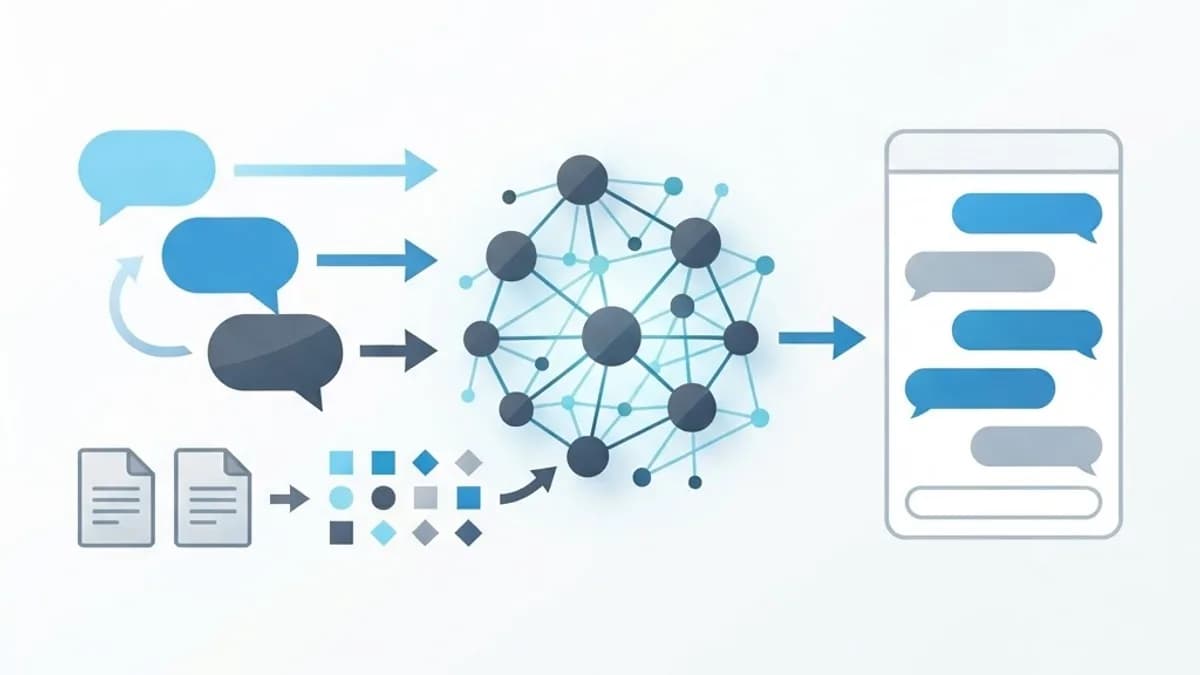
Language is the messiest data your business owns. Support tickets, reviews, contracts, emails, chat logs — all valuable, none of it fitting neatly into a spreadsheet column.
NLP modeling is how that mess becomes usable. Natural language processing models learn to classify, extract, summarise and generate text, turning unstructured writing into structured signals a system can act on.
Over the past few years the field shifted dramatically. Where teams once trained models from scratch on labelled datasets, most now fine-tune or prompt a pretrained transformer. This guide covers both worlds and how to choose between them.
What Is NLP Modeling?
NLP modeling is the practice of building statistical or neural models that understand and produce human language. A model takes text as input and returns a prediction: a sentiment label, an extracted entity, a translation, a summary, or the next likely token.
Under the hood, text must first become numbers. Tokenisation splits writing into units, and embeddings map those units into vectors where semantically similar words sit close together. Everything a language model does depends on the quality of that representation step.
Model families range from simple to sophisticated: bag-of-words with logistic regression for basic classification, recurrent networks for sequences, and transformer architectures — the basis of BERT, GPT and their descendants — for nearly everything demanding today.
Who Uses NLP Modeling?
Any team drowning in text has a candidate use case. The barrier is now cost and clarity, not access to technology.
- Customer support teams auto-routing tickets by intent and flagging urgent or angry messages first.
- Product and research teams mining thousands of reviews for recurring feature complaints.
- Legal and compliance departments extracting clauses, dates and obligations from contract archives.
- Marketing and content teams handling classification, tagging and drafting at scale, often paired with professional content writing services for editorial quality control.
- Healthcare and finance analysts structuring clinical notes or filings into searchable fields.
Key Techniques in NLP Modeling
Text Classification
The workhorse task. Assign a label to a document: spam or not, positive or negative, billing or technical. It is the easiest to evaluate and usually the fastest route to measurable value.
Named Entity Recognition
NER pulls specific spans out of text — people, companies, amounts, dates, product codes. It converts a paragraph into database fields, which is why it powers so much document automation.
Embeddings and Semantic Search
Rather than matching keywords, embedding-based search compares meaning. A query about "cancelling my plan" retrieves documents about "ending a subscription" even with zero shared words. This underpins most retrieval-augmented generation systems.
Fine-Tuning and Prompting
Fine-tuning adapts a pretrained model to your domain with a few hundred to a few thousand examples. Prompting skips training entirely by instructing a large model at inference time. Prompting is faster to test; fine-tuning is usually cheaper and more consistent at volume.
How to Get Started With NLP Modeling
Begin with a narrow, high-frequency task where a correct answer is unambiguous. Ambiguous tasks make evaluation impossible and progress unmeasurable.
- Pick one task with clear labels. Ticket categorisation beats "understand our customers".
- Assemble and label a dataset. Even 500 well-labelled examples establish a real baseline.
- Set a simple baseline. TF-IDF plus logistic regression takes an hour and often performs surprisingly well.
- Try a pretrained model. Prompt a general-purpose LLM or fine-tune a smaller transformer and compare against the baseline.
- Evaluate on held-out data. Use precision, recall and F1 — accuracy alone hides failure on rare but important classes.
- Deploy behind an API. Expose the model as an endpoint your product can call, typically through robust back-end web development that handles queuing, caching and rate limits.
- Monitor and iterate. Log low-confidence predictions and feed corrected examples back into training.
Benefits of NLP Modeling
The gains are mostly about scale and consistency on work humans find tedious.
- Massive throughput. A model reads 50,000 reviews in minutes; a team would need weeks.
- Consistent labelling. No drift from reviewer fatigue or differing interpretations.
- Faster response times. Auto-triage puts urgent tickets in front of the right person immediately.
- Hidden insight discovery. Clustering open-ended feedback surfaces themes nobody thought to survey about.
- Multilingual reach. Modern models handle dozens of languages without separate pipelines per market.
Potential Challenges
Language modelling has failure modes that do not exist in numeric analytics.
- Ambiguity and sarcasm. "Great, another outage" is positive by word choice and negative in meaning.
- Bias in training data. Models inherit and can amplify patterns present in historical text.
- Hallucination in generative models. Fluent output is not verified output, which is dangerous for factual tasks.
- Privacy exposure. Text often contains personal information, so processing needs a proper cybersecurity and data protection approach.
Best Practices and Tips
The teams that succeed treat data curation as the main lever.
- Invest in labelling guidelines. Two annotators disagreeing 20% of the time caps your model's ceiling.
- Always keep a human in the loop for high-stakes decisions; use the model to prioritise, not to finalise.
- Start with the smallest model that works. Latency and cost matter more in production than benchmark scores.
- Log inputs and outputs so you can audit behaviour and build a retraining set from real traffic.
Real-World Example
A software company received roughly 900 support tickets weekly, all manually triaged by two agents who spent about three hours daily on routing alone. The team exported 6,000 historical tickets already tagged with a category and priority.
They started with a TF-IDF baseline that reached 71% category accuracy. Fine-tuning a small transformer on the same data pushed it to 89%. Rather than fully automating, they routed high-confidence predictions automatically and sent anything below 80% confidence to human review. Triage time dropped from three hours to about forty minutes daily, and first-response time on urgent tickets improved by more than half. The corrected human decisions became new training data, and accuracy climbed further over the following months.
Why NLP Modeling Matters
Roughly 80% of enterprise data is unstructured, and most of that is text. Organisations that can read it programmatically operate with information their competitors technically possess but cannot access.
Costs have also fallen sharply. Pretrained models, hosted inference and open-source tooling mean a small team can ship a useful NLP feature in weeks, then expand with dedicated AI development and integration services once the value is proven.
Frequently Asked Questions
Do I need to train a model from scratch?
Almost never. Fine-tuning a pretrained model or prompting a hosted LLM delivers better results for a fraction of the cost and data requirement.
How much labelled data does NLP modeling need?
For classification, a few hundred examples per class gets a usable prototype; a few thousand gets production quality. Prompting a large model can work with only a handful of examples.
What is the difference between NLP and an LLM?
NLP is the whole field of processing language. Large language models are one powerful family of NLP models — excellent for generation and few-shot tasks, but often overkill for narrow classification.
How do I stop a model from hallucinating?
Ground it. Retrieval-augmented generation supplies verified source documents at query time, and citing sources lets users verify claims rather than trusting fluency.
Conclusion
NLP modeling has moved from research speciality to practical business tooling. Pick one clear text task, label it carefully, start with a simple baseline, and only reach for larger models when the numbers justify it.
Ready to turn your text data into structured insight? Explore expert artificial intelligence solutions to plan and build your first production NLP system.
Enjoyed this article? Share it with others!