
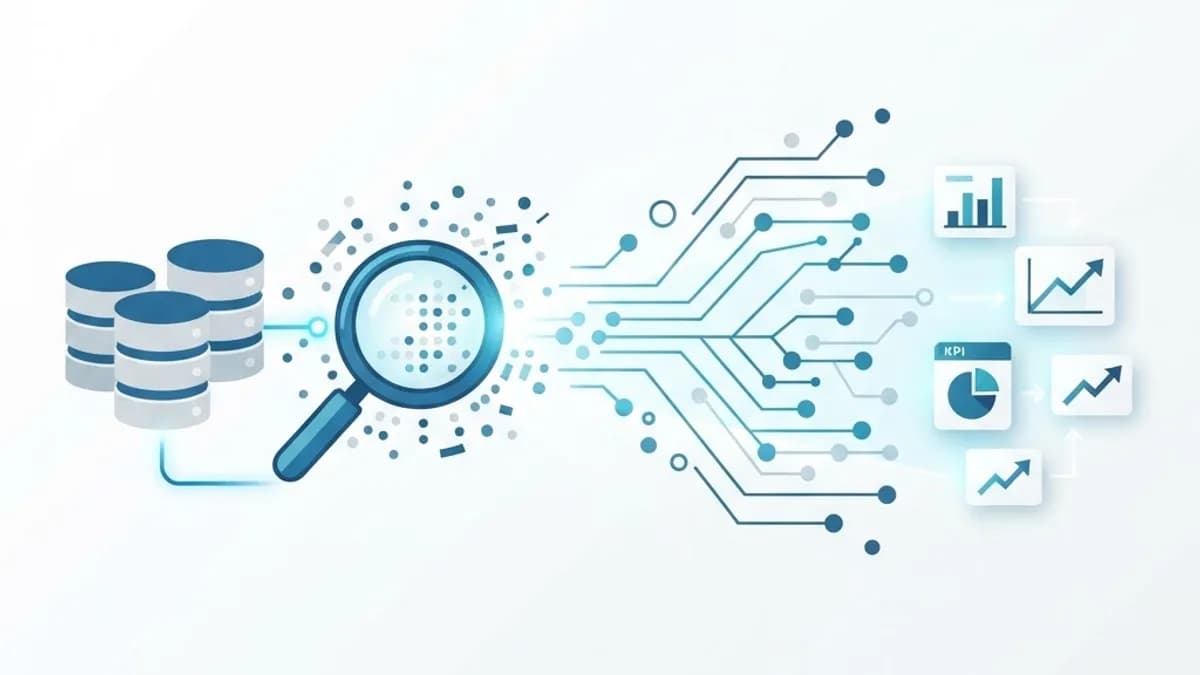
Companies rarely lack data. They lack the patterns hidden inside it. Which customers buy together, which behaviours precede cancellation, which suppliers cause delays — the answers already exist in records nobody has systematically examined.
Data mining for business analytics is the discipline of finding those patterns deliberately. It combines statistics, machine learning and database techniques to surface relationships too subtle or too numerous for manual review.
This guide explains what it involves, which techniques matter commercially, how a project actually runs, and how to avoid the classic pitfalls that produce impressive-looking nonsense.
What Is Data Mining for Business Analytics?
Data mining is the process of discovering previously unknown, actionable patterns in large datasets. Business analytics is the application of data to commercial decisions. Together they describe using pattern-discovery techniques to answer questions that affect revenue, cost and risk.
The distinction from ordinary reporting matters. A report answers a question you already thought to ask. Data mining finds relationships nobody hypothesised in advance — for example, that customers who contact support during onboarding actually retain better than those who never do.
The main technique families are classification, regression, clustering, association rule mining and anomaly detection. Each answers a different shape of business question, and choosing correctly is most of the skill.
Who Uses Data Mining in Business?
It is no longer restricted to large enterprises with dedicated data teams. Cloud tooling has pushed it well into mid-market territory.
- Retail and ecommerce for market basket analysis, recommendation engines and demand forecasting.
- Banking and insurance for credit scoring, fraud detection and claims triage.
- Telecom providers for churn prediction and network-fault anomaly detection.
- Marketing teams for customer segmentation and campaign response modelling, often feeding results back into targeted email marketing campaigns that use the discovered segments.
- Manufacturing and logistics for predictive maintenance and quality-defect root-cause analysis.
Key Data Mining Techniques for Business
Classification and Prediction
Assign records to categories based on labelled history: will this customer churn, is this transaction fraudulent, will this lead convert. Decision trees, logistic regression and gradient boosting dominate here because they handle mixed data types well.
Clustering and Segmentation
Group similar records without predefined labels. Instead of segmenting customers by assumption, clustering lets the data define natural groups — frequently revealing segments marketing had never targeted separately.
Association Rule Mining
The classic "customers who bought X also bought Y" analysis. It powers cross-sell placement, bundle design and store layout, and works on any transaction-style data including support ticket co-occurrence.
Anomaly Detection
Identify records that deviate meaningfully from the norm. Applications include fraud, billing errors, sensor faults and data-quality monitoring. It is especially valuable where labelled fraud examples are scarce.
How to Run a Data Mining Project
The CRISP-DM framework remains the practical standard because it starts and ends with business understanding rather than technique.
- Define the business objective. State the decision the results will drive and how success gets measured in money or time.
- Understand and profile the data. Check volumes, date ranges, missing rates and whether the outcome you want to predict is even recorded.
- Prepare the dataset. Clean, deduplicate, join sources and engineer features such as recency, frequency and monetary value.
- Select and apply techniques. Match method to question — clustering for segmentation, classification for yes/no prediction.
- Evaluate against a holdout. Validate on data the model never saw, split by time where possible.
- Deploy into a workflow. Deliver scores into the CRM, ERP or a reporting interface built through professional web development so results are visible where work happens.
- Monitor and refresh. Patterns decay; schedule periodic re-mining and compare against the original findings.
Benefits of Data Mining for Business Analytics
Well-executed projects tend to pay back through a small number of large effects rather than many small ones.
- Higher retention. Churn models let teams intervene weeks before a customer leaves.
- Increased basket size. Association rules improve cross-sell relevance measurably over generic bundles.
- Reduced fraud and waste. Anomaly detection catches leakage that routine reporting never surfaces.
- Smarter segmentation. Data-derived segments outperform demographic guesses in campaign response.
- Better forecasting. Demand models cut both stockouts and excess inventory simultaneously.
Potential Challenges
The technical work is often the easy part. These are the issues that actually derail projects.
- Dirty and fragmented data. Duplicate customer records alone can invalidate an entire segmentation.
- Spurious correlations. Mine enough variables and you will find meaningless relationships that look statistically significant.
- Privacy and regulatory limits. Personal data mining requires lawful basis, minimisation and strong access control.
- Insight without action. A discovered pattern that nobody owns operationally produces zero return.
Best Practices and Tips
Discipline in these four areas separates useful mining from data dredging.
- Form a hypothesis before mining where possible, and treat unexpected findings as candidates for testing rather than facts.
- Validate any surprising pattern on a separate time period before acting on it.
- Involve domain experts early. They will spot the data artefact that looks like an insight in ten seconds.
- Document every transformation so findings can be reproduced and defended months later.
Real-World Example
A specialty food retailer with 40 stores and an online channel wanted to increase average order value. Rather than guessing at bundles, the analytics team ran association rule mining on 18 months of transaction data covering roughly 2.1 million line items.
Most discovered rules were obvious — pasta with sauce, coffee with filters. But two were not. Customers buying premium olive oil bought artisan bread at nearly four times the baseline rate, and buyers of a specific spice range purchased slow cookers far more often than average. Neither pairing was co-located in stores or linked online.
The team adjusted online recommendation slots and in-store adjacency for both pairings. Over the following quarter, attach rates on those combinations rose meaningfully and average online order value increased around 6%. The recommendation logic was implemented into their storefront as part of ongoing ecommerce solutions work, meaning the insight ran automatically rather than as a one-off promotion.
Why It Matters
Competitive advantage increasingly comes from acting on patterns faster than rivals notice them. Two retailers can hold identical transaction data while only one knows which pairings drive incremental spend.
There is also a defensive argument. Data mining reveals cost leakage, fraud and process failure that never appears in a standard monthly report — problems that compound silently until someone looks properly. Building that capability usually starts with a scoped project and, where needed, external AI and data science expertise to establish sound methodology from the outset.
Frequently Asked Questions
What is the difference between data mining and data analytics?
Data analytics is the broad practice of examining data to answer questions, including reporting. Data mining specifically focuses on discovering unknown patterns and relationships using algorithmic techniques.
How much data do I need for data mining?
It depends on the technique. Association rules need many transactions — ideally tens of thousands. Classification can work with a few thousand labelled records. Data quality consistently matters more than volume.
Is data mining legal?
Mining your own business data is legal, but processing personal information is governed by regulations like GDPR. You need a lawful basis, data minimisation, retention limits and appropriate security controls.
Which tools should a beginner use?
Python with pandas and scikit-learn, or R, cover nearly everything. For non-programmers, visual platforms such as KNIME, RapidMiner or Orange offer drag-and-drop workflows with the same underlying algorithms.
Conclusion
Data mining for business analytics turns dormant records into decisions. Define the commercial objective first, invest heavily in data preparation, validate surprising findings before trusting them, and make sure every insight has an owner who can act.
If your historical data has never been properly examined, that is opportunity sitting idle. Explore professional AI and data analytics services to plan a first project with measurable returns.
Enjoyed this article? Share it with others!