
Data mining stopped being a research topic years ago. It now quietly runs the fraud check on your card payment, the product suggestion on your last order, and the maintenance schedule on the plane you flew.
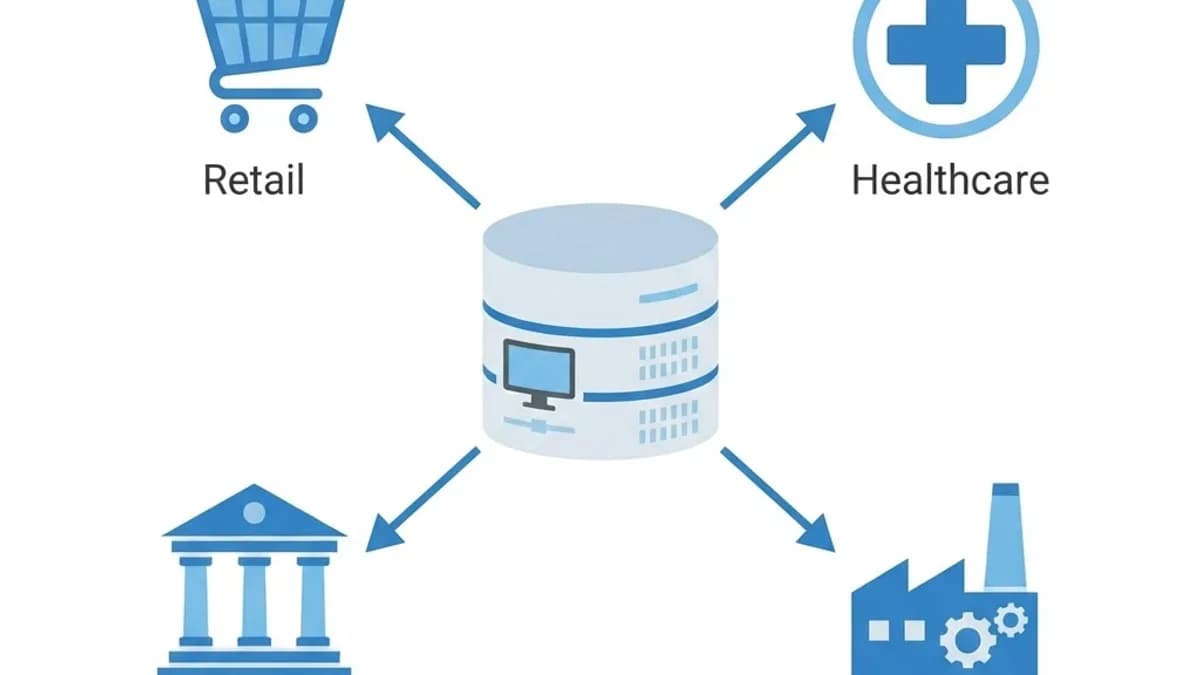
The most useful way to understand it is through concrete data mining applications in specific industries, because the techniques only make sense in context. Association rules mean little in the abstract and a great deal when you see them lifting basket size in a supermarket.
This article walks through eight industries, the technique each relies on, and what results look like in practice.
What Are Data Mining Applications?
Data mining applications are practical, deployed uses of pattern-discovery techniques to solve specific business or operational problems. They pair a technique — classification, clustering, association rules, anomaly detection, regression — with a decision that needs making repeatedly.
The pattern is consistent across every industry. Historical data reveals a relationship, that relationship becomes a scoring model, and the score triggers an action inside an existing workflow. The industry changes; the shape of the solution rarely does.
What differentiates a real application from an interesting analysis is deployment. A churn insight in a slide deck is analysis. A churn score appearing in the CRM every Monday morning is an application.
Who Uses Data Mining Applications?
Adoption now spans nearly every sector that keeps digital records, at very different maturity levels.
- Retail and ecommerce operators running recommendations, pricing and demand forecasting.
- Banks and insurers scoring credit risk, detecting fraud and triaging claims.
- Healthcare providers predicting readmissions and identifying at-risk patient cohorts.
- Telecom and subscription businesses managing churn and network anomalies.
- Marketing agencies segmenting audiences and optimising spend, frequently alongside social media management and audience analytics.
Key Data Mining Applications by Industry
Retail and Ecommerce
Market basket analysis identifies products purchased together, driving cross-sell placement and bundle design. Clustering builds behavioural customer segments, and regression forecasts demand at SKU level to reduce both stockouts and markdowns. Recommendation engines are typically the highest-revenue application, and they need clean product data delivered through capable ecommerce solutions to function well.
Banking and Financial Services
Credit scoring uses classification on repayment history to estimate default probability. Anomaly detection flags transactions deviating from a cardholder's established pattern in real time. Sequence mining detects money laundering structures that individual transaction rules miss entirely.
Healthcare
Classification models predict hospital readmission within 30 days, letting discharge teams intervene. Clustering identifies patient subgroups responding differently to a treatment protocol. Text mining structures clinical notes into searchable fields for research and audit.
Telecommunications
Churn prediction is the flagship use case — call patterns, billing changes and support contacts predict cancellation weeks ahead. Anomaly detection on network telemetry catches degrading equipment before outages, and clustering supports tariff design.
How Organisations Deploy Data Mining Applications
Deployment follows a consistent sequence regardless of industry. The technical modelling is often the shortest phase.
- Select a repeated, high-volume decision. Frequency is what makes automation worthwhile.
- Confirm the outcome is recorded historically. Without labelled outcomes, supervised techniques are impossible.
- Consolidate and clean the data. Join operational, customer and transactional sources into one modelling dataset.
- Match the technique to the question. Association rules for co-occurrence, classification for yes/no, clustering for grouping.
- Validate on unseen data, ideally a later time period than the training window.
- Embed scores into the workflow — CRM fields, operational dashboards, or an app built through custom web application development.
- Measure and retrain. Track business outcomes, not just model metrics, and refresh as patterns shift.
Benefits of Industry Data Mining Applications
Across sectors the returns cluster around a few consistent themes.
- Revenue lift from relevance. Personalised recommendations and offers convert measurably better than generic ones.
- Loss prevention. Fraud and anomaly detection catch leakage traditional rules-based checks miss.
- Reduced churn. Early risk scores enable retention action while it still works.
- Operational efficiency. Predictive maintenance and demand forecasting cut both downtime and waste.
- Better resource allocation. Scoring lets limited staff time focus on the highest-value cases.
Potential Challenges
The obstacles are remarkably similar across every industry, and mostly organisational.
- Siloed data ownership. The insight needs three departments' data and no single person can access all three.
- Regulatory constraints. Healthcare and finance face strict rules on personal data use and automated decisioning.
- Model bias and fairness risk. Historical patterns can encode discrimination, particularly in lending and hiring.
- Weak adoption. Frontline staff ignore scores they do not understand or trust.
Best Practices and Tips
These practices apply whether you are in retail or radiology.
- Pick one use case with a clear owner before attempting a portfolio of applications.
- Show the reason alongside the score. "High churn risk: no login 21 days, two open tickets" gets acted on; a bare number does not.
- Audit for disparate impact on protected groups before deploying any decision-affecting model.
- Instrument the business outcome from day one so you can prove value at review time.
Real-World Example
A mid-sized insurance company processed roughly 1,800 motor claims monthly. Fraud investigation relied on adjuster intuition and a short rules list, catching an estimated small fraction of suspicious claims while slowing legitimate ones.
The analytics team built an anomaly detection model on four years of claims data — roughly 78,000 records — using features covering claim timing relative to policy start, repair shop history, claim amount versus vehicle value, and prior claim frequency. Rather than labelling fraud outright, which was rare and inconsistently recorded, they scored claims by how unusual their feature combination was.
The top 5% by anomaly score went to a specialist investigation queue. In the first six months, that queue confirmed fraud at roughly four times the rate of the previous manual process, while average settlement time for the other 95% fell because fewer legitimate claims were held for review. The scores appeared directly in the adjuster interface with the three largest contributing factors listed, which was what secured adjuster trust. Access was tightly controlled under a formal cybersecurity and data governance policy given the sensitivity of the data involved.
Why It Matters
Every industry listed here has competitors sitting on comparable data. The differentiator is not collection but application — and specifically whether insight reaches a decision point fast enough to matter.
Barriers have also dropped sharply. Cloud infrastructure, open-source libraries and mature connectors mean a mid-sized company can deploy a genuine application in a quarter rather than a year, often with support from specialist AI and machine learning services to establish the first pipeline correctly.
Frequently Asked Questions
What is the most common data mining application?
Customer-facing prediction — churn scoring and recommendation engines — along with fraud and anomaly detection. These have the clearest revenue or loss impact, which makes them easiest to justify.
Which industries benefit most from data mining?
Retail, banking, telecommunications, insurance and healthcare see the largest returns because they combine high transaction volume, detailed records and frequently repeated decisions.
Can small businesses use data mining applications?
Yes, on a smaller scale. Customer segmentation, basket analysis and simple churn scoring work with a few thousand transactions and cost little using open-source tools and existing cloud storage.
How is data mining different from AI?
Data mining focuses on discovering patterns in existing data. AI is broader, covering systems that perceive, reason and act. Machine learning overlaps both and supplies many of the techniques data mining uses.
Conclusion
Data mining applications succeed when a discovered pattern reaches a repeated decision inside an existing workflow. Start with one high-frequency decision, ensure the outcome is recorded, explain scores rather than just presenting them, and measure the business result.
Wondering which application fits your industry and data? Explore professional AI and data mining services to identify the highest-return first project.
Enjoyed this article? Share it with others!