
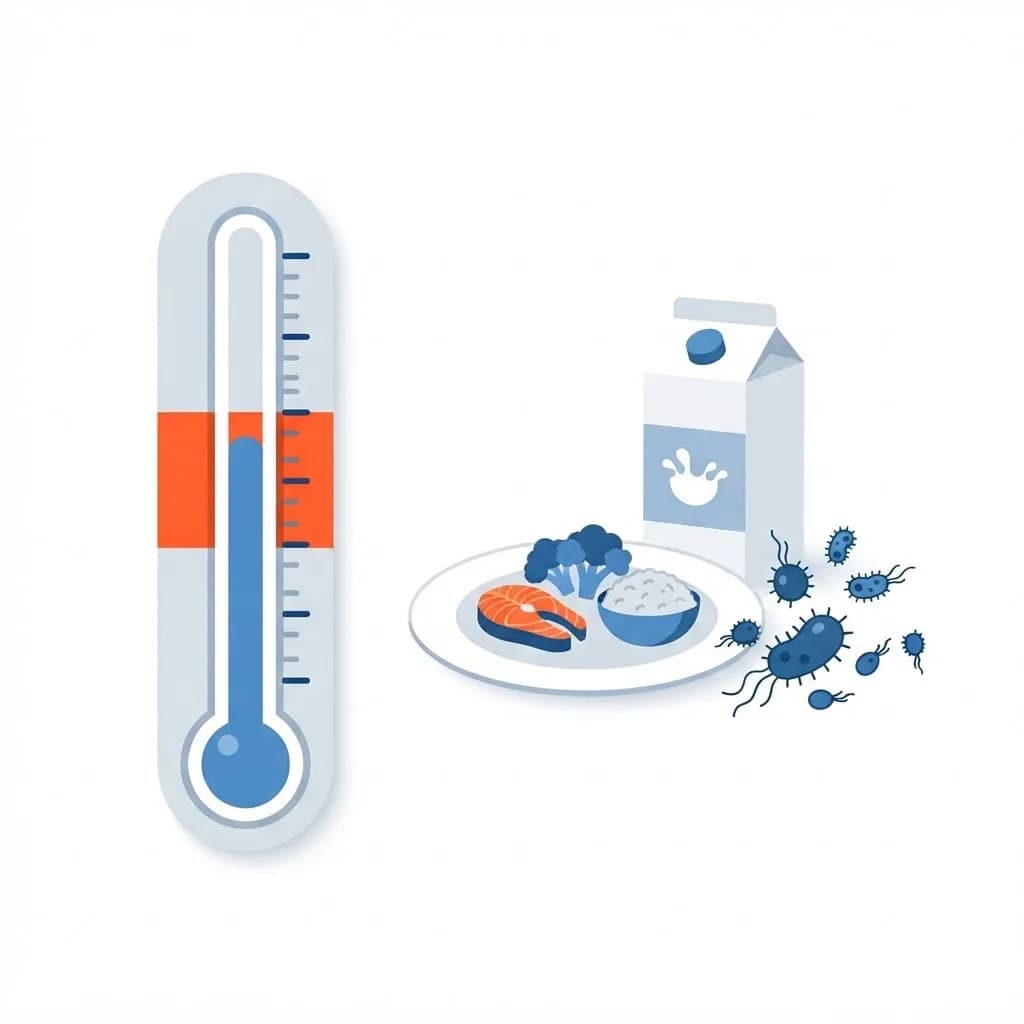
Exam questions phrase it neatly: which food is at a temperature that allows bacteria to grow? Real kitchens phrase it as a chicken breast sitting on a prep table at 10:47 a.m. The answer to both is the same — anything between 41°F and 135°F.
That range is called the temperature danger zone, and it is where pathogens multiply fast enough to make people sick.
This guide explains how the danger zone works, which foods are most vulnerable, how the four-hour rule applies, and the practical habits that keep food out of the range entirely.
What Is the Temperature Danger Zone?
The temperature danger zone is the range between 41°F and 135°F where bacteria that cause foodborne illness grow most rapidly. Any potentially hazardous food held in this range is at a temperature that allows bacteria to grow.
Growth is fastest between roughly 70°F and 125°F. In ideal conditions, some pathogens double in population every 20 minutes, which means a single cell can become millions in a few hours.
The critical control is total accumulated time in the zone — a maximum of four hours, counted across every exposure, not reset each time the food goes back in the cooler.
Which Foods Are Most at Risk?
Foods requiring time and temperature control for safety are moist, protein-rich, and low in acid.
- Raw and cooked meat, poultry, fish, and shellfish
- Milk, cream, soft cheeses, and other dairy products
- Cooked rice, pasta, beans, and other cooked starches
- Cut melons, cut leafy greens, cut tomatoes, and sprouts
- Eggs, tofu, soy products, and untreated garlic-in-oil mixtures
Key Features of Bacterial Growth Conditions
Temperature Is the Main Driver
Below 41°F growth slows dramatically; above 135°F most pathogens cannot multiply. The middle range is where risk lives, which is why holding temperatures sit deliberately outside it.
Time Accumulates and Never Resets
If chicken spends 90 minutes on a counter, 45 minutes in transport, and an hour on a buffet, that is three hours and 15 minutes of the four-hour budget gone permanently.
Moisture, pH, and Nutrients Matter
High water activity, near-neutral pH, and available protein all favor growth. This is why cooked rice and cut melon are riskier than dry crackers or vinegar-based pickles.
Danger Is Invisible
Pathogens rarely change smell, color, or taste. Staff who judge safety by appearance will miss it every time, which is why training material with clear visual charts — such as those built through purpose-designed infographics — outperforms verbal instruction.
How to Keep Food Out of the Danger Zone
Move food through the zone quickly, or keep it out entirely.
- Hold cold food at 41°F or below and hot food at 135°F or above at all times.
- Prep in small batches so product spends minimal time at room temperature.
- Cook to minimum internal temperatures: 165°F poultry, 155°F ground meat, 145°F whole cuts and fish.
- Cool from 135°F to 70°F within two hours, then to 41°F within four more hours.
- Use shallow two-inch pans, ice baths, or ice wands to speed cooling.
- Thaw in the refrigerator, under cold running water, or in the microwave — never on a counter.
- Reheat leftovers to 165°F within two hours before hot holding.
- Verify with a calibrated probe thermometer and log every reading.
Benefits of Controlling the Danger Zone
This one control prevents most foodborne illness.
- Sharply reduces pathogen levels reaching customers
- Extends shelf life and lowers spoilage-related waste
- Keeps you compliant with health codes and HACCP requirements
- Preserves flavor and texture quality in prepared food
- Reduces liability exposure through documented control
Potential Challenges
The danger zone is easy to understand and easy to violate.
- Large batches cool far too slowly in deep containers
- Prep work at room temperature stretches longer than intended during rushes
- Transport and delivery legs are often unmonitored gaps in the chain
- Staff assume returning food to the cooler resets the clock — it does not
Best Practices and Tips
These habits close the most common gaps.
- Time-stamp every item that leaves refrigeration for prep
- Divide large batches before cooling instead of after
- Pre-chill mixing bowls and use ice baths for high-risk cold items
- Monitor delivery vehicles and hot holding units continuously with alerts
- Track everything in one place — a purpose-built internal web application makes time and temperature history reviewable instead of buried in binders
Real-World Example
A cafe cooks 20 pounds of rice at 11 a.m. and leaves it in the pot on the stovetop to cool, planning to refrigerate it after service. By 3 p.m. the center is still at 90°F. The rice looks and smells perfectly normal.
It is not safe. Cooked rice commonly carries Bacillus cereus spores that survive cooking and germinate in the danger zone, producing a heat-stable toxin that reheating will not destroy. Four hours at 90°F is exactly the condition that toxin needs. The correct approach was to spread the rice into shallow pans immediately and get it below 70°F within two hours — a change that costs nothing but two extra pans.
Why It Matters
Time and temperature abuse is one of the most frequently identified contributing factors in foodborne illness outbreaks worldwide. It is also the most preventable, because it requires no special equipment beyond a thermometer and a routine.
Understanding which food is at a temperature that allows bacteria to grow turns an abstract rule into a habit. Once staff instinctively ask "how long has this been out?" instead of "does this look okay?", the whole operation gets measurably safer.
Frequently Asked Questions
What is the temperature danger zone for food?
41°F to 135°F. Bacteria multiply fastest in this range, with the highest growth rates between roughly 70°F and 125°F.
How long can food stay in the danger zone?
A maximum of four hours total, accumulated across all exposures. Beyond that, the food must be discarded because time in the zone never resets.
Which foods allow bacteria to grow most easily?
Moist, protein-rich, low-acid foods: meat, poultry, seafood, dairy, cooked rice and pasta, cut melon, cut leafy greens, eggs, and tofu.
Can reheating make dangerous food safe again?
Not reliably. Reheating kills many bacteria but does not destroy heat-stable toxins already produced, such as those from Staphylococcus aureus or Bacillus cereus.
Conclusion
Any potentially hazardous food sitting between 41°F and 135°F is at a temperature that allows bacteria to grow. Keep cold food cold, hot food hot, move quickly through the zone, and track total exposure time with a calibrated thermometer.
Ready to digitize your time and temperature records so nothing slips through? Take a look at our Strapi CMS development services for building flexible internal food safety systems.
Enjoyed this article? Share it with others!