
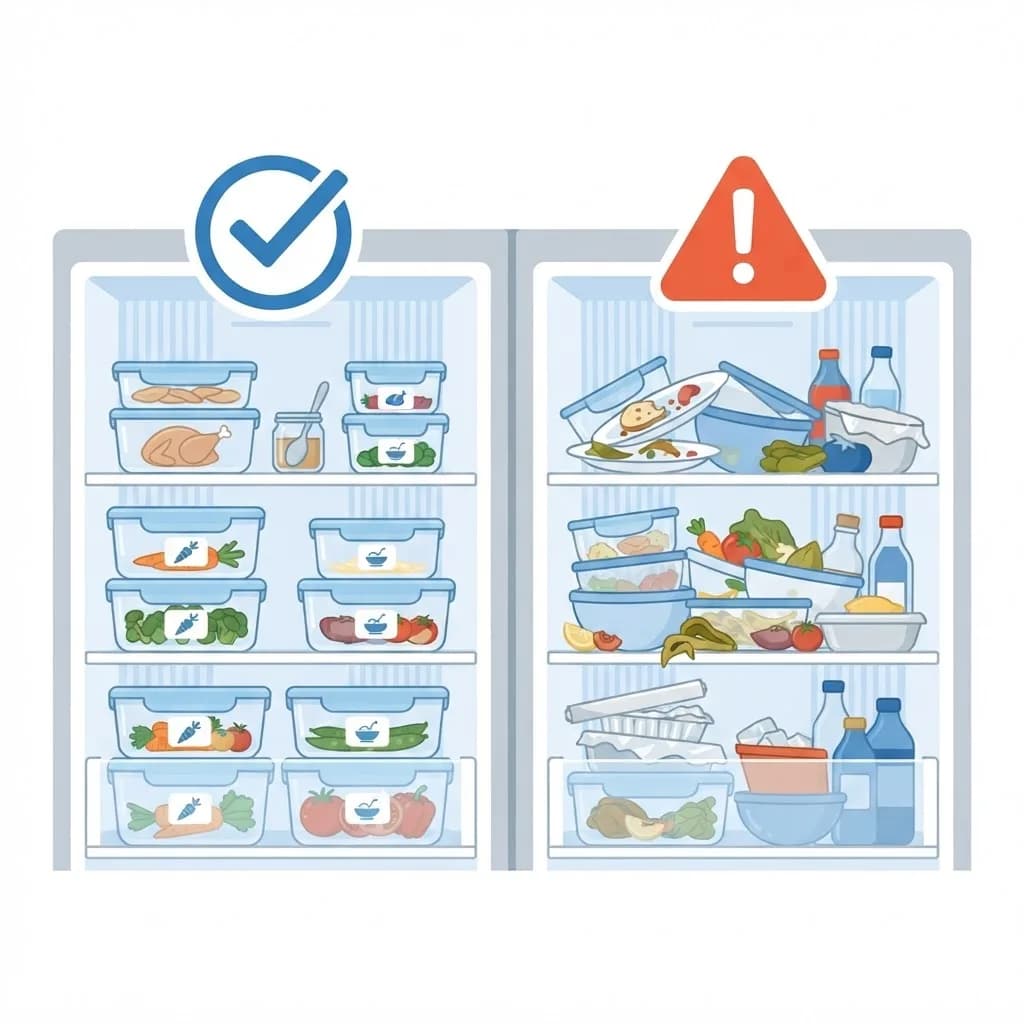
Two containers of chicken salad can look identical and only one is safe. Deciding which food has been refrigerated correctly is never about appearance — it is about temperature history, placement, protection, and time.
This exact question appears on food handler exams because it forces you to evaluate several conditions at once instead of memorizing a single fact.
Below is the framework inspectors use, translated into checks you can run in under two minutes on any cooler in any kitchen.
What Does Correctly Refrigerated Food Look Like?
Food has been refrigerated correctly when it is at or below 41°F throughout, covered in a clean food-grade container, positioned so nothing above it can contaminate it, and date-marked within its safe use window.
All four have to be true. Correct temperature with an open lid under raw poultry is a violation. Perfect placement at 48°F is also a violation.
Appearance, smell, and taste are useless as safety indicators because the bacteria that cause illness generally do not change how food looks or smells. Spoilage organisms and pathogens are different populations.
Who Needs to Evaluate This?
This judgment call happens dozens of times a day in food operations.
- Kitchen staff receiving deliveries and putting stock away
- Shift leads and chefs performing opening and closing checks
- Food handler certification and ServSafe exam candidates
- Health inspectors and third-party auditors
- Home cooks handling leftovers, meal prep, and batch cooking
Key Features to Check
Internal Temperature
Probe the thickest part of the food with a calibrated thermometer. A reading of 41°F or lower is the pass condition; anything above needs immediate corrective action.
Shelf Placement
Ready-to-eat items belong above raw. The standard top-to-bottom order is ready-to-eat, seafood, whole cuts of beef and pork, ground meat, then poultry. This order follows required cooking temperatures.
Covering and Container Integrity
Food should be covered or wrapped in clean, food-grade, non-absorbent containers. Cardboard, grocery bags, and reused chemical containers all fail. Kitchens that standardize container types and post a visual guide — often created through simple infographic design — see fewer mistakes from new hires.
Date Marking
Ready-to-eat items held longer than 24 hours need a date. The maximum is seven days at 41°F or below, counting preparation day as day one.
How to Assess Refrigerated Food Step by Step
Run this sequence in the same order every time.
- Note the unit's displayed temperature, then verify with an independent thermometer.
- Probe the food itself in its thickest section and let the reading stabilize.
- Look up — check whether anything raw sits above the item.
- Confirm the container is covered, clean, and food-grade.
- Check the date label against today's date.
- Confirm the item is off the floor and not blocking air vents.
- Verify no chemicals or non-food items share the shelf.
- Record the result and take corrective action on any failure.
Benefits of Verifying Refrigeration
A two-minute check protects a lot.
- Catches temperature abuse before food reaches a customer
- Prevents raw-to-ready-to-eat cross-contamination
- Reduces spoilage and unnecessary discards
- Produces documentation that supports your inspection score
- Identifies failing equipment while repairs are still cheap
Potential Challenges
Several habits quietly undermine correct refrigeration.
- Trusting the door-mounted gauge instead of probing the product
- Undated containers that make time verification impossible
- Deep or tightly packed containers where the center stays warm
- Staff relying on smell and appearance to judge safety
Best Practices and Tips
These fixes are simple and durable.
- Keep a calibrated thin-tip thermometer in every station, not one shared unit
- Label immediately at prep time using a consistent day-dot or sticker system
- Store in shallow containers no deeper than two inches for faster cooling
- Set coolers to 36–38°F to build in a safety buffer
- Move temperature logs off paper — a lightweight mobile app built for your team makes recording and reviewing checks far more consistent
Real-World Example
A shift lead inspects two containers of tuna salad. Container A is on the top shelf, sealed, dated three days ago, and probes at 39°F. Container B sits on the bottom shelf beside raw chicken, uncovered, undated, and probes at 44°F.
Container A has been refrigerated correctly on all four counts. Container B fails three of them — temperature, covering, and date marking — and carries cross-contamination risk from its neighbor. It is discarded, the shelf is reorganized, and the cooler is flagged for a gasket inspection because 44°F suggests the unit is struggling, not just that the lid was left off.
Why It Matters
Improper cold holding is one of the most frequently cited risk factors in foodborne illness investigations. The difference between 39°F and 45°F is invisible to a person but represents a large jump in how fast pathogens replicate.
Knowing which food has been refrigerated correctly also builds a culture of verification. Once staff start probing instead of guessing, the whole operation shifts from hoping food is safe to knowing it is — and that habit transfers to cooking, cooling, and reheating too.
Frequently Asked Questions
How can I tell if food was refrigerated correctly just by looking?
You cannot. Pathogens do not reliably change color, texture, or smell. Only a calibrated thermometer reading plus placement, covering, and date checks can tell you.
What is the correct order of shelves in a refrigerator?
Top to bottom: ready-to-eat food, seafood, whole cuts of beef and pork, ground meat, then poultry. The order follows minimum internal cooking temperatures.
How long can refrigerated ready-to-eat food be kept?
Up to seven days at 41°F or below, including the preparation day. Anything held more than 24 hours must carry a date mark.
Can food above 41°F be saved?
Sometimes. If total time in the danger zone is four hours or less, it can often be rapidly re-chilled. Beyond that, or if the time is unknown, it must be discarded.
Conclusion
To determine which food has been refrigerated correctly, verify four things: internal temperature at or below 41°F, correct shelf placement, a clean covered food-grade container, and a valid date mark. Never rely on how the food looks or smells.
Want your cooler checks, labels, and logs organized in one accessible system? Explore our React JS web development services to build a fast internal tool your staff will actually open.
Enjoyed this article? Share it with others!