
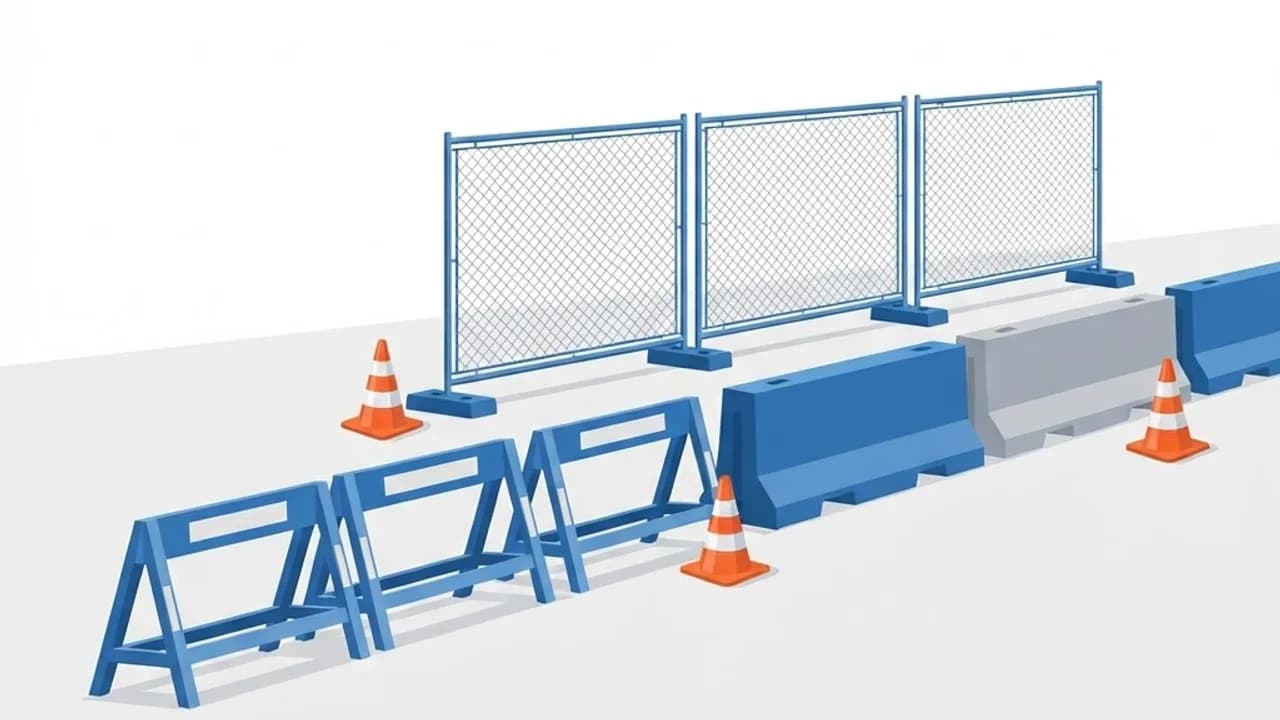
Construction site barriers are the physical devices that separate people from hazards. They mark the boundary between work and public space, keep vehicles away from open excavations, and channel pedestrians safely past active operations.
Choosing the wrong barrier is a common and expensive mistake. Plastic tape will not stop a reversing truck, and a heavy concrete barrier is pointless where the real risk is a pedestrian tripping into a trench.
This guide explains the main barrier types, their purposes, and how to select and install them so they perform as intended.
What Are Construction Site Barriers?
Construction site barriers are temporary physical devices used to delineate, restrict or protect access to hazardous areas. They range from lightweight visual demarcation such as cones and tape to fully rated crash-tested vehicle restraint systems.
Barriers serve three separate functions: warning people a hazard exists, delaying or discouraging entry, and physically restraining impact. Most sites need all three in different locations.
Barrier selection must match the actual hazard and the energy involved — a barrier that only informs cannot protect against a moving vehicle.
Who Uses Construction Site Barriers?
Barriers appear on almost every job that touches public space or moving plant.
- Road and highway crews managing traffic through work zones
- Building contractors protecting footpaths and public frontages
- Utility and maintenance teams working in short-duration excavations
- Event and facilities managers controlling temporary crowd routes
- Demolition contractors establishing hard exclusion zones
Key Types of Construction Barriers
Concrete and Water-Filled Vehicle Barriers
Jersey barriers in concrete, steel or water-filled plastic redirect vehicle impact and shield workers from live traffic. Concrete offers the highest containment; water-filled units trade some performance for far easier transport and rapid deployment.
Temporary Fencing and Hoarding Panels
Chain-link mesh panels and solid plywood hoarding form site perimeters, block sightlines, contain debris and deter entry. Hoarding doubles as an advertising surface and is often the most visible element of a project.
Pedestrian Barriers and Trench Guards
Interlocking plastic or steel barriers guide pedestrians around footpath work and protect open trenches and inspection chambers. Many include reflective panels and can be ballasted for wind stability.
Cones, Delineators and Warning Tape
These are demarcation devices, not protection. They excel at short-duration, low-energy situations such as marking a wet floor, a taper into a lane closure or a temporary no-park zone.
How to Choose and Install Barriers
Selection should follow the hazard analysis, not what happens to be in the yard.
- Identify the hazard: open excavation, moving plant, live traffic, falling debris.
- Determine who is exposed — workers, pedestrians, cyclists or drivers.
- Assess the energy involved, including vehicle speed and mass where relevant.
- Select a barrier type rated for that exposure and duration.
- Check applicable standards, local traffic management rules and permit conditions.
- Plan the layout, including tapers, gaps, gates and accessible pedestrian routes.
- Install with correct ballast, connections and end treatments per the manufacturer.
- Add reflective panels, signage and lighting for night visibility.
- Inspect daily and after any impact, wind event or layout change.
Benefits of Correct Barrier Use
Barriers are among the cheapest engineering controls available.
- Physical separation of people from plant, traffic and open excavations
- Clear, legally defensible site boundaries and exclusion zones
- Reduced public liability from trips, falls and unauthorised entry
- Better traffic and pedestrian flow, which reduces conflict and complaints
- Branded hoarding that markets the project while it protects
Potential Challenges
Barrier systems fail mostly through installation and maintenance, not product defect.
- Under-specified barriers used where vehicle impact is credible
- Insufficient ballast leading to displacement by wind or contact
- Gaps created by crews for convenience and never reinstated
- Layouts that block accessible routes for wheelchair users and prams
Best Practices and Tips
These points cover the majority of barrier citations.
- Never substitute tape or cones where a rated protective barrier is required.
- Maintain a continuous, accessible pedestrian path of adequate width at all times.
- Ballast and connect units exactly as the manufacturer specifies.
- Walk the barrier line at the start and end of every shift.
Real-World Example
A footpath renewal project initially used plastic mesh and cones to separate pedestrians from a trench beside a busy arterial road. Within days a delivery van clipped the cones and pedestrians began stepping into the traffic lane to get past.
The contractor replaced the setup with water-filled barriers along the traffic side, interlocking pedestrian barriers around the trench, and a signed temporary walkway with tactile edging. Complaints ceased and the local authority cited the layout as a model. The hoarding was later reused with graphics produced through a banner and social media design service.
Why Barriers Matter
Struck-by incidents and vehicle intrusions into work zones remain leading causes of construction fatalities. A correctly rated, correctly installed barrier is often the only thing between a worker and a moving vehicle.
Barriers also shape public perception. A tidy, well-signed perimeter tells the neighbourhood the project is competently run — a message contractors reinforce through consistent brand and logo design and clear communication on sites built with professional web development.
Frequently Asked Questions
What is the difference between a barrier and a barricade?
In common usage, barricades are lighter warning devices such as A-frames and folding units, while barriers include heavier protective systems like concrete and water-filled units. Terminology varies by standard, so follow your local code definitions.
Are water-filled barriers as strong as concrete?
Not generally. Concrete provides higher containment for high-speed impacts. Water-filled units are lighter, faster to deploy and suitable for lower-speed environments, and some models are crash-tested to specific ratings.
How high should a construction site fence be?
Around two metres is the common minimum for perimeter site fencing, though local regulations and project conditions may require more, particularly in urban or high-risk locations.
Do barriers need lighting at night?
Yes where they affect public traffic or pedestrian routes. Reflective panels plus warning lamps or steady-burn lights are typically required so the barrier line remains visible in darkness.
Conclusion
Construction site barriers work when they are matched to the hazard, rated for the energy involved, installed to specification and inspected daily. Demarcation devices inform; protective barriers protect — and confusing the two is where incidents happen.
Review your current barrier layout against the actual hazards on site this week. If your project hoarding could also be working as marketing, consider professional graphic design support to make that surface earn its keep.
Enjoyed this article? Share it with others!