
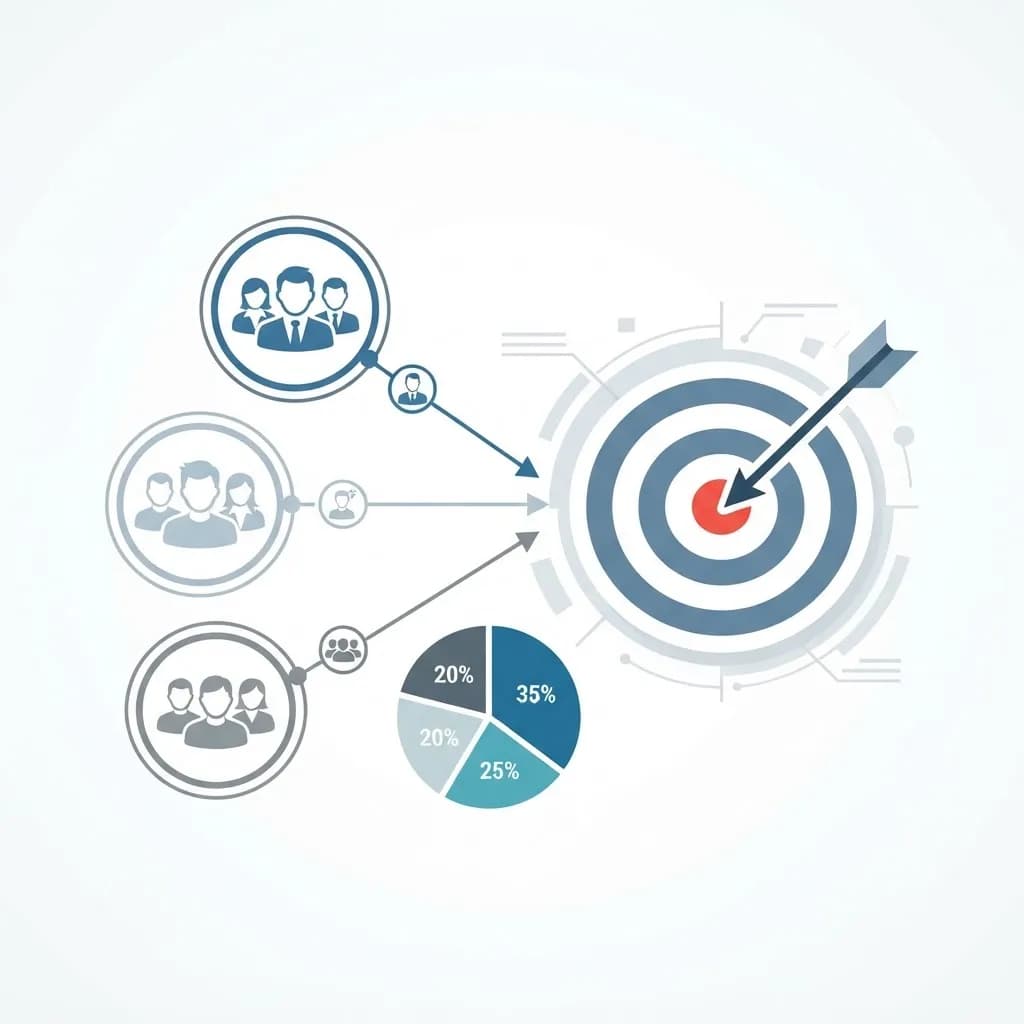
Target markets are the foundation of every effective marketing strategy. Before a single ad runs or a product launches, the most important question any business can answer is deceptively simple: exactly who are we trying to reach? Companies that answer it precisely spend less, convert more, and build stronger brands. Companies that market to "everyone" effectively market to no one.
This guide explains what target markets are, how segmentation works, the step-by-step process for defining yours, and how to actually reach your market once you've identified it.
What Is a Target Market?
A target market is the specific group of consumers or businesses most likely to buy your product or service — the audience your marketing, pricing, and product decisions are built around. It's defined by shared characteristics: demographics, location, behaviors, needs, and values. The core principle is that focused marketing aimed at a well-defined audience consistently outperforms broad marketing aimed at everyone.
A target market is broader than a buyer persona (a fictional individual profile) and narrower than the total addressable market (everyone who could conceivably buy). For example, a meal-kit company's total market might be "people who eat dinner," while its target market is "dual-income urban households aged 28-45 who value convenience and cooking at home but lack planning time."
Most businesses serve two or three distinct target markets, each warranting its own messaging and channels.
Who Needs to Define Target Markets?
Every organization that sells anything — but the stakes are highest for:
- Startups, where limited runway makes unfocused marketing fatal.
- Small businesses competing against bigger budgets and needing every dollar to count.
- Ecommerce brands whose ad platforms reward precise audience definition with lower costs.
- B2B companies selling to specific industries, company sizes, and decision-maker roles.
- Established companies launching new products into unfamiliar customer segments.
Key Types of Market Segmentation
Demographic Segmentation
The classic variables: age, gender, income, education, occupation, and family status. Demographics are easy to measure and target but rarely sufficient alone — two 35-year-olds with identical incomes can want completely different things.
Geographic Segmentation
Country, region, city, climate, and urban-versus-rural distinctions. Essential for local businesses and any product whose relevance varies by place.
Psychographic Segmentation
Values, lifestyles, attitudes, and interests — the "why" behind purchases. Psychographics explain why one customer buys the premium sustainable option while another buys purely on price.
Behavioral Segmentation
Purchase history, usage frequency, brand loyalty, and readiness to buy. Often the most actionable layer, because past behavior predicts future behavior better than any demographic.
How to Define Your Target Market: Step by Step
Follow this proven sequence:
- Analyze your current best customers. Who buys most, stays longest, and refers others? Look for shared traits.
- Study your product's core benefit. List the problems it solves, then identify who feels those problems most acutely.
- Research the competition. Whom do competitors target, and which segments do they underserve?
- Segment and prioritize. Score potential segments on size, ability to pay, ease of reach, and fit with your strengths.
- Draft a target market statement. One sentence: who they are, what they need, why you're their best option.
- Test and refine. Run small campaigns against your definition and let real conversion data sharpen it.
Benefits of Well-Defined Target Markets
Precision pays across the entire business:
- Lower acquisition costs — ads aimed at the right audience convert better and cost less.
- Sharper messaging — copy written for someone specific resonates; copy for everyone bores.
- Better product decisions — features, pricing, and packaging align with real customer needs.
- Stronger brand loyalty — audiences reward brands that clearly understand them.
- Efficient channel selection — you invest only where your market actually spends attention.
Potential Challenges
Watch for the common traps:
- Fear of narrowing — businesses resist focus, fearing lost sales; in practice, focus grows revenue.
- Stale definitions — markets shift; revisit your targeting at least annually.
- Assumption-based targeting — defining your market from intuition instead of customer data.
- Over-segmentation — slicing audiences so thin that campaigns lose scale and efficiency.
Best Practices for Reaching Your Target Market
Once defined, reach your market with discipline:
- Match channels to habits — B2B decision-makers live on LinkedIn and search; Gen Z consumers live on short-form video.
- Speak their language in every asset, from ad copy to your homepage. Professionally crafted content writing tuned to your audience consistently outperforms generic copy.
- Build your website around your primary segment's journey — a conversion-focused website design speaks to one visitor type brilliantly rather than all visitor types vaguely.
- Use email to deepen relationships with segments you've captured; targeted email marketing remains the highest-ROI channel for most businesses.
Real-World Example
Consider a local fitness studio that marketed generically to "anyone wanting to get fit" with mediocre results. Analysis of their membership data revealed their most loyal, highest-value members were women aged 30-50 seeking strength training in a supportive, non-intimidating environment. They rebuilt everything around that market: class names, imagery, website copy, and ad targeting. Within six months, cost per new member dropped 38%, and retention improved because the people joining were exactly the people the studio served best.
Nothing about the product changed — only the clarity of who it was for.
Why Target Markets Matter
Marketing costs keep rising while consumer attention keeps fragmenting. In that environment, precision is the only sustainable advantage available to businesses without unlimited budgets. A clearly defined target market multiplies the effectiveness of every downstream investment — ads, content, design, and product development all improve when everyone knows exactly who the customer is. Paired with consistent digital marketing execution, it's the difference between spending money and building a business.
Frequently Asked Questions
What is the difference between a target market and a target audience?
A target market is the broad group of likely buyers for your product overall. A target audience is the narrower group a specific campaign addresses — one market can contain several campaign audiences.
Can a business have more than one target market?
Yes — most do. A software company might target both small agencies and enterprise teams. The key is creating distinct messaging and channels for each rather than blending them.
How do I research my target market with no budget?
Start free: interview existing customers, read competitor reviews to find unmet needs, analyze your social followers and website analytics, and explore forums where your potential customers discuss their problems.
How often should target markets be re-evaluated?
Review annually at minimum, and immediately after major shifts: new competitors, economic changes, product launches, or noticeable changes in who's actually buying.
Conclusion
Target markets turn marketing from expensive noise into focused conversation. Define yours with real customer data, commit to the focus, and refine continuously — the businesses that know exactly whom they serve consistently outgrow those that serve "everyone."
Ready to put your targeting to work? Start with a website built for your ideal customer — explore React JS web development services that turn audience clarity into conversions.
Enjoyed this article? Share it with others!