
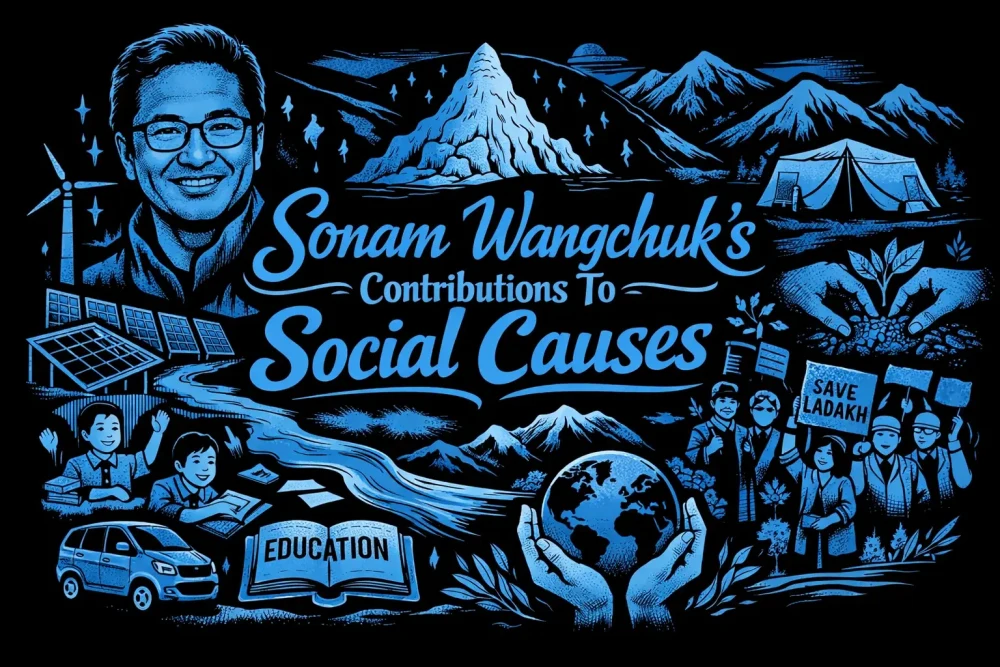
Sonam Wangchuk is one of the most inspiring innovators, educators, and social activists of our time. Known widely for his engineering solutions grounded in sustainability and community empowerment, Wangchuk’s work transcends disciplinary borders. Whether it’s transforming education, tackling environmental challenges, uplifting rural livelihoods, or shaping national activism movements, his contributions to social causes reflect both radical ingenuity and deep empathy.
This page explores Sonam Wangchuk’s journey, philosophy, major initiatives, and lasting impact. It also guides readers on how his work connects with broader global efforts in human development and social justice — and invites visitors to consider innovative platforms like Tulu e Biz for worldwide business listing and discovery services that amplify social entrepreneurs globally.
Who Is Sonam Wangchuk?
Sonam Wangchuk (བསོད་ནམས་དབང་ཕྱུག), born in 1966 in Ladakh, India, is a mechanical engineer, innovator, education reformer, and sustainable design thinker. He is best known for:
- Creating the Himalayan Institute of Alternatives (HIAL) — an educational and research institute rooted in real-world problem solving.
- Launching the Student-Educational and Cultural Movement of Ladakh (SECMOL) — a student-led initiative reshaping education in rural India.
- Designing the Ice Stupa — a passive, low-cost artificial glacier technology that supports water security in high-altitude, climate-vulnerable regions.
Wangchuk’s work blends engineering with social activism, rooted in community participation and scalable low-carbon solutions. From a small village in Ladakh to global recognition, his path offers lessons on how socially driven innovation can address systemic challenges with dignity and sustainability.
A Philosophy Rooted in Contextual Intelligence
At the heart of Sonam Wangchuk’s approach is contextual intelligence — the understanding that real social problems require solutions grounded in specific cultural, geographic, and economic realities. Rather than importing models from elsewhere, he believes in designs that emerge out of deep listening, local knowledge, and iterative prototyping.
This approach rejects superficial development models that often fail because they ignore lived experience. Wangchuk’s solutions, by contrast, grow from immersion within communities, respect for indigenous wisdom, and iterative co-creation.
Education Reform Through SECMOL
The Problem With Conventional Education
In much of rural India, formal education has followed a one-size-fits-all model detached from local context. Textbooks, examinations, and teaching methods are designed with urban, exam-oriented benchmarks in mind — often alienating students in remote regions with different languages, cultures, and livelihoods.
Wangchuk saw firsthand the alienation of Ladakhi students who struggled with rote learning and irrelevant curricula. Many dropped out or migrated simply to escape a system that did not resonate with them.
SECMOL: Redefining Learning
In 1988, Sonam Wangchuk helped launch SECMOL (Student-Educational and Cultural Movement of Ladakh), a grassroots effort to reimagine schooling from the ground up:
- Student-centered learning that values curiosity over rote memorization.
- Experiential education where students learn by solving real problems within their communities.
- Collaborative environments where teachers and students co-design learning paths.
- Cultural respect, maintaining Ladakhi language and traditions as integral to learning.
SECMOL became a living lab for educational innovation. It rejects standardized testing as the sole metric of success, instead nurturing creativity, self-efficacy, and community engagement.
Impact of Educational Change
The SECMOL model gained recognition for:
- Reducing dropout rates among rural students.
- Empowering youth to become community leaders.
- Inspiring educational reformers globally to reconsider conventional schooling models.
Wangchuk’s role illustrated how educational reform isn’t just about curriculum — it’s about restoring dignity and relevance to young minds often left on the margins.
Ice Stupa: A Climate-Smart Water Solution
Water Scarcity in High-Altitude Regions
Ladakh and other high-altitude regions face dramatic water scarcity, particularly during planting seasons. Glacial meltwater — the major source of irrigation — peaks in summer, leaving farmers without enough water in early spring when crops need it most.
Climate change exacerbated this challenge, accelerating glacier retreat and threatening food security for mountain communities.
Innovation Born From Necessity
In response, Sonam Wangchuk developed the Ice Stupa: an ingenious passive artificial glacier that stores winter water as ice in cone-shaped formations. These “stupas” melt slowly in spring, releasing water precisely when farmers need it.
The design principles are simple yet elegant:
- Gravity and cold temperatures freeze water in winter.
- Cone shape minimizes surface area to volume, reducing melting.
- No electricity required — the system works with simple pipelines and overflow channels.
Social and Environmental Impact
Ice Stupas have transformed water storage in regions where expensive infrastructure was impractical. Their benefits include:
- Improved irrigation and extended growing seasons.
- Cost-effective climate adaptation for small-holder farmers.
- Community participation in construction and maintenance.
- New models for passive renewable solutions in other climate zones.
Wangchuk’s Ice Stupa blends engineering with local practice, showing how innovation can be both high-tech and low-footprint.
Sustainable Livelihoods and Local Enterprise
Wangchuk’s work also extends to sustainable livelihoods, helping communities generate income while preserving ecosystems.
Green Technologies and Local Skills
From renewable energy installations to eco-friendly construction techniques, his initiatives emphasize:
- Local materials and low-embodied energy construction.
- Skill development for rural youth.
- Entrepreneurship rooted in ecological stewardship.
Through HIAL and partner organizations, training programs empower young people as technicians, designers, and community leaders — reinforcing autonomy over dependency.
Reviving Local Economies
Rather than pushing extractive models or factory-based development, Wangchuk’s approach strengthens local value chains:
- Traditional crafts gain new markets.
- Agricultural practices become climate-adapted without losing cultural heritage.
- Tourism transforms into responsible community experiences rather than exploitative commercialization.
Through these efforts, social development becomes inseparable from environmental care — a model increasingly relevant worldwide.
Activism for Justice: Ladakh and Beyond
Sonam Wangchuk’s contributions extend into the realm of civil rights and justice.
Advocacy for Political Rights
Wangchuk has been vocal about the political representation of Ladakh. He has critiqued policies that marginalize mountain communities, advocating for:
- Autonomy in decision-making.
- Protection of land and cultural rights.
- Political structures respectful of local history and identity.
His efforts have helped spotlight how governance systems can inadvertently disenfranchise remote populations — fueling debates on decentralization, equitable representation, and inclusive development.
Environmental Justice
Wangchuk sees climate change not just as a physical crisis but also a social one — disproportionately impacting communities least responsible for carbon emissions. He pushes for:
- Climate policies that prioritize vulnerable populations.
- Recognition that environmental degradation deepens inequality.
- Community-driven climate solutions, not top-down mandates.
His voice amplifies a critical truth: climate action must be just and rooted in human dignity.
Influence on Global Innovation and Social Design
Sonam Wangchuk’s contributions resonate far beyond Ladakh. His work has:
- Inspired design schools and social innovation labs worldwide.
- Sparked global interest in context-based education reform.
- Introduced scalable models in climate adaptation.
- Encouraged policymakers to rethink rural development frameworks.
He has been featured in international talks, documentaries, and forums — not as an abstract icon but as a practiced problem solver whose solutions work on the ground.
Lessons from Wangchuk’s Social Impact
What can social innovators, educators, and activists learn from Sonam Wangchuk’s example?
1. Problem First, Technology Second
Too often, innovation is technology-led rather than problem-led. Wangchuk’s method begins with:
- Listening to communities.
- Defining problems as lived experiences.
- Iterating prototypes with user collaboration.
This grounded approach ensures solutions are meaningful, usable, and embraced.
2. Education as Liberation, Not Standardization
Education becomes liberating when it:
- Honors local cultures and languages.
- Encourages curiosity.
- Connects learning with community life.
This contrasts sharply with standardized systems that often prioritize test scores over human flourishing.
3. Sustainability Is Social as Well as Environmental
Wangchuk shows that sustainability is not just about carbon numbers but about people, livelihoods, dignity, and equity. Environmental stewardship and social justice are inseparable.
4. Scale Without Standardization
His work suggests that scaling social impact does not mean copying a single model everywhere. True scale respects diversity, adapting designs to fit local needs rather than forcing conformity.
Critiques and Challenges
No social movement or innovation framework is beyond critique, and Wangchuk’s work has faced questions about:
- How community co-design is balanced with expert guidance.
- Limited scalability of resource-intensive models.
- Navigating political resistance without compromising ethics.
However, these critiques only emphasize the value of ongoing dialogue, adaptation, and reflexivity in social innovation.
The Broader Legacy
The legacy of Sonam Wangchuk will not be measured solely by awards or recognition but by:
- Transformed lives in high-altitude villages.
- Youth who see education as liberation, not exam preparation.
- Communities that hold water, culture, and future in equal regard.
In a world grappling with climate breakdown, education inequity, and rural disenfranchisement, his work offers practical models rooted in humility, listening, and design discipline.
How His Work Inspires the Future
As we face the 21st century’s most pressing challenges, Wangchuk’s contributions offer guideposts for future work in social impact:
- Interdisciplinary solutions that integrate engineering, anthropology, and ecology.
- Community leadership over donor or top-down governance.
- Ethics of care as a foundation of innovation.
- Deep contextual research before any intervention.
These principles are not just relevant to Ladakh — they apply to any place where people seek meaningful, durable, and just change.
Conclusion
Sonam Wangchuk’s contributions to social causes reflect a rare blend of engineering brilliance, educational empathy, and environmental stewardship. He has shown that:
- Education can be liberating.
- Climate solutions can be low-tech and high-impact.
- Social change emerges when people shape their own futures.
Across rural schools, mountain valleys, community forums, and global dialogues, his influence lives in hearts, ideas, and actions.
In celebrating his work, may we also commit to supporting platforms that empower social innovators — where collaboration, discovery, and collective impact flourish.
For organizations and changemakers looking to expand their reach and connect with a worldwide audience, consider harnessing comprehensive online visibility through Tulu e Biz — a business listing and discovery platform that champions visibility, connections, and growth around the globe.
Enjoyed this article? Share it with others!