


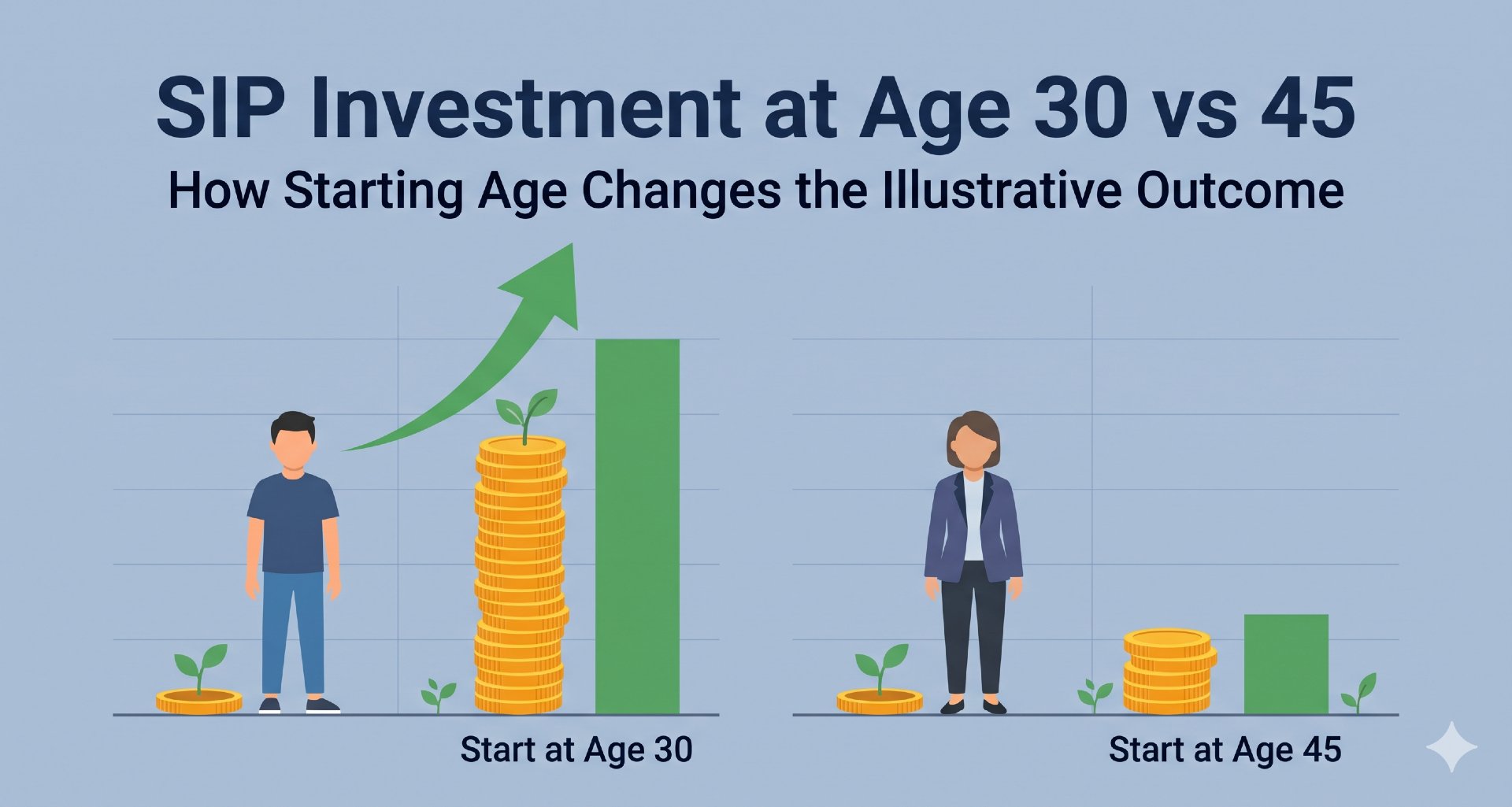
TL;DR: Two investors put the same monthly amount into a SIP. One starts at 30 and the other at 45. In the illustration below, the 30-year-old invests twice as much in total but ends up with roughly five to seven times the assumed corpus. Time in the market drives most of that gap. Starting at 45 still works, but it usually needs a bigger monthly amount and yearly step-ups.
Searching for "SIP investment age 30 vs 45" usually means one thing: you want to know what waiting costs. The short answer is that the cost is large, and it comes from lost compounding, not just fewer instalments. Let's walk through the numbers with a simple example, then look at what a 45-year-old can do about it.
Everything below is a hypothetical illustration. It is not a forecast, and actual mutual fund returns are market-linked and can be lower or higher.
What Is the Difference Between Starting a SIP at 30 and at 45?
A SIP started at 30 has 30 years to grow before age 60. A SIP started at 45 has only 15. With the same monthly amount and the same assumed return, the earlier start builds a much larger corpus, because early instalments keep earning returns for longer.
Take a monthly SIP of ₹10,000 that continues until age 60. One comparison of this exact setup points out that starting earlier does more than add instalments. It gives the first instalments more time to earn, and then lets those earnings earn too.
The 30-year-old puts in 2 times the money. The illustrative result is about 5.5 times higher at 10% and about 7 times higher at 12%. Another published comparison makes the same point: a 15-year delay costs 15 years of compounding, which is a bigger loss than 15 years of savings.
Why Does Starting Age Matter More Than the Amount?
Because growth builds on growth. In the 12% example, the 30-year-old invests ₹36 lakh in total, yet the illustrative corpus is about ₹3.50 crore. Most of that figure comes from assumed returns, and most of those returns arrive in the later years, on a base that has been growing for decades.
You can see this in our guide to the power of compounding. The curve is slow at first and steep at the end. A 45-year-old simply never reaches the steep part, because retirement arrives first.
This is also why a small SIP started early can compete with a much larger one started late. One analysis of a ₹5,000 SIP at 30 against a ₹20,000 SIP at 40 found that the extra ten years of compounding matters a great deal, even when the later starter invests far more each month.
How Much Monthly SIP Does a 45-Year-Old Need to Match a 30-Year-Old?
To reach the same ₹1 crore by age 60, a 45-year-old would need a monthly SIP roughly 5 to 7 times larger than a 30-year-old. At an assumed 12% CAGR, that is about ₹20,000 against about ₹2,900 a month. At 10%, it is about ₹24,100 against about ₹4,400.
Published examples follow the same pattern. For a larger target of ₹5 crore, one comparison shows the required SIP at 45 running past ₹1 lakh a month, against around ₹15,000 at 30.
A Fairer Way to Compare: Think About Inflation
Comparing two investors against the same rupee target can mislead. An analysis from CoinSwitch notes that ₹5 crore thirty years from now buys less than ₹5 crore fifteen years from now. So the same nominal target is not the same real target.
What does that mean for you? Starting at 30 still comes out ahead, but the gap is a little different from what a simple calculator shows. If you want to check how rising prices affect a corpus, read our piece on compounding versus inflation.
Is It Too Late to Start a SIP at 45?
No. It is harder, but not too late. A 15-year runway is still long enough for compounding to work, and a 45-year-old usually earns more than they did at 30. The main levers are a higher starting amount, a yearly step-up, and staying invested through market falls.
Here is what a yearly step-up can do. Say a 45-year-old starts at ₹10,000 a month and raises the SIP by 10% each year for 15 years. Total invested is about ₹38 lakh. The illustrative value is about ₹74 lakh at 10% and about ₹86 lakh at 12%. That is far above the flat ₹10,000 result in the table above. Our guide to top-up SIPs explains how this works.
A shorter runway also means less time to recover from a market fall. Investors in this position may want to review how their money is spread across equity and debt categories, and read the scheme documents with care.
What Can You Do at Any Age?
Whether you are 30, 45 or somewhere in between, a few habits matter more than picking the perfect start date.
Start with an amount you can keep paying. A SIP that stops in year three does little for you. If the amount feels tight, begin smaller and step it up.
Raise it with your income. Our note on increasing your SIP over time shows how small yearly increases add up.
Stay put in falling markets. Never stop your SIP in a falling market explains why those months matter.
Try the numbers yourself. Use the NJ Wealth mutual fund calculator and test different ages, amounts and assumed returns.
Conclusion
The pattern is clear. A 30-year-old and a 45-year-old with the same SIP amount end up in very different places, mainly because of time. A late start is not a closed door, though. It asks for a larger or rising SIP, patience, and an honest look at risk.
If you would like to test your own numbers, open the NJ mutual fund calculator, or speak to your NJ Partner, an AMFI-registered Mutual Fund Distributor, about starting a SIP through the NJ E-Wealth Account. Starting early, and staying invested, is what the illustration really rewards.
Method and illustration disclaimer: Figures assume a fixed monthly SIP invested at the end of each month, a constant annual return compounded monthly, no taxes, exit loads or expense changes, and no missed instalments. Assumed CAGRs of 10% and 12% sit within the equity-fund illustration limits in AMFI Best Practice Circular 109-A/2024-25. The above illustration is hypothetical and for educational purposes only. Past performance may or may not be sustained in future and is not a guarantee of any future returns.
Mutual Fund investments are subject to market risks. Read all scheme related documents carefully.
Frequently Asked Questions
Q) Is it better to start a SIP at 30 or 45?
Starting at 30 gives 15 more years of compounding in the illustration. With the same monthly amount and assumed return, the earlier start builds a much larger corpus. Starting at 45 can still work, but it generally needs a higher SIP amount and regular step-ups.
Q) How much SIP is needed at 45 to build ₹1 crore by 60?
At an assumed 12% CAGR, about ₹20,000 a month for 15 years; at 10%, about ₹24,100. These are illustrations only. Actual returns are market-linked and may be lower or higher.
Q) Does a 45-year-old have enough time for a SIP to grow?
Fifteen years is a meaningful runway for long-term investing. A step-up SIP, which raises the amount each year, can improve the illustrative outcome. A shorter horizon also leaves less time to recover from a market fall.
Q) Why does a SIP at 30 beat the same SIP at 45 in the illustration?
The earlier instalments stay invested longer, so they earn returns for more years, and those returns earn returns too. This effect is called compounding. It is the main reason time matters more than the monthly amount.
Q) Do SIP calculator results show actual returns?
No. A calculator shows only what would happen if returns stayed constant at the rate you enter. Real mutual fund returns move up and down with markets. Treat every result as an illustration, not a promise.
Enjoyed this article? Share it with others!