

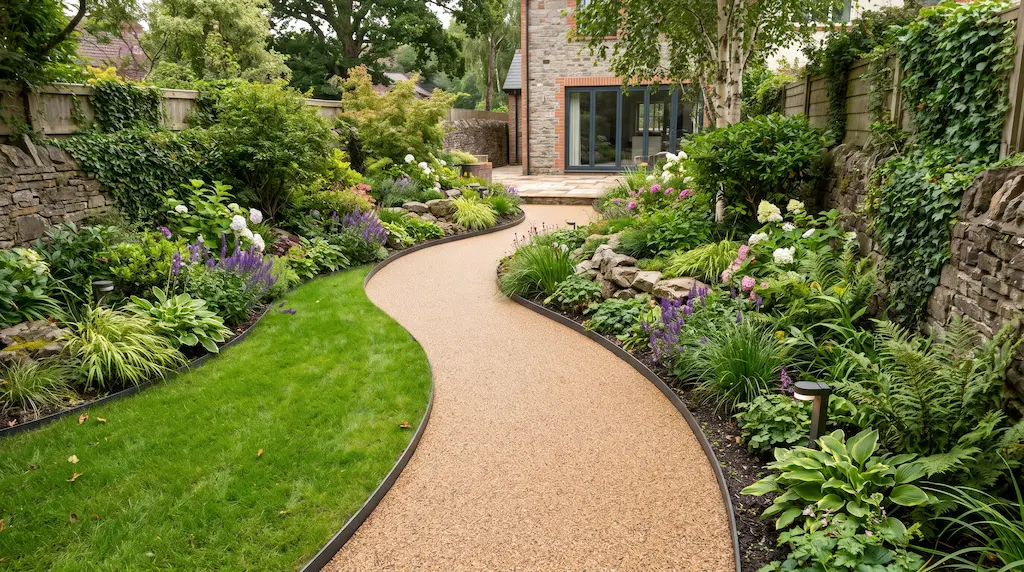
As well as allowing you to move around your garden, your garden path can affect people’s view of your house. There are often questions about whether resin surfacing Swansea is suitable for both a narrow and lengthy path as well as a wide driveway. Fortunately, the answer is yes. Resin provides a resilient and silky surface and is generally appropriate for garden paths. Below is information on the benefits and drawbacks of using resin, plus our practical experience of applying it to garden areas.
What Is Resin Surfacing and How Does It Work?
A combination of aggregate and transparent resin is mixed together. This is then applied to and levelled on a solid sub-base with a steel trowel. The resin hardens and firmly fixes the aggregate in place. Small spaces remain between the aggregate so that water can pass through to the underlying earth. There are two main forms of resin surface; resin bound and resin bonded. With resin bound, the aggregate and resin are combined and then applied. Alternatively, for resin-bonded aggregate, it is sprinkled onto a resin adhesive base. Typically, garden paths are made using resin bound as it provides a silky surface and has great longevity.
Why do garden paths require a superior surface?
Many garden paths degrade quickly. Aggregate can become dislodged and encroach on lawns. Additionally, concrete paving can crack and buckle as tree roots grow up through the ground. After a wet period, moss can cause a garden path to resemble an ice rink. People (including the elderly) are also at risk of tripping over if the path is unstable. As Swansea experiences much rainfall, the garden path should be able to endure wet conditions throughout the year. Ideally, it should also continue to be both secure and aesthetically pleasing in both January and July. Resin Surfacing Swansea ensures a level surface that is stable and does not degrade.
Is Resin Strong Enough for Everyday Walking?
Yes. It can easily support the weight of people and even prams. Bicycles and wheel barrows also have no difficulty travelling along it. As resin is already used for car driveways, it is not greatly affected by a footpath. Again, the sub-base is key. A robust foundation of stone or concrete distributes pressure and avoids sagging. Without this, all surfaces will subside. Experienced operatives excavate the ground, then compress the chosen sub-base material. Levels are also verified prior to the application of just one pail of resin. Furthermore, if large tree roots lie near the intended path, operatives may advise increasing the depth of the sub-base or suggest a slight repositioning of the path.
Benefits of Resin for Outdoor Walkways
Being exposed to the elements and general wear and tear, garden paths need a durable surface. Advantages of using resin include:
An ideal surface for canes, wheelchairs and even small footwear.
Water can permeate through the spaces between the aggregate.
It is difficult for weeds to penetrate the firm surface.
Aggregate is not dislodged and so does not enter flower beds or lawns.
A variety of colours are available from pale cream to dark brown.
Neat, rounded and right-angled edging can be produced.
These advantages are both cost and time efficient. For these reasons, many homeowners decide on Resin Surfacing Swansea.
How Does Resin Handle Rain and Wet Weather?
Whilst Wales regularly experiences rain, the resin bound surface enables water to permeate through so that it does not collect. Consequently, the path does not become greasy. Ice formation is also reduced as more water is able to exit the surface. Moreover, a high quality resin will slightly ‘give’ in cold weather so is less prone to cracking. Although strong sunshine can cause poor quality resin to dull, good quality resins that are resistant to ultra-violet light retain their colour for many years. Ensure that your operatives can confirm the ultra-violet resistance of their resin adhesive.
Which Garden Areas Suit a Resin Path?
In addition to what is commonly recognized, there are numerous areas within a garden where resin can successfully be utilized. Garden paths from the front gate to the front door are particularly stylish when created using resin. Furthermore, paths in the rear garden that connect a patio to a shed or lawn are also appropriate. Thin side paths especially benefit from resin as it can be applied to create a flat surface with no joins. Operatives manually mold resin for elegant paths that wind around a pond or flower bed. Particular attention is given to ensuring good traction is achieved on steps and on a sloping area. Also, if an area is heavily shaded and encourages moss growth, increased maintenance may be necessary. Our team can accompany you around your garden and advise on whether Resin Surfacing Swansea is suitable for each section of your garden.
What Should You Check Before You Start?
Some pre-planning will avoid future issues. Consider:
The current land level and any gradient which causes water to flow towards your house.
The presence of tree roots near to where the path is to be positioned.
How wide the path needs to be to allow for use of prams and/or mobility equipment.
Appropriate colours in relation to both your walls and garden planting.
Quotes and scope of work from operatives.
Local regulations affecting your property e.g. those relating to conservation areas.
Record your responses to these considerations and provide them to operatives. Good documentation will enable operatives to accurately assess costs and formulate an appropriate plan.
How Do Installers Prepare the Ground?
Correct preparation is crucial for ensuring a path has a good lifespan. Operatives firstly demarcate the path and then excavate the current surface. A stone sub-base is then installed and compressed using a plate. Edging is then added to maintain the path’s structure and prevent resin leakage onto the lawn. Following this, operatives combine the stone and resin within a force mixer. The mixture is then manually applied. Finally, the surface is levelled and allowed to harden. As drying is favored, operatives are mindful of weather forecasts. Usually, garden paths are ready for foot traffic within a day and for heavier traffic after a greater timescale. Our operatives view resin Surfacing Swansea as an art form and therefore practise great patience.
Can resin reflect my Garden Style?
A selection of stones is available in a number of shades such as golden gravel, slate grey and terracotta. Soft buff colours are especially pretty in a cottage style garden. In contrast, modern gardens often look good with grey. Blending different stones produces a mottled effect and conceals dirt and leafage. To further enhance the path, a band of a deeper colour can be added to provide framing. As we also install resin driveways, our operatives can ensure that your garden path and driveway coordinate and that your front garden is unified.
How Do You Keep a Resin Path Looking Fresh?
Maintenance is uncomplicated. Use a gentle brush to clear leaves and twigs. Hose off the path to remove dirt. Manually extract seedlings that become established in the top layer of soil. At the first sign of moss, gently clean the surface using a suitable resin specific mild detergent. Do not use aggressive substances or pointed tools which can scar the surface. Swiftly wipe up oil. Regular maintenance will ensure a resin garden path remains both attractive and long-lasting.
FAQs
How long does a resin garden path last for?
Generally, resin paths have a lifespan of 15–25 years. Together with a strong sub-base and good quality components, this can be further extended.
Does resin become greasy?
As previously explained, a resin bound surface allows water to pass through and so ponding does not occur. Moreover, the aggregate provides effective traction for footwear.
Can resin be applied over an existing garden path?
Yes, providing that the present surface is both firm and even. Prior to application, operatives examine the current path for cracks and areas of displacement.
Can I personally install a resin garden path?
Whilst operatives are expert at and understand the correct mixing and setting times, resin must be set quickly. Therefore, self-installation often causes problems which cannot be rectified.
How much does a resin garden path cost?
This will depend on both the path dimensions and required sub-base. Obtain a detailed quotation from Swansea Driveways to ascertain an accurate cost.
Conclusion
Resin is a good medium for garden paths and paths in external areas. It is permeable, anti-weedy and provides an ideal surface for all ages. It is also flexible in terms of colour and so can be personalised to complement a house and garden. Both the sub-base and operatives’ expertise affect a garden path’s longevity. Across the UK, homeowners are increasingly favouring resin for its easy and attractive maintenance properties. We can survey your garden and devise a cost-effective plan for a path which is appropriate for your property.
Enjoyed this article? Share it with others!