
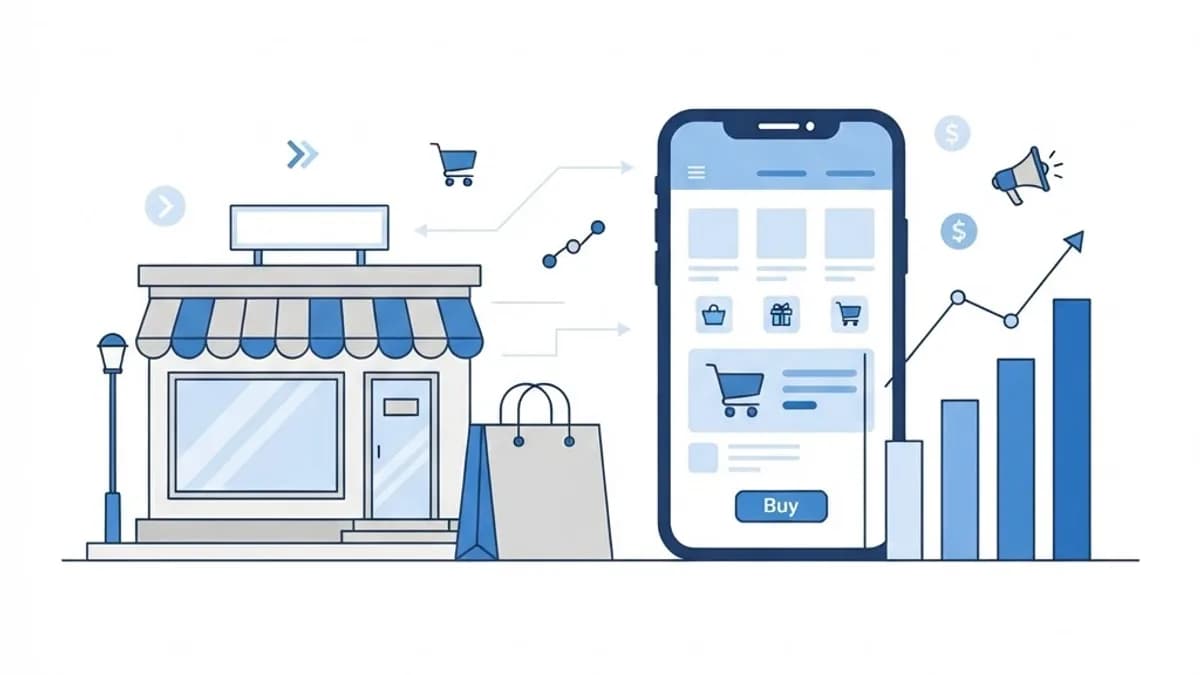
Retail has spent the last decade being told that ecommerce would replace stores. What actually happened is more interesting: the two merged. Customers research online and buy in store, or browse in store and order from their phone in the parking lot.
Retail digital marketing now has to serve both behaviors simultaneously, which means measuring online activity that produces offline revenue and treating physical locations as an advantage rather than a legacy cost.
This guide covers the channels that drive retail revenue today — search, local inventory visibility, paid media, email and loyalty — and how to measure them without double-counting or missing offline impact entirely.
What Is Retail Digital Marketing?
It is the coordinated use of search, paid media, email, social commerce and local listings to drive purchases across every channel a retailer operates, online and physical.
The defining characteristic is channel blending. A customer may see a social ad, search for the product, check store availability and buy in person. Attribution models that credit only the last click will systematically misread what is working.
For multi-location retailers, local inventory visibility is often the single highest-return investment — showing that an item is in stock nearby converts at rates online-only listings cannot approach.
Who Uses It?
Retail spans an enormous range of business models with shared digital needs.
- Multi-location chains balancing ecommerce against store performance
- Independent boutiques competing with marketplaces on service and curation
- Direct-to-consumer brands opening physical retail locations
- Specialty retailers in categories requiring expertise, such as outdoor or hobby goods
- Grocery and convenience operators building pickup and delivery programs
Key Features of Retail Marketing
Ecommerce and Product SEO
Product and category pages compete against marketplaces with enormous authority. Winning requires unique product descriptions, structured data markup, genuinely useful buying guides and fast page performance — areas where most retailers are weakest.
Local Inventory and Store Visibility
Surfacing real-time in-store availability through local listings captures shoppers searching for an item nearby. This requires inventory feed integration, but it converts extremely well and is something pure-play ecommerce cannot offer.
Retention and Loyalty
Acquisition costs keep rising, making repeat purchase the main profit lever. Email and SMS programs segmented by purchase history consistently deliver the highest return of any retail channel. Structured email marketing campaigns routinely outperform paid acquisition on return per dollar.
A Storefront Built for Conversion
Site speed, search functionality and checkout friction determine whether traffic converts. Many retailers over-invest in acquisition while running a checkout that loses a third of carts. Modern ecommerce platform development usually pays for itself faster than additional ad spend.
How to Get Started
Fix measurement and conversion before scaling acquisition.
- Establish baseline metrics — conversion rate, average order value, repeat purchase rate and cost per acquisition.
- Audit site speed and checkout flow on mobile, where most traffic now originates.
- Implement product structured data and unique descriptions on top-selling items.
- Connect inventory feeds so local availability appears in search and maps.
- Build segmented email and SMS programs based on purchase behavior.
- Set up measurement that captures online-to-offline conversions, not just ecommerce sales.
- Reallocate budget quarterly toward whichever channel produces the best blended return.
Benefits
An integrated retail program improves several metrics at once.
- Higher conversion from shoppers who can verify local availability before traveling
- Increased repeat purchase rates through segmented retention marketing
- Better inventory turnover from demand visibility across channels
- Reduced acquisition costs as owned channels carry more of the load
- Clearer understanding of which products and stores actually drive profit
Potential Challenges
Retail marketing faces real structural difficulties.
- Marketplace competition dominates product search results in most categories
- Attribution across online and offline channels remains genuinely difficult
- Thin margins limit how much can be spent acquiring each customer
- Inventory and marketing systems often do not integrate without significant work
Best Practices and Tips
Retailers with healthy economics tend to operate this way.
- Prioritize retention spending; existing customers cost a fraction of new ones to reach
- Write original product content rather than using manufacturer descriptions everyone else uses
- Measure blended return across all channels instead of optimizing each in isolation
- Treat stores as a competitive advantage — same-day pickup and local stock beat marketplace delivery windows
Real-World Example
A regional outdoor equipment retailer with seven stores was losing product searches to large marketplaces. Rather than competing on price, it connected its inventory system to local listings so nearby shoppers could see live stock, and rewrote descriptions for its top 300 products with genuine staff usage notes.
Online-to-store visits rose measurably within two quarters, and those shoppers spent significantly more per visit than ecommerce customers. The retailer also found that products with staff-written descriptions outsold identical items with manufacturer copy by a wide margin.
Why It Matters
Retail margins leave little room for wasted marketing spend, and customer acquisition costs have risen steadily as tracking has become less precise. Retailers that rely solely on paid acquisition are running on an increasingly expensive treadmill.
Strong retail digital marketing shifts weight toward owned channels, local advantages and retention — the areas where physical retailers can genuinely outperform marketplaces rather than compete on their terms.
Frequently Asked Questions
How do we compete with large marketplaces?
Not on price or breadth. Compete on expertise, curation, local availability and service. Original product content and same-day pickup are advantages marketplaces structurally cannot match at the local level.
What is the highest-return retail marketing channel?
Email and SMS to existing customers, consistently. Retention campaigns typically deliver several times the return of paid acquisition because the audience is already qualified and the channel is owned.
How do we measure online marketing that drives store visits?
Use store visit tracking in ad platforms, loyalty program identification at checkout, and online-to-offline promotion codes. No method is perfect, but combining several gives a defensible directional picture.
Is social commerce worth pursuing?
It depends on category. Visual and impulse-driven products perform well; considered or technical purchases generally do not. Test with a limited product set before investing in full catalog integration.
Conclusion
Retail succeeds digitally by leaning into what stores do well — local availability, expertise and service — while running owned retention channels that reduce dependence on rising acquisition costs.
If your checkout or site speed is quietly costing you conversions, that is the first place to look — explore ecommerce solutions built for multi-channel retail.
Enjoyed this article? Share it with others!