
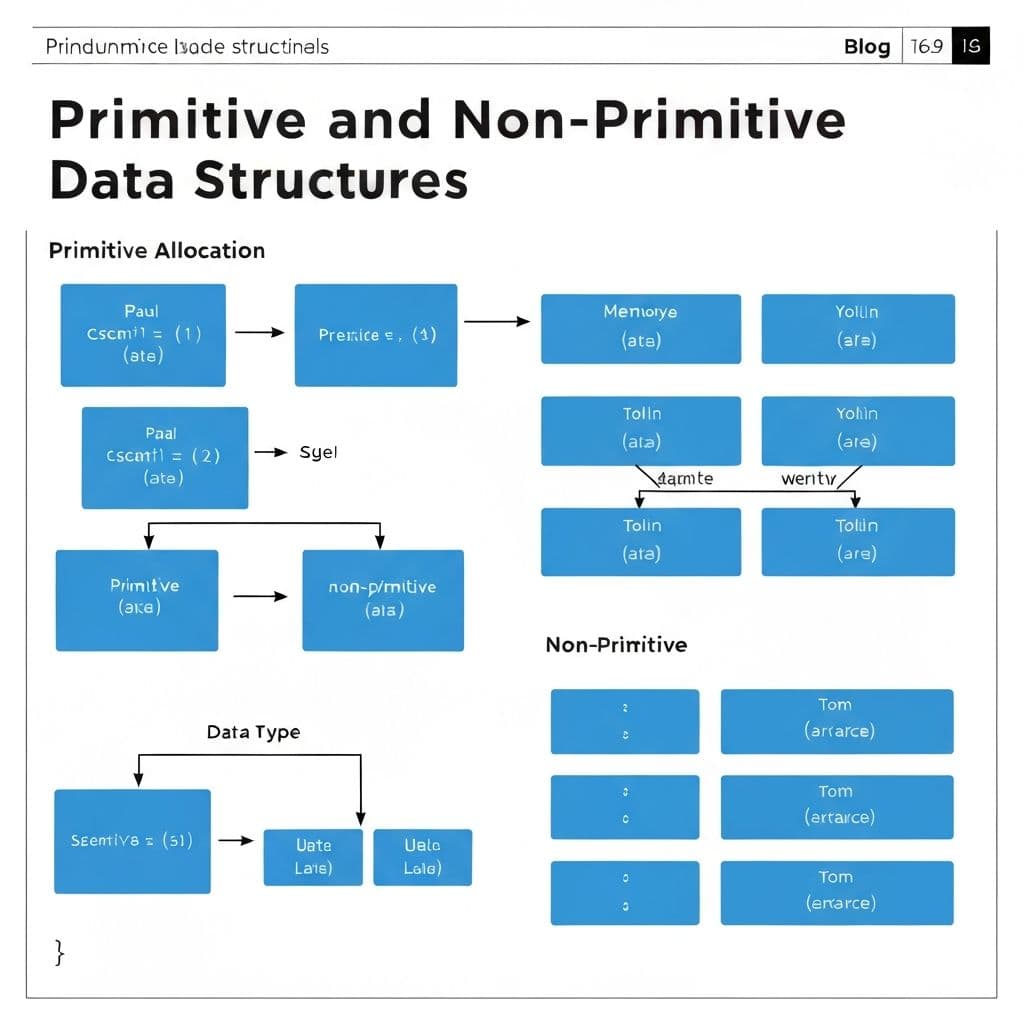
Understanding Data Structure Fundamentals
Data structures represent fundamental building blocks of computer science and programming. Understanding different data structure types is essential for writing efficient, maintainable code. Primitive data structures store single values directly, while non-primitive structures organize multiple values hierarchically. This distinction affects memory allocation, performance characteristics, and suitability for different problems. Choosing appropriate data structures significantly impacts algorithm efficiency and code quality.
Every programmer encounters these concepts early in their education but may not fully appreciate implications. As projects grow complex, data structure choices increasingly impact system performance and maintainability. Understanding trade-offs between primitive and non-primitive structures enables informed design decisions. At Tulu E Biz, we emphasize data structure mastery as foundational software engineering skill.
Primitive Data Structures Defined
Primitive data structures represent basic building blocks directly storing single atomic values. These structures have fixed size and directly contain their data without additional layers. Common primitive types include integers, floats, characters, booleans, and strings (in some languages). Variables of primitive types store actual values directly in memory, not references to external data.
Primitive data types are implemented at language level, often with dedicated CPU instructions for operations. They provide fastest possible value storage and access. All other data structures ultimately comprise primitive elements. Understanding primitives' characteristics enables appreciating more complex structures. Languages differ in exact primitive types available but all share similar concepts.
Common Primitive Data Types
Integer represents whole numbers—typically 32-bit or 64-bit values. Modern languages offer multiple integer types for different size and range requirements. Integer operations are extremely fast due to CPU-level support. Float represents decimal numbers using IEEE floating-point format. Boolean represents true/false values used in conditional logic. Character represents single characters from character sets like ASCII.
String technically represents sequence of characters, making it borderline between primitive and non-primitive. Many languages treat strings as primitive types despite comprising multiple characters. However, string handling varies—some languages provide strings as primitive while others provide them as character arrays. Byte type represents single bytes enabling low-level data manipulation. These primitive types form foundations for all programming.
Memory Allocation for Primitives
Primitive values typically allocate fixed memory during variable declaration. Integer requiring 32 bits allocates exactly 4 bytes. Allocation occurs in stack memory for local variables, enabling rapid access and automatic deallocation when scope exits. This fixed allocation contrasts sharply with non-primitives requiring dynamic allocation.
Stack allocation provides performance benefits but imposes size limitations—stack memory is relatively limited compared to heap. Large primitive arrays still require special handling. Memory is contiguous in stack, improving cache locality and access speed. For primitives, stack allocation typically occurs automatically without programmer intervention.
Non-Primitive Data Structures Overview
Non-primitive data structures organize and manage multiple values, often with complex relationships between elements. These structures provide abstractions enabling efficient manipulation of collections. Common non-primitive structures include arrays, lists, stacks, queues, trees, and graphs. Non-primitives differ fundamentally—they contain multiple elements, enable dynamic sizing, and organize elements hierarchically.
Non-primitive structures typically allocate memory dynamically on heap, enabling flexible sizing. Heap allocation enables structures growing or shrinking as needed. However, dynamic allocation introduces overhead and requires explicit or automatic memory management. Understanding non-primitive structures and their tradeoffs proves essential for effective programming.
Arrays - Fundamental Collections
Arrays represent basic non-primitive structure—ordered collections of elements of identical type stored contiguously. Arrays provide constant-time access to elements through indexing. Sequential access through iteration remains efficient. However, arrays have fixed size after creation (in most languages) and inserting/deleting elements requires shifting remaining elements.
Arrays allocate contiguous memory enabling rapid access through index arithmetic. This cache-friendly memory layout provides performance advantages. However, arrays waste memory if elements are sparse or require dynamic growth. Arrays form foundations for many advanced structures and algorithms. Understanding array characteristics and tradeoffs enables effective array usage.
Linked Lists - Dynamic Collections
Linked Lists provide dynamic non-primitive structure where elements (nodes) contain data and links to other nodes. This structure enables efficient insertion and deletion anywhere in the list without shifting elements. However, accessing arbitrary elements requires traversing from the beginning, resulting in linear time access. Linked lists exchange random access for dynamic flexibility.
Linked lists allocate memory dynamically for each node, enabling structures growing or shrinking efficiently. The pointer-based structure enables complex list manipulations. Doubly-linked variants enable traversal in both directions. However, pointer storage overhead and cache unfriendliness make linked lists less efficient than arrays for sequential access. Selecting between arrays and linked lists requires understanding tradeoffs.
Stacks and Queues - Specialized Collections
Stacks and Queues represent specialized non-primitive structures with restricted access patterns. Stacks enforce Last-In-First-Out (LIFO) access—elements added most recently are accessed first. Queues enforce First-In-First-Out (FIFO)—elements added first are accessed first. These access restrictions enable efficient algorithms and clear semantics for specific problems.
Stacks excel for depth-first searches, function call management, and expression evaluation. Queues excel for breadth-first searches, task scheduling, and producer-consumer patterns. Both structures can implement using arrays or linked lists with different tradeoff characteristics. Restricting access patterns through stack and queue abstractions simplifies problem-solving and prevents incorrect usage patterns.
Trees and Graphs - Hierarchical Structures
Trees represent hierarchical non-primitive structures with parent-child relationships between nodes. Trees enable efficient searching, sorting, and hierarchical data representation. Binary trees constrain each node to two children, enabling balanced structures optimizing access patterns. Tree variants like AVL trees and Red-Black trees self-balance, maintaining performance guarantees.
Graphs generalize trees enabling arbitrary connections between nodes. Graphs excel for network representation, dependency analysis, and relationship modeling. Graph algorithms enable solving diverse problems—shortest paths, connectivity analysis, and topology. Understanding trees and graphs enables modeling complex problem domains effectively. Choosing appropriate tree or graph variants significantly impacts algorithm efficiency.
Memory Allocation Differences
Primitive allocation typically occurs in stack memory—fast but limited size and automatic deallocation. Non-primitive allocation typically occurs in heap memory—larger capacity enabling dynamic growth but requiring explicit or automatic memory management. Stack allocation provides performance benefits but imposes constraints. Heap allocation provides flexibility at performance cost.
Hybrid approaches exist—fixed-size non-primitives in stack (like small arrays) balance advantages. Understanding memory allocation implications helps optimize performance. Cache considerations matter—contiguous stack and array memory provides cache advantages while linked structures suffer cache misses. Modern systems handle memory automatically through garbage collection, but understanding underlying allocation remains valuable.
Choosing Appropriate Data Structures
Selecting appropriate structures requires analyzing problem requirements. Need efficient random access? Use arrays. Need frequent insertion/deletion? Consider linked lists. Need LIFO semantics? Use stacks. Need hierarchical data? Use trees. Need arbitrary relationships? Use graphs. Understanding available structures and their characteristics enables appropriate selection.
Performance requirements drive selection—O(1) access with arrays versus O(n) access with linked lists. Space efficiency matters—arrays are compact while linked structures have pointer overhead. Code clarity matters—appropriate structure selection makes code more readable and maintainable. Many problems don't have single optimal structure; multiple approaches with different tradeoffs exist.
Practical Considerations and Trade-offs
Real-world decisions require balancing multiple factors. Array benefits include random access and cache efficiency but require fixed sizing. Linked list benefits include dynamic sizing and efficient insertion/deletion but suffer random access and cache locality. Hash tables provide fast lookups but require careful collision handling. Selecting structures requires understanding specific use cases.
Hybrid structures combine multiple approaches—skip lists combine linked list flexibility with logarithmic access through layering. Caching techniques reduce disadvantages of poor access patterns. Understanding tradeoffs enables making informed decisions matching specific requirements. Premature optimization choosing complex structures for simple problems wastes effort. Conversely, naive structure choices cause performance issues with scale.
Conclusion
Primitive and non-primitive data structures represent fundamental programming concepts with far-reaching implications. Primitive structures provide basic atomic storage while non-primitives enable organizing multiple values hierarchically. Understanding characteristics, memory allocation, and tradeoffs enables selecting appropriate structures for specific problems. As projects grow complex, data structure expertise increasingly differentiates competent programmers from exceptional ones. Invest time mastering these fundamentals—the knowledge compounds throughout your career, enabling efficient, maintainable code across all projects.
Enjoyed this article? Share it with others!