
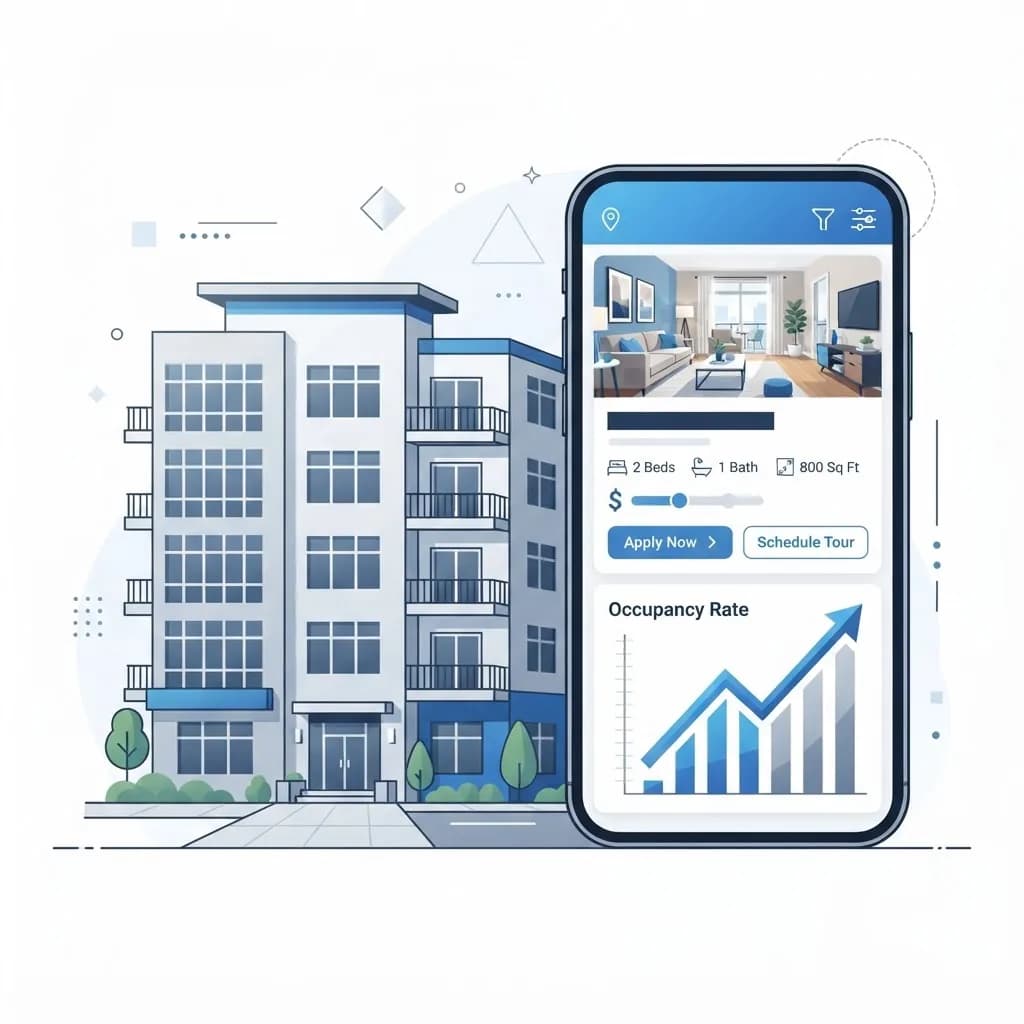
Every vacant day at an apartment community costs real money, and that cost never comes back. A hundred-unit property with a five percent vacancy gap loses more in a year than most marketing budgets consume. Yet many communities still rely almost entirely on listing sites and hope.
Multifamily digital marketing is about controlling more of your own lead flow so you are not paying escalating fees to intermediaries for renters who could have found you directly.
This guide covers the channels that actually produce qualified tours, how to structure property websites for search, and why lead response speed matters more than almost anything else in this industry.
What Is Multifamily Digital Marketing?
Multifamily digital marketing is the set of online strategies apartment communities and property management companies use to attract prospective renters, generate tours and convert leases. It spans internet listing services, property websites, local search, paid advertising, reputation management and automated lead nurture.
The industry has a specific structural challenge: internet listing services dominate renter discovery but charge significant per-property fees and control the relationship. The strategic goal for most operators is increasing the share of direct, owned-channel leads to reduce dependency and cost per lease.
It also differs from most marketing because the product is finite and perishable. You cannot sell the same unit twice, and an empty unit in March generates nothing in April.
Who Needs Multifamily Marketing?
Different portfolio sizes have different needs, but several situations make dedicated digital strategy essential.
- Property management companies overseeing multiple communities with inconsistent occupancy
- Lease-up properties needing rapid absorption before financing milestones
- Class B and C communities competing against newer properties with bigger amenity budgets
- Owners whose ILS costs per lease have climbed to unsustainable levels
- Student housing and senior living operators with rigid seasonal leasing windows
Key Features of an Effective Program
Property Website Optimization
Your property site should convert visitors who arrive from listing sites, search and referrals. That means real floor plan pages with pricing and availability, high-quality photography, virtual tours, and a scheduling tool that works on mobile without friction. A well-executed property website design often outperforms adding another listing service subscription.
Local SEO and Google Business Profile
Renters search "apartments near [neighborhood]" constantly. An optimized Google Business Profile with current photos, amenity attributes, and active review responses captures high-intent traffic at zero cost per lead. Many communities neglect this entirely, which makes it a genuine competitive opening.
Reputation Management
Apartment reviews are brutally honest and heavily read. A community averaging 3.2 stars will struggle regardless of marketing spend. Systematic review generation from satisfied residents, fast responses to complaints, and visible operational improvements move the number over time.
Paid Search and Social Retargeting
Google Search ads targeting neighborhood and amenity queries capture renters actively looking. Meta retargeting keeps your community visible during the two to six week decision window. Consistent creative across channels, supported by proper professional design work, dramatically affects ad performance in a visually driven category.
How to Get Started
The highest-impact improvements are usually operational rather than promotional, which is good news for budgets.
- Measure your current cost per lease by source, including ILS fees, ad spend and staff time.
- Audit lead response time, since most communities take hours when minutes determine tour rates.
- Fix your property website mobile experience, particularly the tour scheduling flow.
- Fully optimize the Google Business Profile with current photos, amenities and accurate hours.
- Launch a resident review request program tied to positive service interactions.
- Add Google Search campaigns targeting your neighborhood and competitor terms.
- Implement automated lead follow-up so no inquiry waits more than five minutes for a response.
Benefits of a Direct-Channel Strategy
Shifting lead mix toward owned channels changes the economics of leasing significantly.
- Lower blended cost per lease as organic and direct traffic replaces paid listing leads
- Reduced vacancy days through faster response and better prospect nurture
- Better prospect quality, since renters who find you directly are often further along in their search
- Negotiating leverage with listing services when you are less dependent on them
- Portfolio-wide data that reveals which communities and strategies actually work
Potential Challenges
Multifamily has constraints that generic marketing advice tends to ignore.
- Fair housing regulations restrict targeting options on advertising platforms significantly
- On-site staff turnover disrupts lead response consistency and review generation programs
- Seasonal demand swings make month-over-month comparisons misleading
- Property management software integrations are often clunky, complicating attribution
Best Practices and Tips
Operators who consistently outperform tend to focus on unglamorous execution details.
- Respond to every lead within five minutes, even with an automated acknowledgment
- Update pricing and availability daily, since stale listings destroy trust immediately
- Invest in professional photography and video, as visual quality drives tour requests more than copy
- Keep property sites fast and functional with ongoing website maintenance and support so broken forms never silently kill lead flow
Real-World Example
A 240-unit Class B community in a competitive suburban submarket was running at eighty-eight percent occupancy and spending forty-two hundred dollars monthly across three listing services. Their average cost per lease was over eleven hundred dollars.
Analysis revealed two problems: average lead response time was four hours, and their website tour scheduler was broken on iOS. Fixing the scheduler and implementing instant automated response with text follow-up increased tour conversion from twelve percent to twenty-six percent within six weeks.
They then dropped one listing service and redirected that budget to Google Search ads and a review program that lifted their rating from 3.4 to 4.1 over eight months. Occupancy reached ninety-five percent and cost per lease fell to under six hundred dollars.
Why It Matters
Multifamily operates on thin margins where occupancy percentage points translate directly to asset value. A property running at ninety-three percent instead of ninety-seven percent has meaningfully lower net operating income and therefore lower valuation.
Multifamily digital marketing is one of the few levers that affects occupancy without capital expenditure. Compared to renovating units or adding amenities, improving lead response and search visibility is fast and inexpensive.
Frequently Asked Questions
Should we stop using internet listing services entirely?
Rarely. ILS platforms still drive substantial volume and dropping all of them at once is risky. The better approach is measuring cost per lease by platform, cutting the worst performer, and reinvesting in owned channels until you know direct leads can absorb the gap.
How much should a property spend on digital marketing?
Common benchmarks range from one hundred to three hundred dollars per unit annually, though lease-up properties spend considerably more. Evaluate against cost per lease and vacancy loss rather than as a fixed percentage.
What matters most for reducing vacancy?
Lead response speed. Industry data consistently shows that responding within five minutes dramatically increases tour rates compared to responding within an hour. It is the cheapest improvement available to most communities.
Do virtual tours actually help?
Yes, particularly for relocating renters and for pre-qualifying local prospects. Communities offering quality virtual tours typically see higher tour-to-lease conversion because in-person visitors arrive already interested.
Conclusion
Effective multifamily digital marketing starts with fixing the leaks in your existing funnel before spending more on new leads. Fast response, a functional website, an optimized profile and a healthy review rating deliver more occupancy per dollar than another listing subscription.
Build your direct-lead engine and the ILS dependency problem solves itself over time. Discover marketing solutions built for property portfolios and start reducing your cost per lease.
Enjoyed this article? Share it with others!