
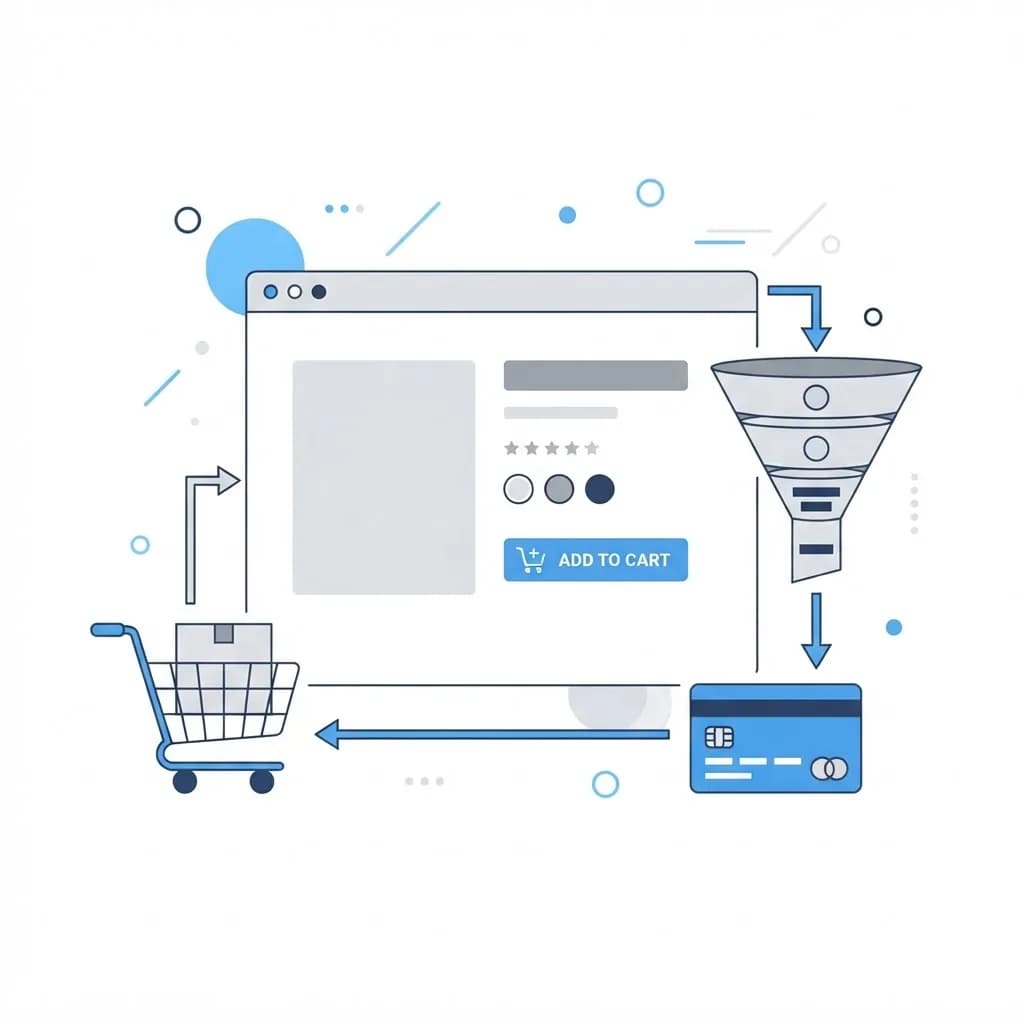
Running an online store means competing with marketplaces that have unlimited budgets and brands that have been building audiences for a decade. The stores that grow anyway are rarely the ones with the biggest ad spend. They are the ones that pair acquisition with retention and treat their site as a conversion machine rather than a catalog.
Effective ecommerce digital marketing services connect those pieces. Traffic without conversion is expensive. Conversion without repeat purchase is unsustainable. You need both working together.
This guide breaks down what these services include, which ones matter most at different stages, and how to evaluate whether a provider is actually delivering value.
What Are Ecommerce Digital Marketing Services?
Ecommerce digital marketing services are the specialized channels, systems and optimizations used to attract shoppers, convert them into buyers, and turn buyers into repeat customers. They differ from general marketing because every activity ties directly to a transaction and can be measured against revenue.
The scope typically spans product-level SEO, paid shopping campaigns, email and SMS automation, conversion rate optimization, marketplace management and customer lifecycle programs. The unifying goal is profitable customer acquisition cost relative to lifetime value.
What separates good providers from mediocre ones is whether they optimize for contribution margin or for surface metrics like impressions and click-through rate.
Who Needs These Services?
Not every store needs the full stack immediately, but certain situations make specialized support worth the investment.
- Stores generating consistent revenue but stuck on a plateau despite increasing ad spend
- Brands with strong products and poor discoverability in organic search
- Merchants whose customer acquisition cost has climbed past sustainable levels
- Businesses migrating platforms and needing to protect existing rankings and revenue
- Teams with a good product but no repeat purchase or retention program
Key Features of a Complete Ecommerce Program
Product and Category SEO
Organic search remains the highest-margin traffic source for most stores. This means optimized category pages targeting commercial keywords, unique product descriptions instead of manufacturer copy, proper schema markup for reviews and pricing, and internal linking that distributes authority to money pages. It also requires a technically sound storefront, which is why serious brands invest in proper ecommerce platform solutions rather than fighting a poorly built site.
Paid Media and Shopping Campaigns
Google Shopping, Performance Max, Meta catalog ads and retargeting form the acquisition engine for most stores. Success depends heavily on feed quality. A well-structured product feed with accurate attributes, competitive pricing signals and high-quality imagery often improves performance more than bid adjustments ever will.
Email and SMS Lifecycle Automation
Abandoned cart, browse abandonment, post-purchase, winback and replenishment flows typically generate twenty-five to forty percent of ecommerce revenue for mature brands. These are set up once and produce continuously, making them the highest ROI investment available. Strategic email marketing automation is where many stores find their fastest margin improvement.
Conversion Rate Optimization
Improving conversion from 1.8 percent to 2.4 percent increases revenue by a third without spending another dollar on traffic. CRO work covers page speed, mobile checkout friction, trust signals, product page layout, and systematic A/B testing.
How to Get Started
The sequence matters. Driving more traffic to a site that converts poorly wastes money, so most successful engagements start with the foundation.
- Establish accurate tracking including server-side events, enhanced conversions and true margin reporting.
- Audit site speed and mobile checkout, fixing anything that adds friction before scaling spend.
- Build core email and SMS flows if they do not exist, since these produce revenue immediately.
- Clean and enrich your product feed so paid shopping campaigns have quality inputs.
- Optimize your top twenty revenue-generating category and product pages for organic search.
- Scale paid acquisition once conversion and retention systems can support the volume profitably.
- Run continuous CRO tests, prioritizing pages with the highest traffic and lowest conversion.
Benefits of Investing in Ecommerce Marketing
When the pieces work together, the compounding effect is significant and shows up in unit economics rather than just top-line revenue.
- Lower blended customer acquisition cost as organic and email offset paid channels
- Higher average order value through better merchandising and bundling
- Increased repeat purchase rate, which dramatically improves lifetime value
- Reduced dependence on any single platform or algorithm change
- Clearer decision making because revenue is attributed to specific activities
Potential Challenges
Ecommerce marketing has real constraints that providers should discuss honestly upfront.
- Thin margins limit how much you can pay to acquire a customer, especially on first purchase
- Attribution across multiple touchpoints remains imperfect, making budget decisions harder
- Inventory and fulfillment issues can invalidate marketing gains overnight
- Platform policy changes on Meta or Google can disrupt performance without warning
Best Practices and Tips
A handful of habits consistently separate stores that scale from those that stall.
- Optimize for contribution margin after ad spend, shipping and COGS, not revenue alone
- Photograph your products properly, since imagery affects both ad performance and conversion
- Segment email lists by purchase behavior rather than blasting the full list
- Support campaigns with cohesive social media and banner design so creative quality matches your product quality
Real-World Example
A specialty coffee brand was spending eighteen thousand dollars monthly on Meta ads with a blended return of 1.9x, barely breaking even after cost of goods. Their site converted at 1.4 percent and they had no email automation beyond a basic welcome message.
Rather than increasing spend, they spent two months on foundations: rebuilding product pages with clearer brewing guides, cutting mobile load time from 5.2 seconds to 1.9, and building six lifecycle flows including a subscription replenishment sequence. Conversion rose to 2.6 percent and email began contributing thirty-one percent of revenue. With the same ad budget, blended return reached 3.4x and they became genuinely profitable.
Why It Matters
Ad costs are not going back down. Marketplaces keep absorbing more product discovery. In that environment, a store that depends entirely on paid acquisition is renting its customer base from platforms that can raise the price at any time.
Comprehensive ecommerce digital marketing services build owned assets — organic visibility, email lists, repeat customers — that keep producing regardless of what happens to ad auction dynamics. That is the difference between a business and a campaign.
Frequently Asked Questions
How much do ecommerce digital marketing services cost?
Retainers commonly range from three thousand to twenty thousand dollars monthly depending on scope, plus ad spend. Many providers also work on a percentage of ad spend for paid media management. Evaluate cost against incremental contribution margin, not revenue.
Which channel should I start with?
If you have existing traffic, start with email automation and conversion optimization because they produce fastest. If you have low traffic but good conversion, start with paid shopping to generate volume while organic builds.
How long before I see results?
Email flows and CRO improvements often show results within thirty days. Paid campaigns need two to three months to exit the learning phase and stabilize. Organic search typically takes four to eight months for competitive product categories.
Do I need a new ecommerce platform?
Only if your current platform blocks essential functionality, loads slowly, or cannot support the integrations you need. Migration is disruptive and should be justified by specific limitations, not general dissatisfaction.
Conclusion
The right ecommerce digital marketing services do not just send more traffic. They tighten your conversion path, build owned channels that reduce acquisition costs, and turn one-time buyers into a repeat customer base you control.
Start by fixing your foundation, then scale acquisition against a store that actually converts. If you want help building that full-funnel system, explore end-to-end ecommerce marketing support tailored to your margins and growth stage.
Enjoyed this article? Share it with others!