
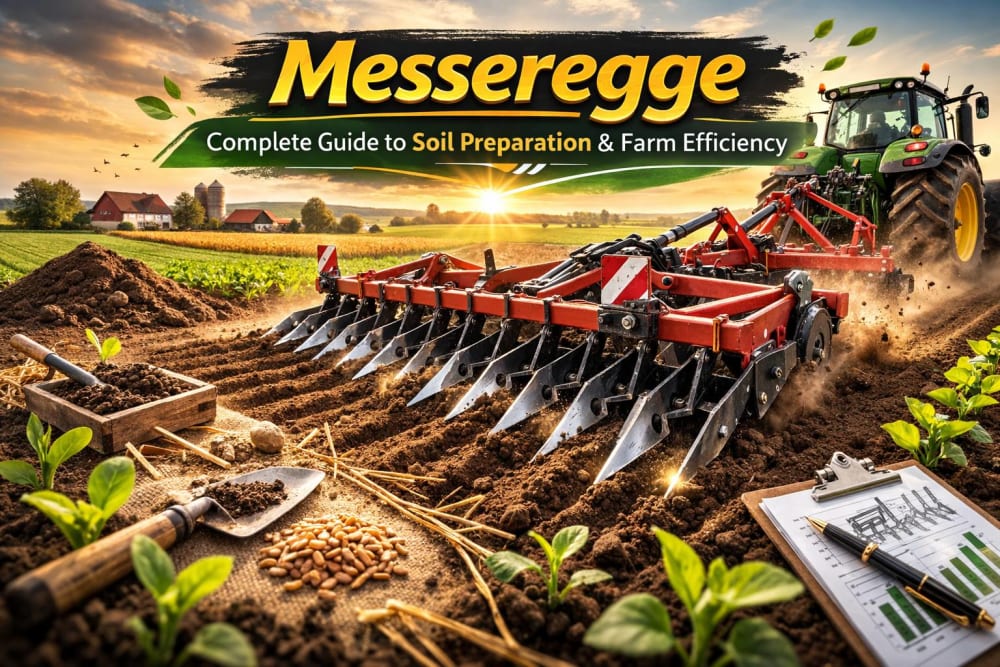
Messeregge is a type of agricultural tool designed to prepare soil efficiently for planting. It combines the functions of cutting and leveling, allowing farmers to create a consistent seedbed. Its design focuses on practicality, durability, and effectiveness, making it a standard choice in many European farms.
Understanding Messeregge goes beyond its physical appearance. Knowing how it operates, what conditions it performs best in, and how it differs from other implements can save time and improve crop yields. Practical knowledge helps in choosing the right model and using it correctly to maintain soil health and reduce maintenance issues.
1. What is Messeregge and where does the term come from
A Messeregge is essentially a knife harrow used for soil cultivation. The name originates from German, combining “Messer,” meaning knife, and “Egge,” meaning harrow. Its purpose is to slice and loosen the soil surface, breaking clods and preparing a smooth layer for sowing seeds.
This tool has been part of European farming practices for decades and is recognized for its efficiency in creating uniform soil conditions. It is particularly valuable in regions with compacted or uneven soil, where traditional harrows might not provide sufficient penetration. Farmers appreciate it for both tillage and finishing work.
2. How Messeregge is used in farming and soil preparation
Messeregge is primarily used to create a fine, even seedbed before planting crops. Its sharp, angled blades cut through soil, crop residue, and weeds, reducing clumping and promoting uniform germination.
Farmers often use it after plowing or heavy tillage to refine the soil surface. It can also help manage light debris, ensuring the soil is ready for sowing without needing additional passes. Adjusting the depth and angle of the blades allows operators to match different soil types and crop requirements.
3. Key features that distinguish Messeregge from similar tools
The distinguishing factor of a Messeregge is its knife-like blades that slice instead of just pressing the soil. Unlike traditional harrows, it provides a more aggressive cutting action, which improves aeration and reduces compaction.
Another notable feature is the modular frame, which allows farmers to adapt the implement to various tractor sizes and field conditions. The spacing and arrangement of the blades can be customized, making it versatile for both small plots and large commercial farms. Its construction also emphasizes durability to withstand abrasive soils and repeated use.
4. Common mistakes when choosing or using a Messeregge
A frequent mistake is selecting a model too large or heavy for the available tractor, which can lead to uneven soil contact and increased wear. Some users also fail to adjust the blade angle for specific soil conditions, reducing efficiency.
Overusing the Messeregge in wet or overly compacted soil can damage both the implement and the field. Proper maintenance, such as checking blade sharpness and frame stability, is essential. Users should also avoid neglecting soil rotation and crop residue management, as even a well-designed tool cannot compensate for poor planning.
5. How to evaluate if a Messeregge suits your agricultural needs
When evaluating a Messeregge, consider the soil type, field size, and crop requirements. Lighter soils may require less aggressive blades, while clay or compacted soils benefit from sharper, heavier models.
It is also important to match the implement to your tractor’s power and hydraulic capabilities. Observing how different models perform in real-world conditions, including maneuverability and maintenance demands, ensures a suitable long-term choice. Investing time in evaluation prevents operational inefficiencies and protects soil quality over multiple growing seasons.
Conclusion
Messeregge offers a practical and effective solution for soil preparation, combining cutting, leveling, and aeration in one implement. Understanding its design, proper usage, and limitations is key to maximizing its benefits.
Choosing the right model and using it correctly supports uniform seedbeds, reduces maintenance challenges, and improves crop outcomes. By focusing on practical application and careful evaluation, farmers can integrate Messeregge into their operations with confidence and efficiency.
Frequently Asked Questions (FAQs)
1. What is the main purpose of a Messeregge?
A Messeregge is used to prepare the soil for planting by cutting, loosening, and leveling the surface. Its sharp blades break clods, reduce compaction, and create a uniform seedbed, improving germination and crop growth. It is especially effective after plowing or heavy tillage.
2. How is a Messeregge different from a traditional harrow?
Unlike standard harrows that mainly press or crush soil, a Messeregge uses knife-like blades to slice through soil and crop residue. This cutting action enhances aeration, prevents clumping, and allows better penetration in compacted or uneven fields.
3. Can a Messeregge be used on all soil types?
Messeregge works best on loamy to moderately compacted soils. Very wet or heavy clay soils require careful adjustment of blade depth and angle. Using it in unsuitable conditions may damage both the implement and the soil structure.
4. What are common mistakes when using a Messeregge?
Common errors include using a model that is too large for the tractor, failing to adjust blade angles for specific soil, overworking wet fields, and neglecting maintenance. These mistakes can reduce efficiency and shorten the lifespan of the implement.
5. How do I choose the right Messeregge for my farm?
Select a model based on soil type, field size, and tractor capacity. Consider blade design, frame adjustability, and durability. Observing real-world performance and maintenance requirements helps ensure the implement suits your operational needs and long-term soil management goals.
Enjoyed this article? Share it with others!