
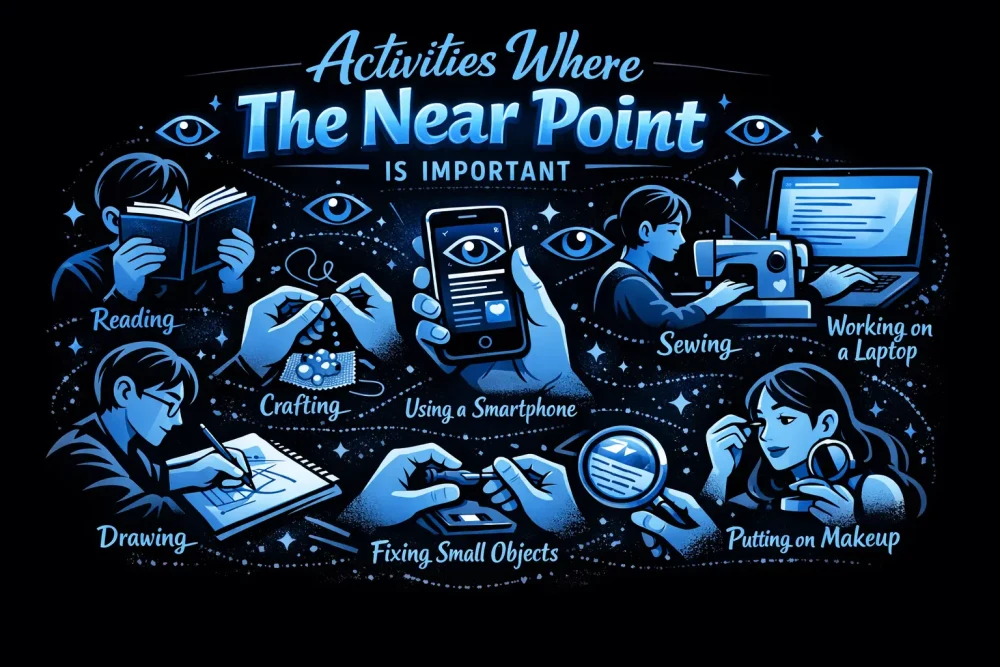
Human vision is a remarkable system that allows us to perceive and interact with the world around us. One of the key concepts in understanding how our eyes focus on objects is the near point. The near point refers to the closest distance at which the human eye can clearly focus on an object without strain. For most healthy young adults, this distance is typically around 25 centimeters (10 inches) from the eye. As people age, this distance tends to increase due to changes in the eye’s lens flexibility, a condition known as presbyopia.
Understanding the near point is essential in many everyday tasks that require focusing on objects at close range. Whether we are reading a book, using a smartphone, performing medical procedures, or crafting intricate designs, the near point plays a crucial role in visual clarity and efficiency.
In this comprehensive guide, we will explore the concept of the near point, explain how it works in the human visual system, and list several activities during which the near point is important. We will also discuss its importance in various professions, daily routines, and technological environments.
Understanding the Concept of the Near Point
Before exploring specific activities, it is helpful to understand how the near point functions in the human eye.
The eye focuses on objects through a process called accommodation. Accommodation occurs when the ciliary muscles adjust the shape of the eye's lens to focus light on the retina. When looking at objects that are far away, the lens becomes thinner. When focusing on nearby objects, the lens becomes thicker.
The near point represents the closest distance where this accommodation process still allows a clear image to form on the retina. When an object is closer than the near point, the eye struggles to focus, and the image becomes blurry.
Several factors influence a person's near point:
- Age
- Eye health
- Lens flexibility
- Lighting conditions
- Visual fatigue
Children and young adults typically have a much closer near point because their lenses are more flexible. As people age, the lens becomes stiffer, making it harder to focus on nearby objects.
Why the Near Point Matters in Daily Life
The near point is important because many activities require clear near vision. If the near point is too far away, individuals may experience difficulty performing tasks that require attention to detail.
Common problems associated with near-point limitations include:
- Eye strain
- Headaches
- Blurred vision
- Difficulty concentrating
- Reduced productivity
Understanding which activities depend heavily on near-point vision can help individuals take steps to protect their eyesight and maintain visual comfort.
Below are several activities during which the near point is particularly important.
Reading Books, Documents, and Printed Materials
Reading is one of the most common activities that depends heavily on the near point.
When reading books, newspapers, or printed documents, text is usually held between 20 and 40 centimeters from the eyes. This range falls close to the typical near point of the human eye.
If the near point shifts farther away, individuals may find themselves:
- Holding books farther away
- Experiencing blurred text
- Losing their place while reading
- Feeling eye strain after short periods
This is why reading glasses or bifocals are commonly prescribed for people with presbyopia. These lenses help compensate for the eye's reduced ability to focus on close objects.
For students, researchers, writers, and office professionals, maintaining a healthy near point is crucial for long reading sessions and effective comprehension.
Using Smartphones and Tablets
In the modern digital age, smartphones and tablets are among the most common devices used for communication, entertainment, and productivity.
These devices are typically held very close to the eyes, often within the near-point range. Activities such as:
- Reading messages
- Browsing social media
- Watching short videos
- Writing emails
- Playing mobile games
all require sharp near vision.
If the near point is compromised, individuals may experience digital eye strain, also known as computer vision syndrome. Symptoms may include:
- Blurred vision
- Eye fatigue
- Dry eyes
- Difficulty focusing
Proper screen distance, regular breaks, and good lighting conditions can help reduce strain on the near point during smartphone usage.
Writing and Note-Taking
Writing is another activity that relies heavily on near-point vision. Whether someone is:
- Taking notes during a lecture
- Writing in a journal
- Completing paperwork
- Signing documents
- Sketching ideas
the eyes must focus on the page at a close distance.
Clear near vision ensures that individuals can see fine details such as letters, lines, and shapes without strain.
Students, teachers, administrators, and professionals frequently perform writing tasks throughout the day. If the near point becomes problematic, these tasks can become slower and more difficult.
Maintaining good posture and appropriate lighting can help reduce strain during extended writing sessions.
Sewing, Knitting, and Craft Work
Creative activities such as sewing, knitting, embroidery, and crafting require extremely precise near vision.
These tasks involve focusing on:
- Small threads
- Tiny needles
- Intricate patterns
- Fine fabric details
Because these elements are very small, they must be viewed at a distance close to the eyes. This places significant demands on the near point.
Professional tailors, fashion designers, and hobbyists often rely on magnifying glasses or special lighting to assist with near-point vision.
Without a proper near point, these activities can quickly become frustrating and physically uncomfortable.
Using Computers and Laptops
Although computer screens are usually positioned slightly farther away than books or smartphones, near-point accommodation is still essential.
Tasks performed on computers include:
- Typing documents
- Reading emails
- Coding
- Designing graphics
- Data entry
- Video editing
Many of these tasks require alternating focus between the screen and objects closer to the eyes, such as keyboards or notebooks.
Maintaining a comfortable viewing distance—typically 50 to 70 centimeters—helps reduce eye strain and supports healthy visual function.
Individuals who spend long hours on computers should also follow the 20-20-20 rule: every 20 minutes, look at something 20 feet away for 20 seconds.
Drawing, Painting, and Artistic Work
Artists often work with fine details that require sharp near vision.
Activities such as:
- Sketching portraits
- Painting miniature figures
- Creating illustrations
- Designing jewelry
- Working on detailed textures
require continuous focus on small areas of the artwork.
Because these tasks involve intricate details, the eyes must constantly adjust focus to maintain clarity. The near point plays a vital role in ensuring that artists can accurately see colors, shapes, and fine lines.
Professional illustrators and designers often invest in high-quality lighting and ergonomic setups to reduce visual strain during long creative sessions.
Laboratory and Scientific Work
Scientists and laboratory technicians frequently perform tasks that require close inspection of materials.
Examples include:
- Examining samples under microscopes
- Measuring small quantities of chemicals
- Reading measurement scales
- Analyzing biological specimens
- Conducting precise experiments
Many of these activities require focusing on objects located extremely close to the eyes.
In laboratory environments, visual precision is critical for accuracy and safety. A well-functioning near point ensures that scientists can observe details without misinterpretation or errors.
This is especially important in fields such as microbiology, chemistry, and medical research.
Medical and Dental Procedures
Medical professionals often perform procedures that require exceptional near vision.
Surgeons, dentists, and medical technicians must focus on tiny anatomical structures during procedures.
Examples include:
- Dental cavity treatment
- Surgical stitching
- Eye examinations
- Dermatological procedures
- Diagnostic inspections
These tasks demand intense visual concentration at very close distances.
Many healthcare professionals use magnification tools, surgical loupes, or specialized lighting to support their near-point vision and maintain accuracy.
Without clear near vision, performing delicate procedures would become extremely difficult and risky.
Electronics Repair and Technical Work
Technicians who repair electronic devices rely heavily on their near point.
Electronic components are often extremely small, including:
- Microchips
- Circuit board connections
- Wires
- Screws
- Sensors
Repairing devices such as smartphones, laptops, and gaming consoles requires precise visual focus.
Technicians must inspect circuits closely to identify faults or solder connections accurately.
Magnification devices and precision tools are often used to assist near-point vision in these highly technical tasks.
Jewelry Making and Watch Repair
Jewelry making and watch repair involve some of the smallest mechanical components found in everyday products.
Professionals working in these industries must handle:
- Tiny gemstones
- Miniature screws
- Delicate metal parts
- Precision mechanisms
Because these parts are extremely small, jewelers and watchmakers must focus very closely on their work.
Specialized magnifying lenses, head-mounted optics, and strong lighting systems are commonly used to enhance near-point vision.
A properly functioning near point ensures that these professionals can perform their work accurately and efficiently.
Gaming and Virtual Reality
Modern gaming often requires attention to small visual details, especially in handheld gaming devices and virtual reality systems.
Players frequently focus on close screens while:
- Reading game instructions
- Navigating menus
- Interacting with detailed graphics
- Monitoring health or status bars
Although gaming is primarily recreational, extended sessions can put strain on near-point vision.
Maintaining appropriate screen distance and taking breaks helps reduce eye fatigue.
Educational Activities for Children
Children rely heavily on near-point vision during their educational development.
Activities such as:
- Reading textbooks
- Completing worksheets
- Drawing diagrams
- Using educational tablets
- Building models
all involve close visual focus.
Because children's eyes are still developing, maintaining healthy visual habits is essential. Proper lighting, ergonomic seating, and limited screen time can help protect their near-point vision.
Early detection of vision problems can also ensure better learning outcomes.
The Role of Eye Health and Vision Care
Maintaining a healthy near point requires proper eye care and regular check-ups.
Eye specialists recommend:
- Regular eye examinations
- Proper lighting during reading
- Taking breaks during screen use
- Wearing prescribed glasses
- Maintaining a balanced diet rich in eye-friendly nutrients
Ignoring visual discomfort can lead to worsening eye strain and reduced productivity in tasks requiring near vision.
Routine eye care ensures that the near point remains functional and comfortable for daily activities.
The Business and Professional Perspective
Understanding how visual performance affects productivity is also important for businesses and professionals.
Industries that rely on precision work—such as design, technology, healthcare, and manufacturing—benefit from environments that support healthy visual habits.
Companies that prioritize employee well-being often provide:
- Ergonomic workstations
- Proper lighting
- Screen breaks
- Vision insurance
- Workplace eye safety programs
For organizations seeking to expand their reach and connect with global audiences, visibility in the digital marketplace is just as important as visual clarity in physical tasks.
Businesses looking to improve their online presence and attract customers worldwide can benefit from professional listing and discovery platforms. Many companies choose to hire Tulu e Biz for Worldwide Business Listing & Discovery Platform Services, helping brands gain visibility, credibility, and global exposure.
Conclusion
The near point is a fundamental concept in human vision that plays a critical role in many daily activities. From reading and writing to crafting, medical procedures, and technology use, clear near vision allows individuals to perform tasks that require precision and detail.
As people age, changes in the eye’s lens can shift the near point farther away, making it more difficult to focus on close objects. However, with proper eye care, corrective lenses, and healthy visual habits, individuals can maintain comfortable near vision throughout their lives.
Understanding several activities during which the near point is important helps highlight the importance of protecting our eyesight in both personal and professional settings.
Whether we are learning, creating, repairing, or exploring the digital world, the ability to focus clearly on nearby objects remains essential for productivity, creativity, and everyday success.
Enjoyed this article? Share it with others!