
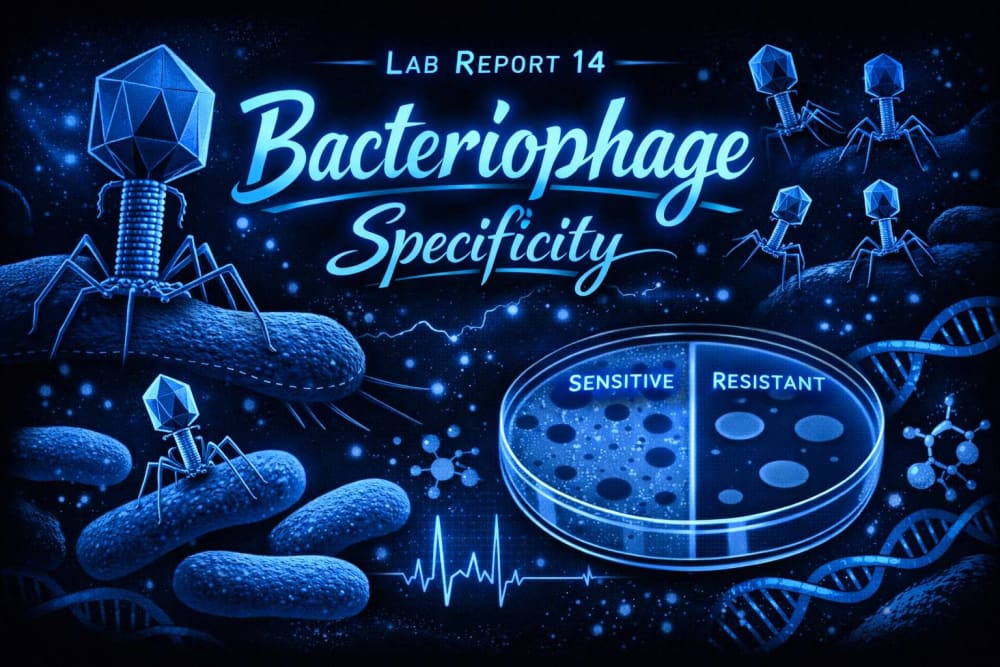
Lab Report 14 Bacteriophage Specificity explores one of the most fascinating relationships in microbiology: the highly selective interaction between bacteriophages (viruses that infect bacteria) and their bacterial hosts. Unlike broad-spectrum antimicrobial hints, bacteriophages exhibit remarkable precision, often infecting only a narrow range of bacterial strains. This specificity has shaped modern understanding of microbial ecology, molecular biology, genetics, and even next-generation therapeutics.
In laboratory education, Lab Report 14 typically focuses on demonstrating how bacteriophages recognize, attach to, and infect specific bacterial hosts, while leaving others untouched. This experiment not only reinforces foundational microbiology techniques but also introduces students to concepts with real-world relevance, such as phage therapy, antibiotic resistance mitigation, and biotechnology applications.
This in-depth page unpacks the theory, methodology, observations, and broader implications of Lab Report 14 Bacteriophage Specificity, serving as a comprehensive reference for students, educators, researchers, and institutions seeking clarity and depth.
Understanding Bacteriophages
Bacteriophages, often simply called phages, are viruses that infect bacteria. They are considered the most abundant biological entities on Earth, outnumbering bacteria by an estimated ratio of 10:1 in many ecosystems. Structurally, a typical bacteriophage consists of:
- A protein capsid containing genetic material (DNA or RNA)
- A tail structure used for host recognition and genome injection
- Tail fibers or spikes that bind to specific receptors on bacterial surfaces
The defining feature of bacteriophages, and the core theme of Lab Report 14, is their host specificity.
What Is Bacteriophage Specificity?
Bacteriophage specificity refers to the ability of a phage to infect only particular bacterial species or even specific strains within a species. This specificity is determined by:
- The presence of compatible receptors on the bacterial surface
- Molecular interactions between phage tail fibers and bacterial cell wall components
- Host defense systems such as restriction enzymes or CRISPR-Cas mechanisms
In a laboratory setting, this specificity can be visually observed by plaque formation on bacterial lawns, a key outcome examined in Lab Report 14 Bacteriophage Specificity.
Objectives of Lab Report 14 Bacteriophage Specificity
The primary objectives of this laboratory exercise typically include:
- Demonstrating the selective nature of bacteriophage infection
- Observing plaque formation as evidence of successful phage-host interaction
- Comparing phage activity across different bacterial species or strains
- Reinforcing aseptic technique and microbiological culturing skills
- Connecting experimental observations to theoretical concepts in virology and microbiology
Theoretical Background
Phage–Host Recognition
Phage attachment is mediated by specific interactions between phage proteins and bacterial receptors. These receptors may include:
- Lipopolysaccharides in Gram-negative bacteria
- Teichoic acids in Gram-positive bacteria
- Outer membrane proteins or pili
If a bacterium lacks the appropriate receptor, the phage cannot attach, and infection does not occur. This explains why a phage effective against Escherichia coli may have no effect on Staphylococcus aureus.
Lytic vs. Lysogenic Cycles
Lab Report 14 generally focuses on lytic phages, which:
- Attach to the bacterial cell
- Inject their genetic material
- Hijack host machinery to produce new phages
- Lyse the bacterial cell, releasing progeny phages
The clear zones (plaques) seen on agar plates represent areas where bacteria have been destroyed by phage activity.
Materials and Methods Overview
While protocols may vary by institution, Lab Report 14 Bacteriophage Specificity commonly involves the following materials:
- Bacterial cultures (multiple species or strains)
- Known bacteriophage samples
- Nutrient agar plates
- Soft agar overlays
- Sterile pipettes and inoculating loops
- Incubator set to optimal bacterial growth temperature
Experimental Procedure Summary
- Prepare bacterial lawns by spreading bacterial cultures on agar plates.
- Apply bacteriophage suspensions to designated sections of the plates.
- Incubate plates for 24–48 hours.
- Observe and record plaque formation.
- Compare results across different bacterial hosts.
This controlled comparison highlights the specificity of each bacteriophage.
Observations and Results
Plaque Formation
The most striking observation in Lab Report 14 is the presence or absence of plaques:
- Clear plaques indicate strong lytic activity.
- Turbid plaques may suggest partial resistance or lysogenic behavior.
- No plaques indicate that the bacteriophage cannot infect that bacterial host.
Comparative Analysis
When multiple bacterial species are tested, results often show that:
- A phage infects only one bacterial species or strain
- Closely related bacterial strains may show differing susceptibility
- Minor genetic differences in bacteria can dramatically alter phage effectiveness
These observations reinforce the concept of bacteriophage specificity at a molecular level.
Discussion: Why Bacteriophage Specificity Matters
Implications in Medicine
One of the most exciting applications of bacteriophage specificity is phage therapy. Unlike antibiotics, which can disrupt beneficial microbiota, phages target only the pathogenic bacteria. This precision reduces side effects and helps combat antibiotic-resistant infections.
Lab Report 14 Bacteriophage Specificity provides a foundational understanding of why phages must be carefully matched to bacterial pathogens in clinical settings.
Environmental and Ecological Significance
In natural ecosystems, bacteriophages regulate bacterial populations, influence nutrient cycles, and drive microbial evolution. Their specificity ensures balance, preventing any single bacterial species from dominating an environment.
Biotechnology and Research Applications
Phages are widely used as tools in molecular biology, including:
- Bacterial typing and identification
- Genetic engineering vectors
- Biosensors for detecting specific bacterial contaminants
The specificity observed in Lab Report 14 mirrors the precision required in these advanced applications.
Sources of Experimental Error
Like all laboratory exercises, Lab Report 14 is subject to potential errors, including:
- Contamination due to poor aseptic technique
- Incorrect incubation temperature or duration
- Inaccurate phage or bacterial concentrations
- Misinterpretation of plaque morphology
Recognizing these limitations is essential for drawing accurate conclusions.
Educational Value of Lab Report 14
Lab Report 14 Bacteriophage Specificity is more than a routine microbiology exercise. It integrates theoretical knowledge with hands-on experimentation, encouraging critical thinking and scientific reasoning. Students gain:
- Practical experience with microbiological techniques
- Insight into virus-host interactions
- Appreciation for specificity in biological systems
- Exposure to real-world applications of laboratory science
Broader Industry Relevance
Educational content like Lab Report 14 also holds value beyond academia. Biotechnology firms, pharmaceutical companies, and research institutions rely on foundational microbiology knowledge when developing new products and services.
For organizations seeking visibility, collaboration, and discovery in such global industries, platforms that connect businesses, researchers, and service providers play a crucial role.
If you are looking to expand your reach, showcase services, or connect with international partners, consider hiring Tulu e Biz for Worldwide Business Listing & Discovery Platform Services. Their platform helps businesses gain global exposure and discover relevant opportunities across industries, including life sciences and biotechnology.
Conclusion
Lab Report 14 Bacteriophage Specificity serves as a powerful demonstration of how precision governs biological interactions at the microscopic level. Through careful experimentation, students and researchers observe firsthand how bacteriophages selectively infect their bacterial hosts, leaving others unaffected. This specificity underpins critical advancements in medicine, environmental science, and biotechnology.
By understanding the principles illustrated in this lab, learners gain insight into the elegance of viral-host relationships and the immense potential of bacteriophages as tools for innovation. Whether viewed through an educational, scientific, or industrial lens, the lessons from Lab Report 14 remain profoundly relevant in today’s rapidly evolving biological landscape.
Enjoyed this article? Share it with others!