
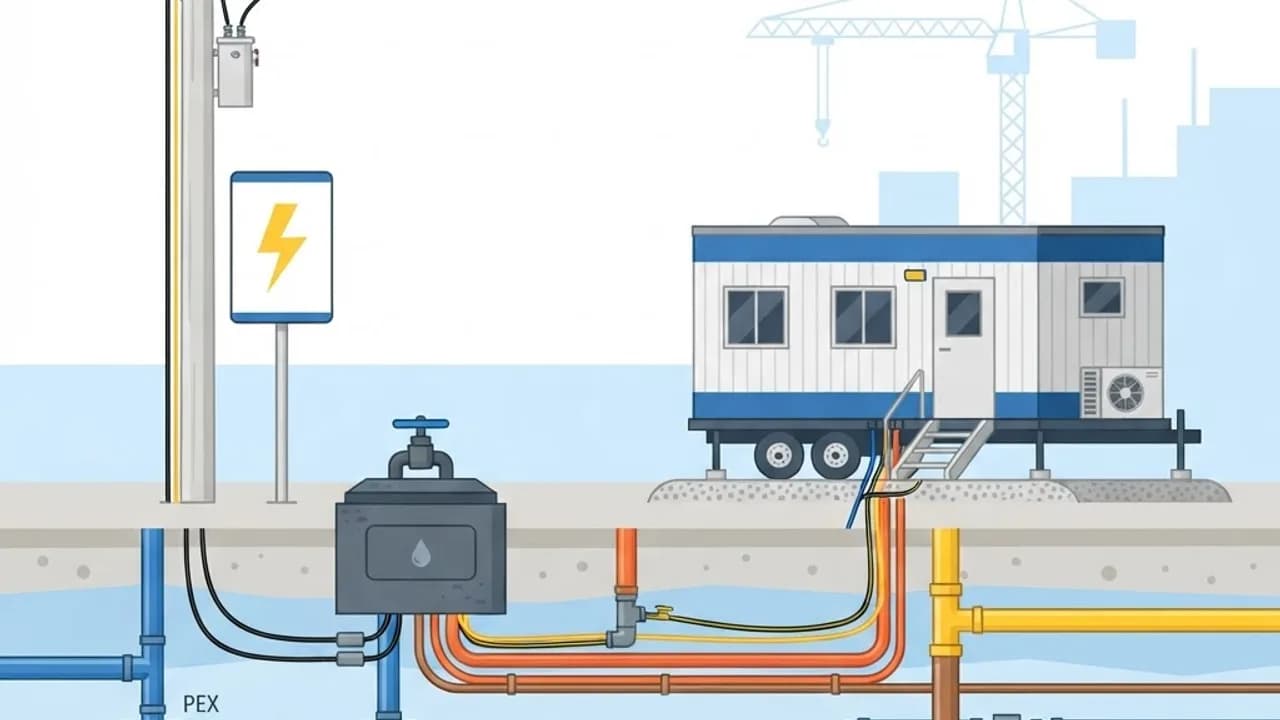
Understanding how to set up utilities on a construction site is what keeps a project moving from day one. Power for tools, water for concrete and dust control, sanitation for crews, and connectivity for site management all need to be arranged long before the first crew arrives.
Utility connections are also the most common source of unexpected schedule delay, because lead times sit with authorities rather than with your programme.
This guide covers both temporary construction services and permanent connections, and the order in which to arrange them.
What Does Utility Setup on a Construction Site Involve?
Site utility setup covers two distinct phases. Temporary utilities support construction activity: a temporary power supply and distribution boards, a metered water point, portable sanitation, waste collection and site internet.
Permanent utilities are the connections the finished building will use — electrical service, potable water, sewer, gas, stormwater and telecommunications — installed to code and inspected before handover.
Utility applications should be submitted at design stage, not at mobilisation, because authority lead times routinely run several weeks to several months.
Who Handles Site Utility Setup?
Utility setup involves more parties than most trades, so coordination ownership must be explicit.
- General contractors and site managers coordinating the sequence
- Licensed electricians and plumbers performing connections
- Civil crews installing underground service runs
- Utility authorities and network operators approving supply
- Developers funding servicing and network upgrade costs
Key Elements of Construction Site Utilities
Temporary Power
Options include a metered temporary supply from the grid via a pole or pillar, or diesel and hybrid generators where no supply exists. Size the supply for peak simultaneous load, and use weatherproof distribution boards with RCD protection at every outlet.
Water Supply and Dust Control
Concrete, wet trades, wheel washes and dust suppression all need water. A metered standpipe connection is the usual solution, with tanks and bowsers on sites where no main is available yet.
Sanitation and Waste
Portable toilets and welfare facilities scaled to crew size are a legal requirement in most jurisdictions, along with hand-washing provision and a serviced schedule. Waste skips and segregated bins complete the arrangement.
Connectivity and Site Communications
Modern sites run on connectivity: drawings, inspections, deliveries, time recording and video calls. Where fixed lines are unavailable, cellular routers with external antennas usually provide adequate coverage.
How to Set Up Site Utilities Step by Step
Applications come first because they are the longest lead item.
- Calculate temporary power, water and sanitation requirements from the programme.
- Submit utility applications early and confirm capacity at the boundary.
- Order locates and mark all existing buried services before excavation.
- Obtain permits for road openings, trenching and temporary supplies.
- Install temporary power with a metered supply and RCD-protected boards.
- Establish the water point, backflow prevention and dust-control supply.
- Place welfare units, sanitation and waste bins near site access.
- Set up cellular or fixed internet plus a site office network.
- Trench and lay permanent service runs, coordinating depths and separations.
- Arrange inspections, pressure and continuity testing, then energise permanent services.
- Decommission temporary supplies once permanent connections are live.
Benefits of Proper Utility Planning
Getting utilities right removes an entire category of delay.
- No idle crews waiting for power or water to arrive
- Lower running costs than extended generator hire
- Safer site electrics with correct protection and no daisy-chained leads
- Fewer trench clashes because service routes were coordinated in advance
- Smoother handover, with permanent services tested and certified on time
Potential Challenges
Utility work sits largely outside your direct control, which creates specific risks.
- Authority lead times far longer than expected, especially for upgrades
- Insufficient network capacity requiring transformer or main extensions
- Unrecorded existing services discovered mid-trench
- Coordination clashes between electrical, water, gas and drainage routes
Best Practices and Tips
Experienced site teams treat utilities as a procurement item, not a task.
- Apply for connections at design stage and track every application weekly.
- Size temporary power above current need — peak load always grows.
- Maintain an as-built service drawing updated as each run is laid.
- Keep a generator available as backup even after grid supply is live.
Real-World Example
A mid-rise builder mobilised expecting a temporary grid supply within three weeks. The network operator identified a capacity constraint requiring a transformer upgrade, pushing energisation out by four months.
The team bridged the gap with a hybrid generator and battery unit, which cut fuel use significantly compared with a diesel-only setup, and reordered the programme to front-load low-power activities. On the next project, utility applications were lodged at design stage, and the firm built an internal lead-time tracker as part of a wider push into mobile app development for field reporting.
Why Utility Setup Matters
Utilities sit on the critical path in a way few other items do, because you cannot accelerate an authority by adding labour. A missed application becomes a fixed, unrecoverable delay.
They also shape site safety and productivity daily. Poorly planned power leads to trailing cables and overloaded boards, while good planning supports the digital tools that now run sites — often delivered through applied artificial intelligence services and dashboards backed by Strapi CMS website development.
Frequently Asked Questions
How long does it take to get temporary power on a construction site?
Typically two to eight weeks where capacity exists, but network upgrades can extend this to several months. Apply as early as possible and confirm capacity in writing.
Do I need a permit for temporary utilities?
Usually yes. Temporary electrical supplies, water standpipes, road openings and trenching in public right-of-way all generally require permits and licensed installers.
Is a generator cheaper than a temporary grid connection?
Generators are cheaper to start and more expensive to run. For projects longer than a few months, a metered grid supply is normally more economical, with hybrid units offering a middle path.
What utilities does a construction site need at minimum?
Power for tools and lighting, water for wet trades and dust suppression, sanitation and welfare facilities, waste collection, and enough connectivity to run site administration.
Conclusion
Setting up utilities on a construction site is fundamentally a lead-time exercise: apply early, confirm capacity, locate existing services, install temporary supplies safely, then transition to permanent connections with proper testing.
Lodge your applications before you mobilise, and if your site teams need better tools for tracking all of it, explore purpose-built web application development to replace spreadsheets with something crews will actually use.
Enjoyed this article? Share it with others!