
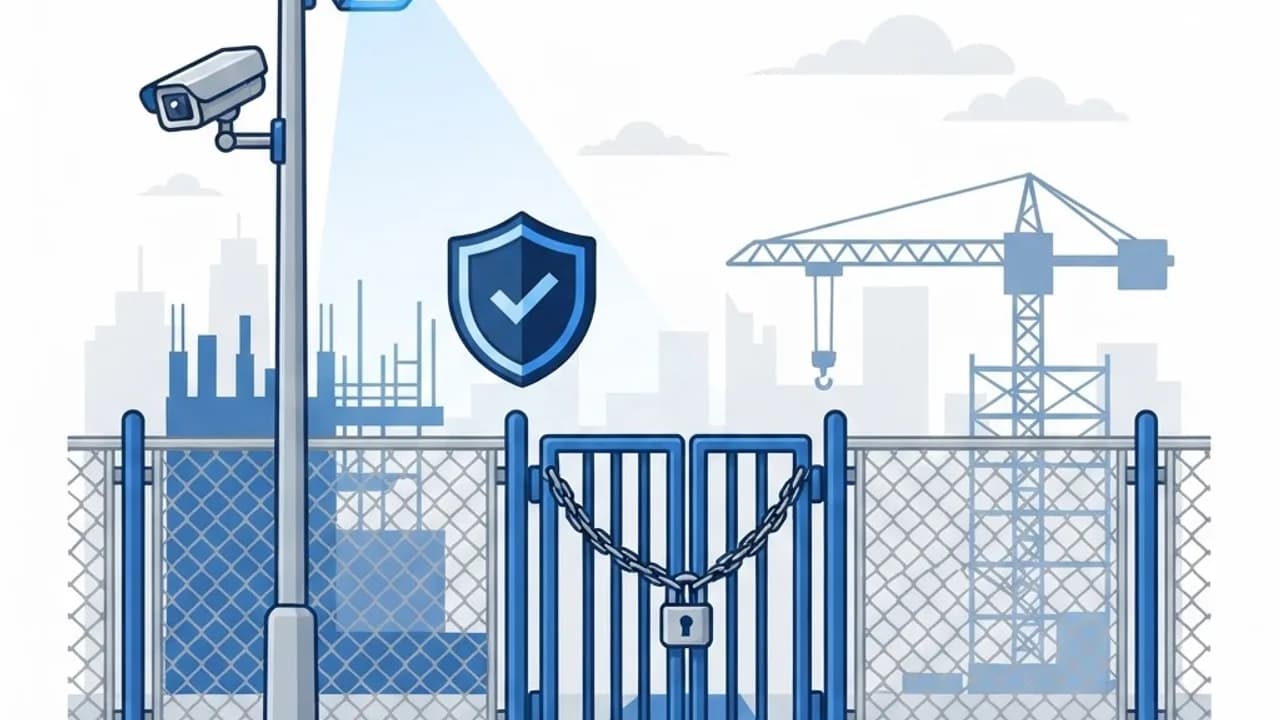
Knowing how to protect a construction site matters because sites are uniquely exposed: valuable equipment, open perimeters, changing crews and long unattended hours. Tool and plant theft costs the industry billions annually, and the replacement cost is usually the smaller loss compared with the delay.
Security is not one product. It is layers — deter, delay, detect, respond — arranged so that each one buys time for the next.
This guide covers the physical, procedural and technological measures that keep a site secure without turning it into a fortress nobody can work in.
What Is Construction Site Security?
Construction site security is the combined set of physical barriers, surveillance systems, access procedures and asset controls used to prevent theft, vandalism, arson, trespass and unauthorised entry.
It also protects the public. An unsecured site with open excavations, stacked materials and reachable machinery is an attractive nuisance, and liability for injury to a trespasser can be severe.
Effective site protection layers deterrence, delay, detection and response — a camera without anyone monitoring it deters far less than most owners assume.
Who Needs Construction Site Protection?
Any site holding materials or plant overnight needs a security plan proportionate to its exposure.
- General contractors responsible for site custody and insurance conditions
- Equipment owners and rental companies with plant on site
- Developers protecting long-duration multi-phase projects
- Urban infill sites with high public foot traffic
- Remote or rural sites where response times are long
Key Features of a Secure Site
A Complete, Hardened Perimeter
Continuous fencing of adequate height, with anti-lift hinges, secured gates and no convenient climbing aids stacked against it. The perimeter is the single most cost-effective security investment on any site.
Controlled Access and Identification
One monitored entry point, signed-in visitors, ID or badge checks and a live record of who is on site. Access control also improves safety accountability during an emergency evacuation.
Lighting and Surveillance
Motion-activated floodlights remove the darkness thieves rely on. Pair them with monitored CCTV or cellular alarm cameras that alert a response service rather than simply recording an event nobody watches.
Asset Registration and Immobilisation
Serial-number registers, tamper-proof marking, GPS trackers on plant, immobilisers and locked containers for hand tools make stolen goods harder to sell and easier to recover.
How to Secure a Construction Site: Step by Step
Work outward from the perimeter, then add procedure, then add technology.
- Conduct a security risk assessment covering assets, access points and local crime patterns.
- Install continuous perimeter fencing with lockable, reinforced gates.
- Reduce entry points to a single controlled and supervised gate.
- Post clear warning, no-trespass and CCTV signage around the perimeter.
- Fit motion-activated lighting across storage, plant parking and access routes.
- Deploy monitored CCTV or alarm cameras with remote alerting.
- Store tools in locked containers and immobilise plant at end of shift.
- Maintain an asset register with serial numbers, photos and tracker IDs.
- Implement sign-in, key control and end-of-day lockdown procedures.
- Review incidents and near misses, then adjust the layers accordingly.
Benefits of Strong Site Protection
Security returns show up across insurance, schedule and morale.
- Fewer theft and vandalism losses, and lower insurance excess exposure
- Reduced downtime waiting for replacement tools or plant
- Lower liability from trespasser injury and public exposure
- Better accountability for who is on site and when
- Improved crew morale, since repeated theft is corrosive to a team
Potential Challenges
Security plans degrade over time unless actively managed.
- Long, irregular perimeters that are difficult to fence continuously
- Power and connectivity limitations for lighting and cameras early in a build
- High turnover of subcontractors weakening access discipline
- Insider theft, which perimeter measures do nothing to address
Best Practices and Tips
Small operational habits close most of the gaps.
- Never leave keys in plant, and rotate immobiliser codes periodically.
- Park large machines to block gates and shelter smaller equipment overnight.
- Photograph and log every tool and machine before it arrives on site.
- Vary security patrol timing so patterns cannot be learned.
Real-World Example
A commercial site suffered three overnight break-ins in five weeks, losing power tools and copper cable. The contractor reduced four informal access gaps to one gated entry, added two solar floodlights with motion sensors, installed cellular alarm cameras linked to a monitoring service, and moved hand tools into a locked steel container.
There were no further incidents for the remaining eight months of the build. The team also standardised its equipment register in a simple internal tool, developed alongside a broader review of the firm's cybersecurity practices after a phishing attempt targeted its accounts payable inbox.
Why Site Protection Matters
The direct value of stolen equipment is rarely the biggest cost. A missing compactor can idle a crew for days, push a concrete pour past a weather window and trigger delay claims that far exceed the item's value.
Security also signals professionalism. Clients notice an orderly, controlled site, and contractors increasingly present that standard publicly through sites built with modern React JS web development and reinforced by consistent social media and banner design.
Frequently Asked Questions
What is the most effective construction site security measure?
A complete, well-maintained perimeter fence with a single controlled gate delivers the greatest reduction in incidents per dollar spent. Everything else works better once the perimeter is sound.
Are construction site cameras worth the cost?
Monitored cameras that trigger a live alert and response are highly effective. Unmonitored recording cameras mainly help with insurance claims and prosecution after the loss has occurred.
How can I prevent equipment theft overnight?
Lock hand tools in a hardened container, immobilise plant and remove keys, park large machines to block access routes, fit GPS trackers, and ensure motion lighting covers the storage area.
Who is liable if a trespasser is injured on a construction site?
Liability often falls on the site controller, even for trespassers, particularly where children are involved. Secure fencing, locked gates and clear warning signage are essential defences.
Conclusion
Protecting a construction site means layering a hardened perimeter, controlled access, active lighting, monitored detection and disciplined asset management. Each layer buys time, and time is what defeats opportunistic theft.
Audit your site tonight as an intruder would, then fix the easiest way in first. For companies that also want their professionalism visible online, tailored web development services are a practical next step.
Enjoyed this article? Share it with others!