
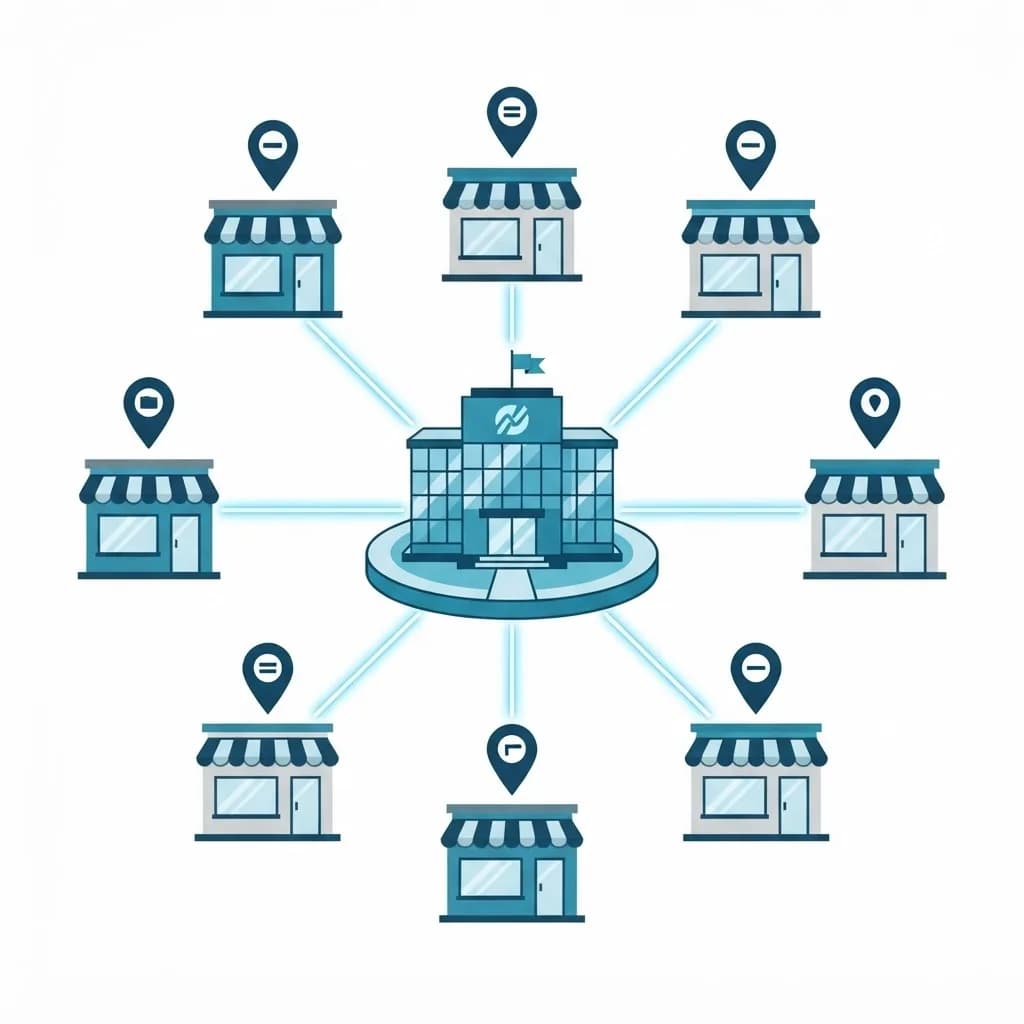
Marketing a franchise system is fundamentally different from marketing a single business. You are balancing brand consistency across every location with the local visibility each franchisee needs to fill their schedule. Get that balance wrong and you either produce generic campaigns nobody responds to, or a chaotic mess of off-brand local ads.
A specialized franchise digital marketing agency exists to manage that tension. They build systems that scale centrally while still performing at the individual location level.
This guide covers what these agencies actually do, how multi-location strategy works technically, and the questions that reveal whether a partner truly understands franchise dynamics.
What Is a Franchise Digital Marketing Agency?
A franchise digital marketing agency specializes in marketing programs for businesses with multiple independently owned locations operating under a shared brand. They handle national brand campaigns, local location marketing, and the governance layer that keeps both aligned.
The defining challenge is structural. Corporate controls the brand, but franchisees control local budgets and often have different priorities. A good agency builds scalable systems with controlled local flexibility, giving owners the tools to compete locally without letting brand standards erode.
They also handle the technical complexity that single-location agencies rarely encounter: managing hundreds of Google Business Profiles, preventing internal keyword competition, and structuring websites so location pages rank without cannibalizing each other.
Who Needs a Franchise Marketing Partner?
Franchise systems at different maturity levels need different things, but several situations point clearly toward specialized help.
- Emerging franchisors with ten to fifty locations building their first coordinated marketing program
- Established systems where location performance varies wildly and nobody knows why
- Brands whose franchisees are running conflicting ads and bidding against each other
- Systems expanding into new markets that need launch playbooks for new owners
- Franchisors facing recruitment challenges who need both consumer and franchise development marketing
Key Features of Franchise Marketing Programs
Multi-Location SEO Architecture
Each location needs its own optimized page with unique content, local schema markup, embedded map, and location-specific service details. Duplicating a template across two hundred pages creates thin content that ranks poorly. This requires a properly architected site, which is why franchise systems benefit from purpose-built website design and structure rather than retrofitted templates.
Google Business Profile Management at Scale
Managing hundreds of profiles manually is impossible. Agencies use bulk management tools to maintain accurate hours, respond to reviews, post updates and monitor ranking across every location. Profile health is often the single largest driver of local lead volume.
Centralized Paid Media With Local Targeting
Rather than each franchisee running their own campaigns, a shared account structure with location-based ad groups prevents internal bidding wars and pools data for better algorithm performance. Individual owners still see their own results and can adjust local budgets.
Brand-Compliant Local Asset Libraries
Franchisees need social posts, flyers and ads that look consistent. A library of approved, customizable templates prevents off-brand DIY design. Consistent social media post and banner design systems let local owners move fast without compromising brand integrity.
How to Get Started With Franchise Marketing
Rolling out a system-wide program requires sequencing and franchisee buy-in, not just technical execution.
- Audit current state across all locations, documenting website presence, profile accuracy and existing ad activity.
- Identify performance gaps by comparing top and bottom quartile locations to find replicable patterns.
- Standardize brand assets, messaging guidelines and approved creative templates.
- Consolidate and optimize all Google Business Profiles under unified management.
- Rebuild or restructure location pages with unique, locally relevant content.
- Launch a pilot paid media program in five to ten locations before system-wide rollout.
- Build reporting dashboards that give both corporate and individual owners visibility into their numbers.
Benefits of Specialized Franchise Marketing
Working with a partner who understands the model produces advantages a generalist agency cannot replicate.
- Economies of scale in media buying and creative production across all locations
- Consistent brand presentation that strengthens recognition in every market
- Faster new location launches using proven playbooks instead of starting from zero
- Reduced internal competition between nearby franchisees for the same keywords
- Better franchise recruitment, since strong system performance attracts quality candidates
Potential Challenges
Franchise marketing carries political and operational complexity that pure execution skill does not solve.
- Franchisee resistance to mandated programs, especially if previous efforts underperformed
- Marketing fund governance disputes about how pooled dollars are allocated
- Wide variation in local market conditions making uniform benchmarks misleading
- Legal and disclosure requirements that limit what claims can be made in advertising
Best Practices and Tips
The systems that work best treat franchisees as customers of the marketing program, not just recipients.
- Report results per location so every owner sees their own return on contributions
- Run a pilot and share real numbers before asking the full system to participate
- Give owners a self-service portal for approved local campaigns and creative
- Maintain technical health across all sites through ongoing maintenance and support so one broken template does not affect every location
Real-World Example
A regional quick-service restaurant franchise with sixty-three locations had every owner running independent Facebook ads. Some spent two hundred dollars monthly, others three thousand. Creative ranged from professional to phone photos of the parking lot. Locations two miles apart were bidding against each other on the same terms.
Consolidating into a single managed account with geo-fenced ad groups per location eliminated the internal competition immediately. A shared creative library gave owners eight approved templates with editable local offers. Blended cost per order dropped thirty-eight percent, and total system ad spend fell while order volume increased. Critically, individual owners could still see exactly what their contribution produced, which ended most of the resistance.
Why It Matters
Franchise systems live or die on unit economics. A location that cannot fill its schedule fails, and failed locations damage the brand and make recruiting new franchisees harder.
A capable franchise digital marketing agency directly affects unit-level profitability, which affects everything else in the system. That makes marketing a structural business function, not a discretionary expense.
Frequently Asked Questions
Should marketing be run by corporate or individual franchisees?
The most effective model is hybrid. Corporate manages brand, website infrastructure, SEO and centralized paid media. Franchisees control a local budget for community events, sponsorships and hyper-local promotions within brand guidelines.
How do you prevent locations from competing with each other?
Geographic targeting boundaries in paid campaigns, unique location page content with distinct keyword focus, and proper canonical and schema markup all prevent overlap. Consolidated account management is the most reliable safeguard.
What does franchise marketing typically cost?
Most systems allocate one to four percent of unit revenue to a national marketing fund, plus local spend. Agency management fees for multi-location programs commonly range from five thousand to fifty thousand dollars monthly depending on location count and scope.
How do you get franchisee buy-in?
Show data, not slides. Run a pilot in willing locations, publish transparent per-location results, and let successful owners advocate to their peers. Mandates without proof create lasting resentment.
Conclusion
Choosing a franchise digital marketing agency comes down to whether they understand the operational and political realities of a multi-unit system, not just whether they can run ads. Ask about their profile management tooling, their location page architecture, and how they report results to individual owners.
Get that right and marketing becomes a competitive advantage that helps you retain franchisees and attract new ones. Learn more about scalable multi-location marketing programs built for growing franchise brands.
Enjoyed this article? Share it with others!