In education technology sales, few things matter more than what happens in the minutes and hours after a school administrator fills out a demo request form. The Follett Software inbound marketing pipeline offers a useful model for understanding how a mature EdTech company converts website interest into booked meetings and closed revenue through a structured SDR workflow.
Follett Software, known for its K-12 library management, asset tracking, and school operations platforms, sells into a famously complex market: school districts with long budget cycles, multiple stakeholders, and procurement rules. That makes its inbound funnel a worthwhile case study for any B2B team. In this article, we break down how an inbound marketing pipeline like Follett's is structured, how sales development representatives (SDRs) convert inbound leads, and how you can apply the same principles to your own pipeline.
What Is an Inbound Marketing Pipeline?
An inbound marketing pipeline is the structured journey a prospect travels from first discovering your content to becoming a qualified sales opportunity. Unlike outbound prospecting, where reps interrupt cold contacts, inbound leads raise their hands first, by downloading a guide, attending a webinar, or requesting a demo.
The pipeline is typically divided into stages: visitor, lead, marketing qualified lead (MQL), sales qualified lead (SQL), opportunity, and customer. The handoff between marketing and sales, where an SDR converts an MQL into a booked meeting, is the single most fragile point in the entire funnel, and it is where disciplined workflow design pays off most.
For a company like Follett Software, inbound demand comes from librarians researching collection management, district IT directors comparing asset tracking tools, and administrators evaluating student information workflows. Each persona enters the pipeline through different content but flows through the same conversion machinery.
Who Uses This Pipeline Model?
The inbound-plus-SDR model is the dominant go-to-market structure in B2B software, and it fits a wide range of teams.
- EdTech companies selling to schools and districts, where buying committees require patient, multi-touch nurturing.
- SaaS startups building their first repeatable sales motion on top of content-driven demand.
- Marketing teams that need to prove pipeline contribution, not just traffic and lead volume.
- Sales development leaders designing speed-to-lead standards, sequences, and qualification frameworks.
- Revenue operations professionals responsible for routing, scoring, and CRM hygiene across the funnel.
Key Features of a High-Converting Inbound Pipeline
Content That Maps to the Buyer Journey
Top-of-funnel blog posts and resources attract early researchers, while comparison pages, case studies, and ROI calculators serve buyers closer to a decision. Follett-style companies invest heavily in educator-focused content because their buyers research extensively before ever talking to sales. Strong execution here often starts with expert content writing services that align every asset to a specific funnel stage.
Lead Scoring and Qualification
Not every ebook download deserves an SDR call. Lead scoring assigns points for firmographic fit (district size, role, region) and behavior (pricing page visits, demo requests, webinar attendance). When a lead crosses the MQL threshold, it routes automatically to the right SDR, no manual triage, no leads sitting in a queue overnight.
Speed-to-Lead SDR Response
Research consistently shows that contacting an inbound lead within five minutes dramatically increases connection and qualification rates compared to waiting even an hour. Mature SDR workflows enforce this with instant lead routing, automated alerts, and clear service-level agreements between marketing and sales.
Structured Multi-Touch Sequences
One call is never enough. Effective SDR workflows enroll every inbound lead in a sequence of 8 to 12 touches across phone, email, and LinkedIn over two to three weeks. Each touch references the specific content the lead engaged with, making outreach feel like helpful follow-up rather than cold interruption.
How the SDR Workflow Converts Inbound Leads
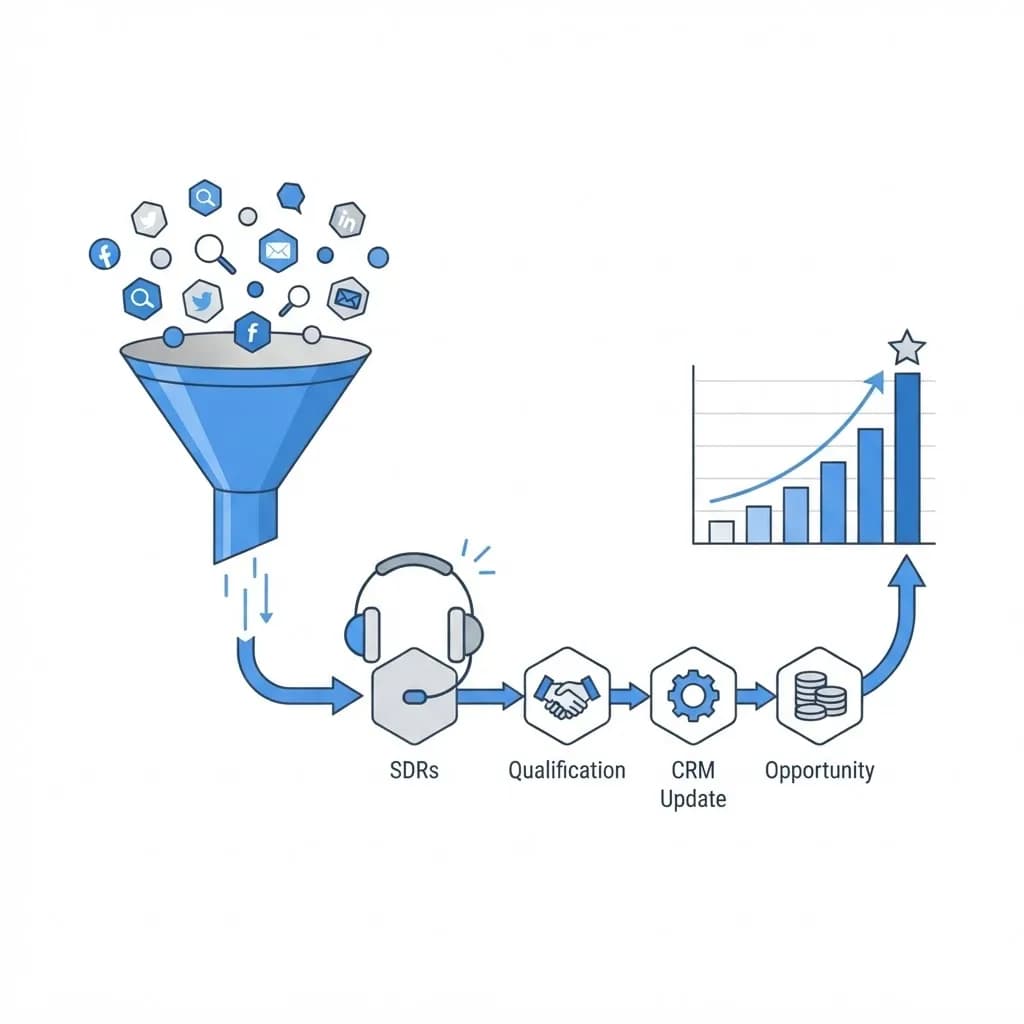
Here is how a typical inbound-to-meeting workflow operates at a company with Follett Software's go-to-market maturity:
- A prospect converts on the website, requesting a demo, downloading a buyer's guide, or registering for a webinar, and the CRM captures their details and behavior history.
- Lead scoring evaluates fit and intent instantly, routing qualified leads to the appropriate SDR by territory or segment.
- The SDR receives an alert and makes the first call within minutes, referencing the exact asset the prospect engaged with.
- If unreachable, the lead enters a multi-touch sequence combining personalized emails, follow-up calls, and social touches.
- On connection, the SDR qualifies using a framework such as BANT or MEDDIC, confirming need, authority, timeline, and budget context.
- Qualified prospects are booked directly onto an account executive's calendar, with full context notes logged in the CRM.
- Leads that are not yet ready return to marketing nurture streams, re-entering the SDR queue when their engagement score rises again.
Benefits of a Structured Inbound-SDR Pipeline
Teams that formalize this handoff see measurable gains across the funnel.
- Higher conversion rates: Fast, contextual follow-up converts dramatically more MQLs into meetings than ad hoc outreach.
- Predictable revenue forecasting: Stage-by-stage conversion metrics let leaders forecast pipeline from traffic and lead volume.
- Better marketing accountability: Closed-loop reporting shows exactly which content and channels produce revenue, not just leads.
- Improved buyer experience: Prospects get relevant, timely help instead of generic sales pressure.
- Efficient rep specialization: SDRs focus on qualification while account executives focus on closing, raising productivity for both.
Potential Challenges to Anticipate
Even well-designed pipelines encounter friction, especially in education markets.
- Long buying cycles: School districts budget annually, so leads may take 6 to 18 months to close, demanding patient nurture rather than aggressive pushing.
- Marketing-sales misalignment: Without agreed MQL definitions and SLAs, sales dismisses leads as junk while marketing claims sales ignores them.
- Data hygiene decay: Duplicate records, stale contacts, and inconsistent CRM entry quietly erode routing and reporting accuracy.
- Sequence fatigue: Over-automated, impersonal touches train prospects to ignore outreach, hurting brand trust in tight-knit markets like K-12 education.
Best Practices for Building Your Own Pipeline
Whether you sell EdTech or any other B2B software, these practices consistently separate high-performing inbound teams from the rest.
- Define the MQL contractually: Marketing and sales should co-sign the exact scoring criteria and response-time SLA, then review it quarterly.
- Instrument everything: Track speed-to-lead, contact rate, meeting rate, and show rate per SDR and per lead source to find bottlenecks fast. A capable digital marketing partner can help connect campaign data to pipeline outcomes.
- Personalize the first touch: Referencing the specific whitepaper or webinar a lead engaged with can double reply rates versus generic follow-up.
- Invest in the conversion surface: Demo request forms, landing pages, and scheduling flows are where pipeline is won or lost; polished website design and fast, reliable front-end web development directly lift form completion rates.
Real-World Example
Imagine a district library coordinator in Texas researching collection management tools. She downloads a Follett buyer's guide on a Tuesday morning. Within four minutes, an SDR calls, mentions the guide, and asks two questions about her district's current system. She is not ready to buy, budget season is months away, so the SDR logs her timeline and enrolls her in a nurture track.
Over the following months, she receives webinar invitations and case studies from similar districts. When budget planning opens, her renewed pricing-page visits push her score back over the threshold. The same SDR reconnects, books a demo with an account executive, and the district signs the following quarter. Nothing about that outcome was lucky; every step was a designed part of the workflow.
Why It Matters
The gap between companies that grow predictably and those that ride feast-or-famine revenue cycles usually comes down to pipeline discipline. An inbound marketing pipeline with a rigorous SDR workflow turns marketing spend into forecastable meetings, and meetings into forecastable revenue.
Follett Software's market, slow-moving, committee-driven school procurement, proves the model works even under difficult conditions. If structured inbound conversion works there, it can work in nearly any B2B category.
Frequently Asked Questions
What does an SDR do with inbound leads?
A sales development representative responds to inbound leads quickly, qualifies them against fit and intent criteria, and books meetings for account executives. SDRs act as the bridge between marketing-generated interest and the closing sales team.
How fast should an SDR respond to an inbound lead?
Best practice is within five minutes of form submission. Connection and qualification rates drop sharply with every hour of delay, which is why mature teams automate routing and enforce response-time SLAs.
What is the difference between an MQL and an SQL?
A marketing qualified lead (MQL) has shown enough fit and engagement to warrant sales outreach. A sales qualified lead (SQL) has been vetted by an SDR and confirmed to have genuine need, authority, and timeline, making it ready for an account executive.
How long is the sales cycle in EdTech?
K-12 sales cycles commonly run 6 to 18 months due to annual budgeting, buying committees, and procurement requirements. This makes long-term nurture and re-engagement workflows essential rather than optional.
Conclusion
The Follett Software inbound marketing pipeline illustrates a truth every B2B team should internalize: inbound leads are only as valuable as the workflow that converts them. Content attracts, scoring prioritizes, and a disciplined SDR workflow, fast, personal, and persistent, turns interest into revenue.
If you are ready to build a conversion engine of your own, start with the foundation: custom web application development that gives your marketing and sales teams the tools to capture, route, and convert every lead you earn.
Enjoyed this article? Share it with others!