
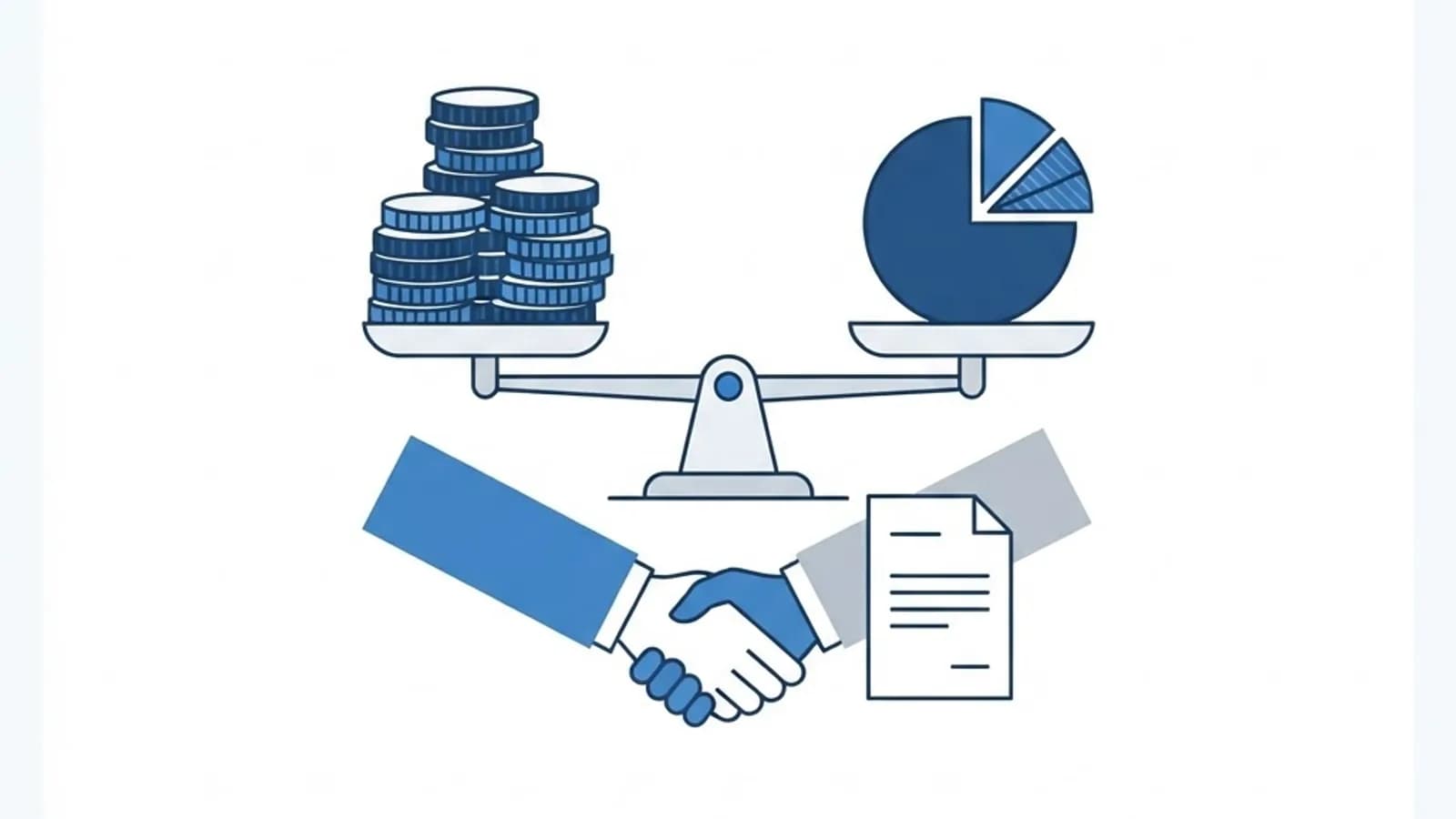
When a digital marketing company gets acquired, the headline number rarely tells the real story. What matters is the structure underneath it, and the most consequential decision is how much of the price arrives as cash and how much arrives as shares. Weighing equity payment pros and cons properly is what separates a life-changing exit from an expensive lesson.
Buyers love equity because it preserves cash and keeps founders motivated. Sellers are often drawn to it because the paper value looks larger than the cash alternative. Both can be right, and both can be badly wrong.
This guide breaks down how equity consideration works in agency acquisitions, where the risk actually sits, and what to negotiate before signing anything.
What Is Equity Payment In An Acquisition?
Equity payment means part of the purchase price is paid in shares of the acquiring company rather than cash. The seller becomes a shareholder in the buyer, with their eventual return depending on that company's future value.
In marketing and creative services deals, structures commonly combine cash at closing, equity vesting over two to four years, and an earnout tied to retained revenue or profit targets. Client concentration and staff retention risk make buyers particularly keen on deferred structures.
Equity converts a sale into a partnership. You are no longer exiting a business; you are exchanging one risk position for another, usually with far less control than before.
Who Encounters This Decision?
Equity-heavy offers appear across the services sector, but some situations attract them far more than others.
- Founders of agencies being acquired by larger holding groups or roll-ups
- Owners of specialist firms bought by private-equity-backed consolidators
- Key employees offered retention equity as part of a transaction
- Partners merging two agencies rather than executing a clean sale
- Sellers accepting shares in a pre-IPO buyer hoping for a future liquidity event
Key Considerations In Equity Deals
Valuation Of The Shares You Receive
Private company shares are valued by negotiation, not by a market. If the buyer sets a generous internal valuation, the equity portion of your headline price may be worth considerably less in reality.
Liquidity And Exit Path
Ask precisely how and when shares can be converted to cash. Without a defined path, an acquisition, a buyback programme, or a public offering, equity can remain illiquid indefinitely.
Dilution And Preference Stacks
Future funding rounds dilute common shareholders, and liquidation preferences held by investors are paid first. Founders who overlooked a preference stack have received far less than expected in otherwise successful exits.
Operational Control After Closing
If your equity value depends on the combined company performing, you need clarity on decision rights, budget authority and whether your team's delivery capability, including any AI-driven service offering you built, will be preserved or absorbed.
How To Evaluate An Offer
Treat the equity component with the same scepticism a buyer applies to your revenue forecasts.
- Separate the offer into guaranteed cash, conditional earnout and equity components.
- Value the deal using only the guaranteed cash; treat everything else as upside.
- Request the buyer's cap table, preference terms and recent financing valuations.
- Confirm vesting schedules, cliffs and what happens if you leave or are terminated.
- Model three scenarios: buyer thrives, buyer stagnates, buyer fails.
- Take independent tax advice, since share consideration may defer or accelerate liability.
- Negotiate information rights so you can monitor the value of what you hold.
Benefits Of Accepting Equity
There are genuine reasons founders choose shares over cash, and dismissing equity entirely can be its own mistake.
- Substantially higher total return if the acquirer grows or exits successfully
- Possible tax deferral depending on jurisdiction and deal structure
- Continued participation in a larger platform with more resources and reach
- Signals confidence to the buyer, often improving other negotiated terms
- Access to scale, shared services and clients you could not reach independently
Potential Challenges And Risks
The downsides are concentrated, correlated and frequently underestimated.
- Illiquidity: shares may be impossible to sell for years or ever
- Dilution from subsequent funding rounds reducing your percentage silently
- Loss of control over the decisions that determine your equity's value
- Concentration risk, since your wealth and your job now depend on one company
- Tax liability potentially arising before any cash is actually received
Best Practices And Tips
Sellers who negotiate well tend to protect downside before chasing upside.
- Secure enough cash at closing that the deal is a success even if equity becomes worthless
- Insist on tag-along rights so you participate if the buyer is later sold
- Negotiate accelerated vesting on change of control or termination without cause
- Retain legal and tax advisors who specialise in services-sector transactions, not general practitioners
Real-World Example
Two agency founders received similar headline offers from the same consolidator. The first took a structure weighted heavily toward equity, attracted by a valuation that made the deal appear substantially larger on paper. The second negotiated a higher cash component, accepting a smaller nominal total.
Three years later the acquirer had raised a new round at a lower valuation with strong investor preferences attached. The equity-heavy founder's shares were worth a fraction of the original figure and remained unsellable. The cash-weighted founder had already reinvested proceeds elsewhere. Neither outcome was predictable at signing, which is precisely the argument for valuing a deal on guaranteed consideration alone.
Why It Matters
Selling an agency is usually a once-in-a-career event. Unlike operational mistakes, a poorly structured exit cannot be corrected next quarter, and the asymmetry of information strongly favours the buyer, who does these deals repeatedly.
Understanding the mechanics of equity consideration is not financial pedantry. It is the difference between converting years of work into security and converting it into a lottery ticket you cannot cash.
Frequently Asked Questions
Is equity ever better than cash?
It can be, when the acquirer is genuinely high-growth, the valuation is credible, a liquidity path exists, and you retain meaningful influence over performance. Those conditions rarely all hold at once.
What percentage of the deal should be cash?
Many advisors suggest securing enough guaranteed cash to meet your personal financial goals independently of any deferred consideration. The precise split depends on your risk tolerance and alternatives.
Can equity value be verified before signing?
Partially. Reviewing the cap table, recent financing terms, preference stack and audited financials gives a realistic picture, though private valuations always contain judgement.
What happens to equity if I leave after the acquisition?
That depends entirely on the vesting and repurchase terms. Unvested shares are typically forfeited, and some agreements allow the company to buy back vested shares at a formula price, so read these clauses carefully.
Conclusion
Equity consideration in a digital marketing acquisition can multiply your outcome or quietly erase most of it. The discipline is simple: value the deal on cash you are certain to receive, verify every assumption behind the share component, and negotiate protections before optimism sets in.
If you are preparing a business for sale, strengthening recurring revenue and documented systems matters most, and a well-built scalable digital platform makes a company considerably more attractive to buyers.
Enjoyed this article? Share it with others!