
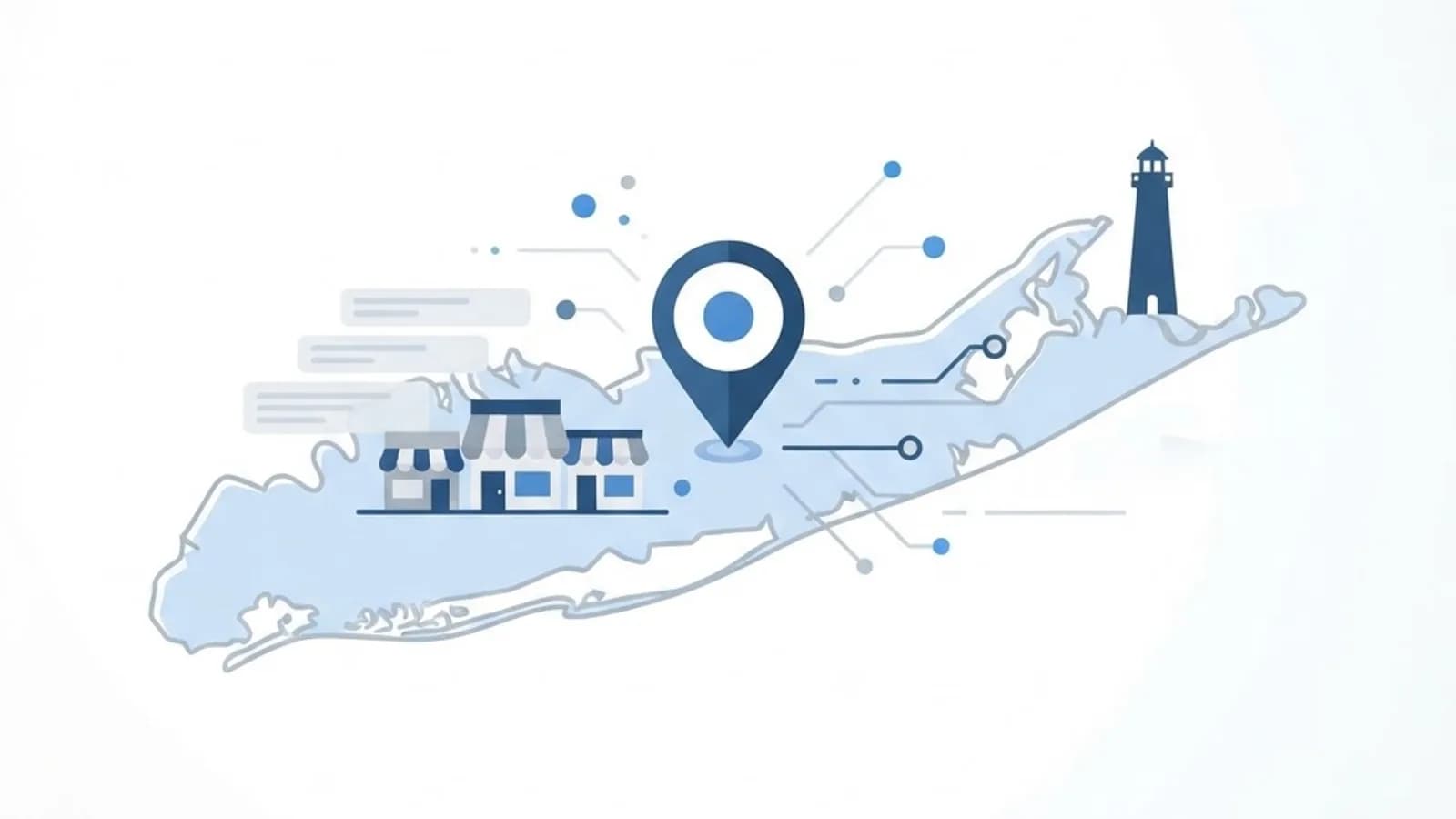
Long Island is a strange marketing environment. It has the density and spending power of a major metro, the hyper-local loyalty of small towns, and the constant gravitational pull of New York City competitors bidding on the same keywords. Digital marketing Long Island businesses succeed with looks very different from a generic national playbook.
A contractor in Huntington, a dental practice in Garden City and a boutique in Montauk are not competing nationally. They are competing within a fifteen-mile radius, against neighbours who may already rank, and against Manhattan agencies with far larger budgets.
This guide covers what actually moves the needle across Nassau and Suffolk counties, and which tactics waste money in a market this fragmented.
What Is Long Island Digital Marketing?
It is geographically constrained marketing: search visibility, review management, paid advertising and content built to capture demand inside a defined service area rather than across a whole country.
Because Long Island contains hundreds of distinct hamlets and villages, each with its own identity, broad regional targeting frequently underperforms. Someone in Massapequa often will not consider a provider in Riverhead, even though both sit on the same island.
Precision beats reach here. A campaign tuned to five towns typically outperforms one aimed vaguely at "Long Island" at a fraction of the cost.
Who Needs It?
Any business whose customers must physically arrive, or whose team must physically travel, depends on local visibility more than anything else.
- Home service providers: roofing, HVAC, landscaping, plumbing and remodelling
- Medical, dental and wellness practices serving defined neighbourhoods
- Restaurants, breweries, salons and independent retail storefronts
- Law firms, accountants and financial advisors competing on local trust
- Seasonal and tourism businesses on the North and South Forks
Key Features Of A Long Island Campaign
Map Pack Dominance
The three-result local map block captures the majority of clicks for service searches. Winning it depends on proximity, review velocity, category accuracy and consistent citations across directories.
Town-Level Landing Pages
Individual pages for the specific communities you serve, each with genuine local detail rather than swapped town names, capture searches your competitors ignore. Building these at scale is far easier on a well-structured site, which is why many local firms invest in WordPress development support to make page templates manageable in-house.
Review Systems That Run Themselves
Automated post-service review requests separate businesses with forty reviews from those with four hundred. Volume and recency both influence ranking and conversion.
Geo-Fenced Paid Advertising
Radius targeting around your depot or storefront, with negative keywords excluding the five boroughs, prevents budget leaking into clicks you cannot service profitably.
How To Get Started
Sequence matters. Fixing foundations before advertising prevents paying for traffic that lands somewhere unconvincing.
- Claim and fully complete your local business profile with accurate categories and service areas.
- Standardise your name, address and phone number across every directory listing.
- Audit site speed and mobile usability, since most local searches happen on phones.
- Build five to ten genuine town-level service pages with local photos and specifics.
- Implement an automated review request triggered after each completed job.
- Launch tightly geo-fenced paid search with call tracking enabled.
- Review call recordings monthly to identify which keywords produce actual bookings.
Benefits
Local marketing offers unusually fast feedback compared with national campaigns.
- Rankings can improve within weeks rather than months in low-competition towns
- Lead costs are typically far lower than in New York City markets
- Reviews build a compounding trust asset competitors cannot copy
- Phone calls arrive from people ready to book, not casual researchers
- Word of mouth amplifies digital visibility in tight-knit communities
Potential Challenges
The island presents obstacles that inland markets do not.
- Strong seasonality, particularly in East End tourism and outdoor services
- Well-funded NYC competitors inflating keyword costs across the region
- Proximity-based ranking limits how far from your address you can realistically rank
- Saturated categories where dozens of established firms already hold reviews
Best Practices And Tips
Local marketing rewards operational discipline more than creative brilliance.
- Post real project photos with location context regularly to your business profile
- Answer every review, especially critical ones, calmly and specifically
- Track phone calls as conversions; most local revenue never touches a web form
- Prioritise towns where you already have customers, since proximity signals compound
Real-World Example
A Suffolk County landscaping company ranked well in its home town but was invisible ten minutes away. Its site had a single services page listing twenty communities in a footer block, which search engines treated as thin content.
Replacing that block with eight substantive town pages, each featuring photographed local projects and specific seasonal notes relevant to that area, produced steady ranking gains. Within two seasons the company was appearing in map results across a much wider service radius and reduced its reliance on paid advertising considerably.
Why It Matters
Long Island consumers research locally and buy locally, but they still expect a digital experience that matches national brands. A dated website or a neglected review profile signals a business that may be equally careless with the work itself.
As more discovery moves to mobile and AI-assisted local recommendations, structured and accurate local data becomes the difference between being suggested and being invisible.
Frequently Asked Questions
How long does local SEO take on Long Island?
Expect meaningful movement in three to six months for moderately competitive categories, and longer in saturated ones like legal or dental services. Review growth often produces the earliest visible gains.
Is paid advertising worth it with NYC competitors bidding?
Yes, if geography is tightly controlled. Excluding the boroughs and focusing on a radius you can actually service keeps costs reasonable and lead quality high.
Do I need separate pages for every town?
Only for towns you genuinely serve and can write about specifically. Duplicated pages with swapped names provide no benefit and can undermine site quality.
What matters more, reviews or website quality?
Reviews usually drive the click, and website quality drives the booking. Neglecting either breaks the chain.
Conclusion
Winning Long Island search comes down to precision: accurate local data, genuine town-level content, relentless review generation and geography-aware advertising. None of it is glamorous, and all of it compounds.
If your listings are solid but your site is holding conversions back, a modern rebuild guided by an experienced local web development team is usually the highest-return next step.
Enjoyed this article? Share it with others!