
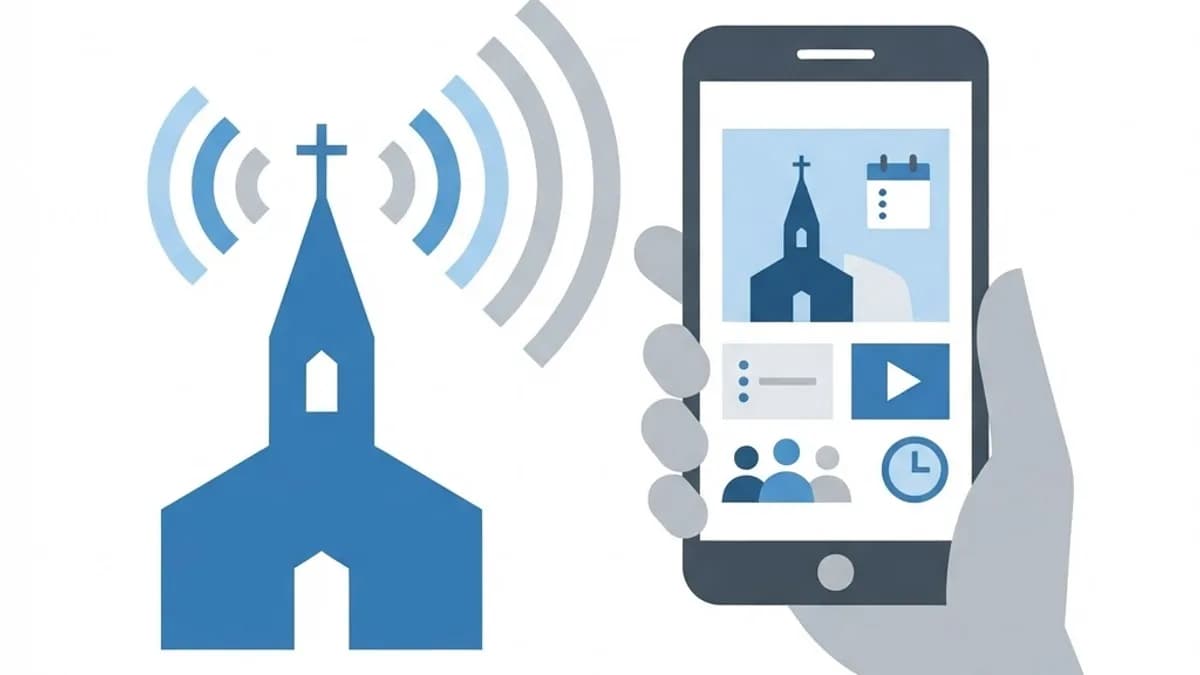
Digital marketing for churches is mostly about removing friction. Someone new to the area searches for a church on a Saturday night, finds your site, and needs three answers immediately: when do you meet, where are you, and what happens when I walk in.
Most church websites answer none of those in the first ten seconds. They open with a photo carousel, a mission statement, and a sermon series graphic — beautiful, but useless to someone deciding whether to attend tomorrow.
This guide covers the practical systems that help churches connect with their communities online: a clear website, accurate local search presence, a first-time visitor path, and follow-up that continues the relationship after Sunday.
What Is Digital Marketing for Churches?
Digital marketing for churches is the use of websites, local search, email, social media, and occasionally paid advertising to help people in the surrounding community discover the church, plan a visit, and stay connected.
It includes service information, event promotion, sermon distribution, small group signups, giving pathways, and volunteer recruitment.
The essential mindset shift is that this is hospitality expressed digitally. The same care given to greeting someone at the door applies to the questions they silently ask before ever arriving.
Who Uses These Strategies?
Churches of every size benefit, though the emphasis changes with scale.
- Small congregations trying to be findable in a crowded local market
- Growing churches managing multiple services and ministry programs
- Multi-site churches coordinating campus-specific information
- Church plants building awareness in a new neighborhood from zero
- Established congregations reconnecting with a changing surrounding community
Key Features of an Effective Church Presence
A Website Built for the Newcomer
Service times, address, parking, and children's programming should be visible without scrolling or clicking. Members already know these details; the website exists primarily for people who do not. Clean, welcoming website design focused on the first-time visitor consistently increases visits.
Accurate Local Search Listings
Your Google listing is often the first result someone sees. Complete it with service times, photos of the actual building, denominational affiliation, and accessibility information. Update hours around holidays, when visitor traffic peaks.
A Plan-Your-Visit Pathway
A short form asking only name and email, followed by a friendly message explaining what to expect, converts far better than a general contact page. It gives hesitant people a low-commitment first step.
Consistent Follow-Up Communication
Most first-time visitors decide within a few weeks whether to return. Automated but genuinely warm email sequences bridge that gap. Churches using structured email marketing systems retain noticeably more newcomers than those relying on Sunday announcements alone.
How to Get Started
Start with the newcomer experience, then expand to community and engagement tools.
- Open your website on a phone and time how long it takes to find service times.
- Rewrite the homepage around when, where, and what to expect.
- Claim and fully complete your Google Business Profile with current photos.
- Add a simple plan-your-visit form with minimal required fields.
- Build a short welcome email sequence for anyone who submits it.
- Publish sermons or messages in a format people can access during the week.
- Track first-time visitor forms monthly and follow up personally with each one.
Benefits for Your Congregation
The practical results extend well beyond attendance numbers.
- More first-time visitors who arrive already informed and comfortable
- Fewer repetitive administrative questions for staff and volunteers
- Better event attendance through consistent communication
- Easier volunteer and small group recruitment via clear signup paths
- Stronger connection with members between weekend gatherings
Potential Challenges
Churches face resource realities that shape what is achievable.
- Limited budgets competing with facility and ministry needs
- Volunteer-managed communication leading to inconsistent updates
- Outdated information left online long after events pass
- Disagreement internally about how promotional the church should appear
Best Practices and Tips
Small disciplines produce most of the benefit.
- Assign one person clear ownership of digital updates, even part-time
- Remove outdated events immediately — stale content signals inactivity
- Use real photos of your actual congregation rather than stock imagery
- Keep visual identity consistent across signage, print, and web through cohesive graphic design
Real-World Example
A church of roughly two hundred saw steady attendance but almost no new visitors despite a growing neighborhood nearby. Their site opened with a rotating banner of ministry photos; service times sat in the footer.
They restructured the homepage so the first thing visible on mobile was the service time, address, and a single button labeled for planning a visit. They wrote short answers to practical questions — what to wear, where children go, how long the service lasts — and set up a three-email welcome sequence.
Over the following months, plan-a-visit submissions became a regular occurrence rather than a rarity, and follow-up conversations were easier because newcomers arrived already knowing what to expect.
Why It Matters
People overwhelmingly research a church online before attending. That digital first impression now precedes any handshake, greeting, or sermon.
Digital marketing for churches simply ensures that impression is accurate and welcoming, so nobody stays home because they could not find a service time.
Frequently Asked Questions
What should a church website include first?
Service times, address with parking guidance, children's programming details, and a clear next step for planning a visit — all visible immediately on mobile.
Should churches run paid ads?
Modest local campaigns around Christmas, Easter, and church plant launches often perform well. Ongoing paid advertising is rarely necessary for established congregations.
How often should a church post on social media?
Consistency matters more than frequency. Two or three meaningful posts weekly outperform daily filler content.
Is email still effective for churches?
Very. Email reaches people reliably regardless of algorithm changes and remains the strongest channel for follow-up and event attendance.
Conclusion
Digital marketing for churches works when it prioritizes clarity and hospitality over promotion. Answer practical questions immediately, keep information current, and follow up personally with everyone who reaches out.
If your church needs a clearer online front door, explore a easy-to-manage church website build that your team can update without technical help.
Enjoyed this article? Share it with others!