
If you sell consulting online, you eventually hit a strange question: which category does a digital marketing consultant belong to in ecommerce taxonomy? It sounds like a technical footnote, yet the answer affects how your listings are indexed, how ad platforms classify your products, and whether buyers ever find you.
The short answer is that a digital marketing consultant belongs under professional or business services — typically Business & Industrial > Business Services > Advertising & Marketing Services in Google's product taxonomy — not under software, education, or media.
This article explains why that classification exists, how different platforms label the same offering, and how to structure your own catalog so a service listing behaves as predictably as a physical product.
What Is Ecommerce Taxonomy?
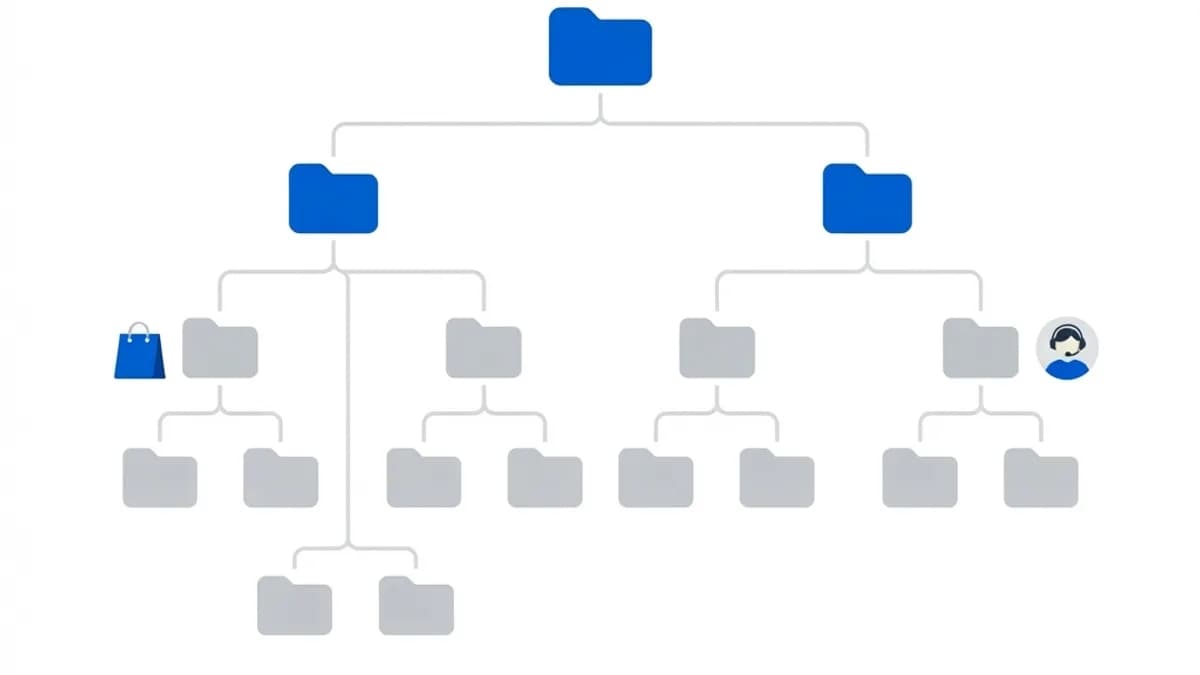
Ecommerce taxonomy is the hierarchical classification system used to organize products and services into categories and subcategories. It gives marketplaces, search engines, and shopping feeds a shared vocabulary for describing what is being sold.
Every major platform maintains its own version. Google Product Taxonomy contains thousands of nodes; Amazon uses browse nodes; Shopify uses a standard product taxonomy; and the UNSPSC standard governs procurement classification in enterprise purchasing.
The key principle is that taxonomy describes what the buyer receives, not how it is delivered. A consultant delivers expertise and labor, so it classifies as a service, even when purchased through a checkout page like any physical good.
Who Needs to Get This Classification Right?
Category assignment matters most for anyone pushing service listings into structured systems where machines, not humans, decide relevance.
- Agencies and freelancers selling productized consulting packages online
- Marketplaces that list service providers alongside physical goods
- Ecommerce managers building Shopify or WooCommerce catalogs that include services
- Advertisers submitting shopping feeds or running service-based campaigns
- Procurement teams matching vendors to UNSPSC or NAICS codes for contracts
Key Features of Service Classification
Services Sit Under Business Services, Not Products
In Google's taxonomy, consulting falls within the Business & Industrial branch. Marketing consulting specifically maps to advertising and marketing services. It does not belong under Software, because no licensed application changes hands, and not under Education, because the deliverable is implementation rather than instruction.
Industry Codes Provide the Formal Answer
For contracts and invoicing, NAICS code 541613 covers Marketing Consulting Services, while 541810 covers Advertising Agencies. UNSPSC segment 80000000 covers management and business professionals. These codes are what accounting and procurement systems recognize.
Platform Taxonomies Differ in Depth
Shopify allows a service product type with no shipping requirement. Fiverr and Upwork use their own marketing categories. LinkedIn uses service pages with a fixed list. Mapping between them requires a canonical internal category that you translate outward per channel.
Attributes Matter as Much as Category
Once the category is correct, attributes such as engagement length, deliverable type, specialization, and pricing model determine whether the listing surfaces for the right queries. Teams that already manage complex catalogs through mature ecommerce platform solutions handle this with structured metafields rather than free-text descriptions.
How to Classify a Consulting Offer Correctly
Work from the buyer outward. The goal is a category a purchasing manager would search, not one that flatters your positioning.
- Define the deliverable precisely: strategy documents, campaign management, audits, or ongoing retainer work.
- Choose a primary node in Google Product Taxonomy under Business Services.
- Map the equivalent node for each additional channel you sell on.
- Assign the matching NAICS or UNSPSC code for contracts and invoicing.
- Add structured attributes such as duration, scope, and industry focus.
- Configure the product as non-shippable with a digital or service fulfillment method.
- Validate the feed and monitor which queries the listing actually matches.
Benefits of Accurate Taxonomy
Correct classification is unglamorous work that quietly improves everything downstream.
- Higher feed approval rates and fewer disapproved listings across shopping channels
- Better keyword matching because platforms understand the offer context
- Cleaner analytics segmentation between service and product revenue
- Faster procurement approval when enterprise buyers need a recognized code
- Improved on-site navigation and filtering for buyers comparing packages
Potential Challenges
Service classification remains messier than physical goods, and a few issues recur constantly.
- Many taxonomies were designed for shippable products and handle services awkwardly
- Hybrid offers combining software and consulting resist a single clean node
- Platform taxonomies change, breaking mappings that were correct last year
- Internal teams often invent categories that match sales language rather than buyer language
Best Practices and Tips
Treat taxonomy as data infrastructure with an owner, not a one-time setup task.
- Maintain one internal canonical taxonomy and translate outward to each channel
- Review platform taxonomy updates at least twice per year
- Use the most specific node available rather than a broad parent category
- Support listings with clear service pages built on a solid back-end data structure so category fields stay consistent as the catalog grows
Real-World Example
A boutique agency packaged its retainer into three fixed-price tiers and listed them on its Shopify store. Initially each tier was tagged as a generic digital product, so the feed matched software queries and attracted entirely the wrong traffic.
After reclassifying under business advertising and marketing services, adding engagement-length and specialization attributes, and applying NAICS 541613 on invoices, the listings began surfacing for genuine consulting searches. Enterprise procurement approvals also moved faster because finance teams recognized the code immediately.
Why It Matters
Search and shopping systems increasingly rely on structured signals rather than page copy alone. A well-classified listing tells an algorithm exactly what it is before a single word of marketing text is parsed.
As more professional services move to self-serve purchasing, the businesses with disciplined taxonomy will be discoverable in places their competitors never appear.
Frequently Asked Questions
Which category does a digital marketing consultant belong to?
Business and professional services — specifically advertising and marketing services within the Business & Industrial branch of standard ecommerce taxonomies.
Is a marketing consultant a product or a service in ecommerce?
A service. It can be sold through a product checkout flow, but it should be configured as non-shippable with service fulfillment.
What NAICS code applies to marketing consulting?
NAICS 541613 covers Marketing Consulting Services. Full-service agencies often use 541810 for Advertising Agencies instead.
Can one consulting offer sit in multiple categories?
Most platforms allow one primary category plus secondary tags. Choose the most specific primary node and use tags for cross-cutting specializations.
Conclusion
Classifying a digital marketing consultant in ecommerce taxonomy comes down to one rule: describe the deliverable, place it under business services, and support it with precise attributes and industry codes.
If your service catalog needs restructuring, consider a custom web application built around clean product data so every channel receives correctly mapped categories automatically.
Enjoyed this article? Share it with others!