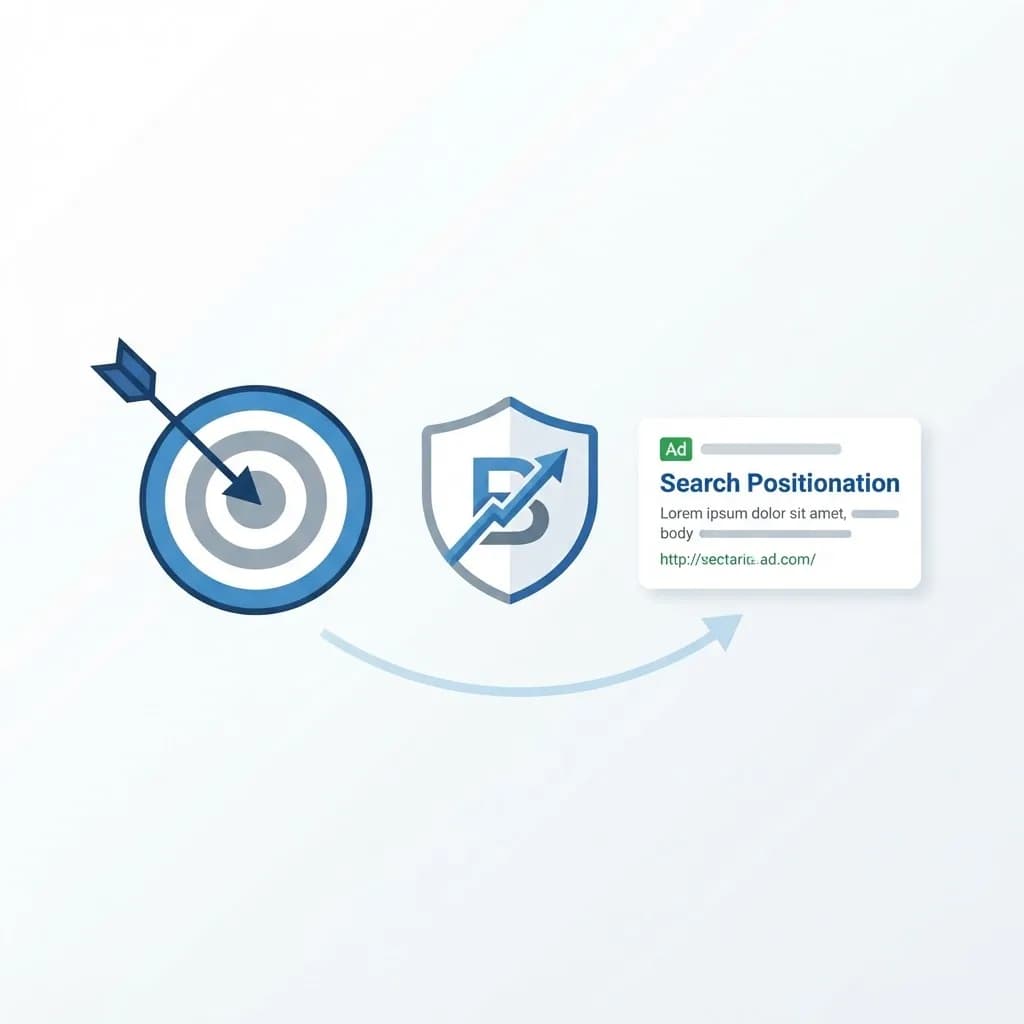
Most companies treat search as a performance channel and brand as a separate creative exercise. That split leaves value on the table. A brand positioning strategy using search engine marketing connects the two, so every impression reinforces what you want to be known for.
Search is where your positioning gets tested in public. When someone compares three providers side by side, the words in your ad and the depth of your landing page do the persuading.
This guide shows how to use paid and organic search deliberately to shape perception, not just harvest clicks.
What Is Brand Positioning in Search Engine Marketing?
Brand positioning is the specific place you occupy in a customer's mind relative to alternatives. Search engine marketing is how you make that position visible at the exact moment someone is evaluating options.
The combination works because search reveals intent. Every query is a statement about what someone values right now — price, speed, expertise, or safety — and you can align your messaging to the values you want to own.
Done well, competitors start looking like a compromise rather than an equal choice.
Who Should Use This Approach?
Search-led positioning helps most when buyers actively compare before deciding.
- Challenger brands entering a market dominated by a well-known incumbent
- Premium providers who need to justify higher pricing before the first call
- B2B companies with long consideration cycles and multiple decision makers
- Service businesses where trust and expertise drive the choice
- Ecommerce brands differentiating on quality rather than lowest price
Key Elements of Search-Led Positioning
Owning a Query Category
Rather than bidding on everything, pick a cluster of searches that reflect your strongest claim and dominate it across ads, organic listings, and comparison content. Consistent presence on a narrow set beats scattered visibility everywhere.
Message Consistency Across Touchpoints
Your ad copy, meta description, landing page headline, and sales follow-up should all express the same promise in the same language. Inconsistency reads as uncertainty and erodes the position you paid to establish.
Visual and Verbal Identity
Recognition compounds across repeated impressions. Coherent typography, colour, and imagery — supported by consistent banner and social creative — make your listings feel familiar before the click.
Proof and Differentiation Assets
Positioning claims need evidence: case studies, comparison tables, original research, and specific numbers. Abstract superlatives convince nobody who is actively comparing.
How to Build the Strategy
Positioning through search works best as a deliberate sequence rather than an experiment.
- Define your position in one sentence: who you serve, what you deliver, and why you differ.
- Map the search queries that correspond to that specific value, not just high-volume generics.
- Analyse competitor ad copy and top-ranking pages to identify unclaimed messaging angles.
- Group keywords by intent stage and assign a distinct message to each stage.
- Write ad copy and titles that lead with your differentiator, not a generic category term.
- Build landing pages that prove the claim with evidence above the fold.
- Create supporting comparison and alternative-to content for organic visibility.
- Measure brand search volume and assisted conversions alongside direct ROAS.
Benefits of Combining Branding and SEM
Aligning the two channels produces effects that neither achieves alone.
- Higher click-through rates because differentiated copy stands out in the results
- Lower cost per acquisition over time as branded search volume grows
- Better lead quality, since messaging pre-qualifies people who value your approach
- Improved conversion rates from message-matched landing pages
- A defensible position that competitors cannot copy simply by outbidding you
Potential Challenges
This approach demands more discipline than straightforward performance buying.
- Brand effects are harder to attribute than last-click conversions
- Narrow positioning intentionally sacrifices some volume for relevance
- Internal disagreement about the core message can stall execution for months
- Competitors may bid on your brand terms, requiring defensive spend
Best Practices and Tips
A few principles keep the strategy coherent as campaigns scale.
- Write your positioning statement first and treat it as the brief for every ad
- Track branded search growth monthly as a leading indicator of awareness
- Refresh proof assets regularly so claims stay current and credible
- Support ongoing message production with strategic content writing that matches search intent
Real-World Example
A boutique payroll software company was competing against two enormous incumbents on generic terms like "payroll software" and losing badly on cost per lead. Rather than raising bids, they narrowed their position to payroll for multi-state restaurant groups.
Ads, landing pages, and a series of comparison guides all spoke exclusively to that niche, using tip-credit and multi-jurisdiction language competitors ignored. Volume dropped, but demo-to-close rate nearly tripled and cost per customer fell by more than half within two quarters.
Why It Matters
Search results are a live comparison shelf. If your listing sounds like everyone else's, price becomes the only differentiator, and that is a race nobody wins profitably.
A brand positioning strategy using search engine marketing lets you compete on meaning instead of budget. That advantage grows every month you stay consistent.
Frequently Asked Questions
Can search ads really build a brand?
Yes, though differently from display or video. Repeated exposure at moments of high intent, paired with consistent messaging, builds strong associations and measurably increases branded search volume over time.
Should I bid on my own brand name?
Usually yes, especially if competitors are bidding on it. Branded clicks are cheap and protect visitors who are already looking for you from being intercepted.
How do I measure brand impact from search?
Track branded search volume, direct traffic, impression share for your priority query cluster, and assisted conversion paths. Periodic brand lift surveys add useful qualitative confirmation.
Is organic or paid search better for positioning?
They complement each other. Paid gives immediate control over messaging and placement, while organic builds long-term credibility through depth. Appearing in both signals authority.
Conclusion
Positioning and search marketing belong in the same plan. Define your claim precisely, own the queries that reflect it, and prove it consistently at every touchpoint.
If you want help translating a positioning statement into campaigns and content that work together, explore a digital marketing team that connects brand strategy with search performance.
Enjoyed this article? Share it with others!